In June 2026 a heat dome sat over Europe and pushed temperatures as much as 15°C above normal. At least 1,300 people died in a single wave. Across the continent people scrambled to buy portable air conditioners. One popular model, priced around 900 euros, sold out and was resold second-hand for up to 5,000. Whole countries argued on the news about whether air conditioning is a lifesaver or a climate sin.
Watching this from Singapore is a strange experience, because we settled this argument a long time ago. Air conditioning here is not a debate. It is infrastructure. Lee Kuan Yew called it one of the signal inventions that let a tropical country become productive, and he was right. More than eight in ten Singapore households own an aircon today, and among private apartments it is close to everyone. In Europe, only about one in five homes has one.
So it would be easy to sit here and say Europe simply needs more aircon. That is the wrong lesson, and it is worth explaining why, because the right lesson is one plenty of Singapore homes still get wrong too.
Europe is not short of cooling. It is short of good cooling.
Look closely at what Europe is actually buying in a panic, and you see the problem. The units flying off the shelves are single-hose portable air conditioners, the kind that sit on the floor with a fat tube running to a window. These are the least efficient way to cool a room that exists. A single-hose portable cools the air, then vents that same conditioned air out the window, which drops the pressure in the room and sucks hot outside air back in through every gap. You pay to cool air you then throw away. Much of the electricity does nothing.
On top of that, Europe is bolting these units onto buildings never designed to be cooled. Much of the housing stock is old, walls are thick and beautiful and impossible to run pipework through neatly, and several countries restrict what you can hang on a heritage facade. So the cooling that does get installed is often the wrong size, badly fitted, and running flat out with the windows leaking heat back in. Then everyone points at the electricity bill and the waste heat and concludes air conditioning is the problem.
The air conditioning is not the problem. The way it is being used is.
What Singapore actually did
Singapore did not just adopt aircon. Over the years an efficiency system grew up around it, and that system is the part worth exporting, not the machines.
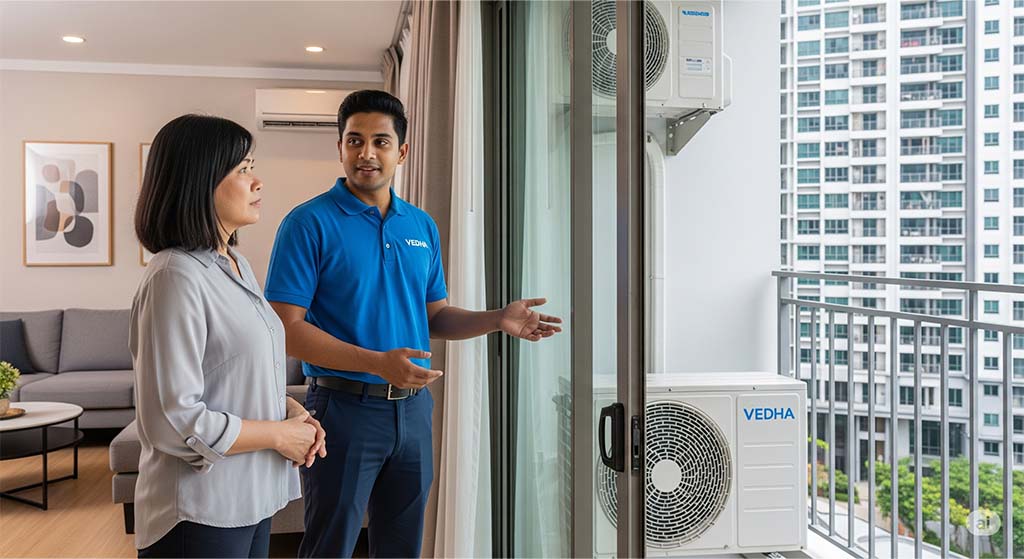
We cool with wall-mounted split systems, designed into the home, with the noisy compressor outside and the quiet fan coil inside. NEA’s energy rules pushed the old fixed-speed compressors off the market, so nearly every unit sold here now is an inverter that ramps its speed up and down instead of slamming on and off. Energy labels with tick ratings let buyers see efficiency before they pay. Modern units run on R32 refrigerant. And through the Go25 movement, the country is being nudged toward setting the aircon at 25°C rather than freezing rooms at 18.
None of that is exotic. It is just cooling done on purpose instead of in a panic. A right-sized inverter split, set to a sensible temperature, in a room that is sealed and serviced, cools comfortably on a fraction of the power a bolted-on portable burns. That is the whole lesson Europe is learning the hard way this summer.
The catch: plenty of Singapore homes cool the European way too
Here is the part we see every week, and the reason this matters to you and not just to someone in Paris.
A European family moved into an Orchard-area condo last year and called us because their bills were frightening and the flat still felt sticky. They were cooling the way you would with a rare, precious portable unit back home. The aircon was set to 18°C around the clock, running against a balcony door left ajar for fresh air, in a living room whose unit had not been serviced since the last tenant. They were fighting Singapore’s humidity with brute force and losing, exactly like Europe is now. We did not sell them a thing beyond a service. We set the unit to 25°C, told them to shut the door and run the ceiling fan, and cleaned a coil that had stopped pulling moisture from the air. The bill dropped and the room finally felt dry.
The mistakes are the same everywhere. Oversizing a unit so it short cycles and leaves the room clammy. Running it at a freezing setpoint. Leaving doors and windows open. Skipping servicing until a grimy coil is wasting a third of the power. Europe is making these mistakes at national scale right now. Singapore homes make them one flat at a time.
The old-building problem is not only Europe’s
There is one more parallel worth drawing, because it is not only European heritage buildings that fight cooling. We install in Singapore’s conservation shophouses too, the ones in areas like Blair Road and Joo Chiat, and the constraints are real. You cannot drill wherever you like, the party walls are shared, and there is nowhere obvious to hang a bank of condensers. We did a Joo Chiat shophouse where the owner had been quoted a clumsy setup with long, ugly pipe runs and an oversized system. We planned the condenser placement around the conservation rules, sized the units to the actual rooms, and kept the pipework tidy and short, because long runs and oversizing both waste energy. Old buildings cool perfectly well. It just takes planning instead of a bracket and a prayer.
The efficiency lessons, plainly
Strip away the politics and the heatwave headlines, and cooling well comes down to a short list that is true in Lisbon and true in Lentor.
Use an inverter split, not a single-hose portable. The portable is the cheapest to buy and the most expensive to run. Size the unit to the room, because an oversized aircon cools the air fast, switches off, and leaves the humidity behind, which is why the room feels cold and clammy at once. Set it to 25°C and add a fan, not 18°C and an open window. Seal and shade the space you are cooling. And service the unit, because a coil choked with grime cannot dehumidify and burns extra power doing a worse job. A general service runs $30 to $40 a unit here, a chemical wash $110 to $130, and either one pays for itself in efficiency on a neglected unit.
What we will not do
Cooling companies make easy money selling people more aircon than they need. We do not. We will not oversize a unit to pad the invoice, because an oversized system costs you more to buy, more to run, and leaves your room sticky. We will not push a new install when a service brings your old unit back to full efficiency. And we will not fit a cheap system with sloppy, over-long pipework to save ourselves an hour, because you pay for that shortcut every month on your bill. The Singapore way of cooling is not about more. It is about right.
The takeaway
Europe’s painful summer is not an argument for buying every aircon you can find. It is an argument for cooling properly. Singapore worked that out decades ago, not by using the most air conditioning, but by building efficiency into how we use it: inverter units, sensible sizing, 25°C, sealed rooms, and regular servicing. Those same habits are what keep a Singapore home cool and cheap, and they are exactly what most high bills are missing.
If your aircon is running hard and your bills are climbing, you are probably cooling the brute-force way without realising it. Call or WhatsApp us on 9654 0044 or 9644 0652, or email sales@vdairconservices.com, and we will get your home cooling the efficient way instead.
VD Aircon Services has installed and serviced more than 40,000 units across Singapore since 2016. We are BCA-registered and NEA-registered for refrigerant handling, and we service every major brand for HDB, condo, landed and commercial properties islandwide. Office: 11 Mandai Estate #02-04 ELDIX, Singapore 729908. Call or WhatsApp 9654 0044 or 9644 0652, or email sales@vdairconservices.com.

We specialize in Aircon installation, repair, and service. We have all type & model of recon compressor, full set & fancoil. Our technicians are highly proficient in their respective field and repairs and fixes aircon of various brands.