Team Vedha

We specialize in Aircon installation, repair, and service. We have all type & model of recon compressor, full set & fancoil. Our technicians are highly proficient in their respective field and repairs and fixes aircon of various brands.

West-Facing HDBCondo The Afternoon Heat Survival Guide for Your Aircon

Why Your Aircon Smells Different After Haze Season (And What’s Actually in Your Filters)

Every year, sometime between July and October, the skies over Singapore turn grey. The familiar acrid smell drifts in. PSI numbers climb. You seal your windows, crank up the aircon, and wait it out. Then the haze clears. The skies turn blue again. Life returns to normal. Except your aircon doesn’t smell quite right anymore. It’s not the usual musty aircon smell of a unit that needs servicing. It’s something else. A slight burnt quality. A heaviness in the air that wasn’t there before. Sometimes it triggers sneezing or a scratchy throat that you didn’t have during haze season itself. That smell is telling you something important. Your aircon absorbed weeks of haze pollution, and now it’s releasing it back into your home, one cooling cycle at a time. This guide explains exactly what accumulated in your aircon during haze season, why it smells different from normal dust and mould, and what it takes to properly clean it out. What Actually Happens to Your Aircon During Haze Most people assume their aircon protects them from haze. Seal the windows, turn on the aircon, stay indoors. Safe, right? Partially. But there’s a critical detail most people miss. Your aircon doesn’t pull air from outside. Split-system aircons, which are what virtually every Singapore home uses, recirculate indoor air. The indoor unit draws air from your room, cools it, and pushes it back out. The outdoor unit handles heat exchange but doesn’t pump outdoor air inside. So where does the haze come from? It seeps in. Through gaps around windows. Under doors. Through the gap where your aircon pipes enter the wall. Through the building’s ventilation system. Every time you open your front door, haze particles rush in. Once inside, those particles circulate. Your aircon draws them in, passes them through the filter, and most of the larger particles get trapped. But here’s the problem: the particles that make haze dangerous are the smallest ones, and standard aircon filters don’t catch them effectively. What your filter catches: Dust, hair, larger debris, some pollen What passes through: PM2.5 particles, the fine particulate matter that defines haze pollution Those PM2.5 particles, smaller than 2.5 micrometres, pass through your mesh filter like sand through a tennis racket. They settle on the evaporator coils, accumulate in the drainage tray, and coat the interior surfaces of your aircon unit. Over a typical haze season lasting 4-8 weeks, your aircon accumulates a significant layer of this material. And unlike normal dust, this residue doesn’t just sit there passively. What’s Actually in Haze (And Now in Your Aircon) Singapore’s haze comes primarily from peat and forest fires in Indonesia’s Sumatra and Kalimantan regions. When peat burns, it releases a cocktail of pollutants far more complex and toxic than ordinary wood smoke. The primary component: PM2.5 Fine particulate matter makes up approximately 90% of the particle mass in haze smoke. These particles are small enough to penetrate deep into human lungs and even enter the bloodstream. They’re what makes haze a health hazard, not just a visibility problem. Research on Indonesian peat fire smoke has identified the following components: Gases: Particulate components: Heavy metals: The heavy metals are particularly concerning. Research published in Environmental Science & Technology found that when fires burn through areas with structures, vehicles, or infrastructure, the smoke contains elevated levels of copper, lead, zinc, and nickel. Indonesian fires frequently burn through agricultural areas with equipment, buildings, and treated materials. Why peat smoke is worse than regular smoke: Peat fires are fundamentally different from forest fires. Peat is partially decomposed organic matter that has accumulated over thousands of years. When it burns, it smoulders rather than flames, producing incomplete combustion that releases far more particulate matter and toxic compounds. A study published in Nature Communications found that PM2.5 from wildfire smoke causes 1.3 to 10% increases in respiratory hospitalisations per 10 μg/m³ increase, compared to only 0.67 to 1.3% for the same concentration of non-wildfire PM2.5. The smoke is measurably more toxic than equivalent concentrations of urban air pollution. This is what’s coating the inside of your aircon. Why It Smells Different From Normal Dirt Normal aircon smell, the musty odour you get from a neglected unit, comes from mould and bacteria growing in the damp environment of the evaporator coils and drainage tray. It’s biological. It smells like mildew or a damp basement. Post-haze smell is different. It has a slight burnt quality, sometimes described as smoky, acrid, or chemical. That’s because the residue contains actual combustion products, not just biological growth. The smell comes from: Organic compounds trapped in the residue that slowly off-gas when the aircon runs. These include volatile organic compounds (VOCs) from the original smoke that were absorbed into the particulate matter and are now releasing over time. Tar balls, which are spherical carbonaceous particles that form during biomass burning. They’re essentially tiny droplets of partially burned organic material that continue to release compounds as they age. The interaction between haze residue and the mould that grows on it. Haze residue provides nutrients and surface area for biological growth. The combination produces odours that neither component would produce alone. The timeline matters: Right after haze season ends, you might not notice much change. The residue is fresh and relatively stable. Over the following weeks, as the aircon runs through heating and cooling cycles, as humidity fluctuates, and as biological activity begins, the smell develops. This is why people often notice the problem in November or December, weeks after the haze has cleared. What Happens If You Don’t Clean It Left untreated, haze residue in your aircon creates several problems: 1. Continuous low-level exposure Every time your aircon runs, it circulates air over that contaminated residue. Fine particles that settled on coils become resuspended. Trapped compounds off-gas into your room air. You’re breathing diluted haze pollution months after the haze ended. This isn’t theoretical. Studies have documented that indoor air quality remains compromised long after outdoor haze clears, precisely because HVAC systems retain

Why Your Aircon Smells Different After Haze Season (And What’s Actually in Your Filters) Read More »

7-Day Aircon Installation Checklist Before You Move In

Just Got BTO Keys? The 7-Day Aircon Installation Checklist Before You Move In

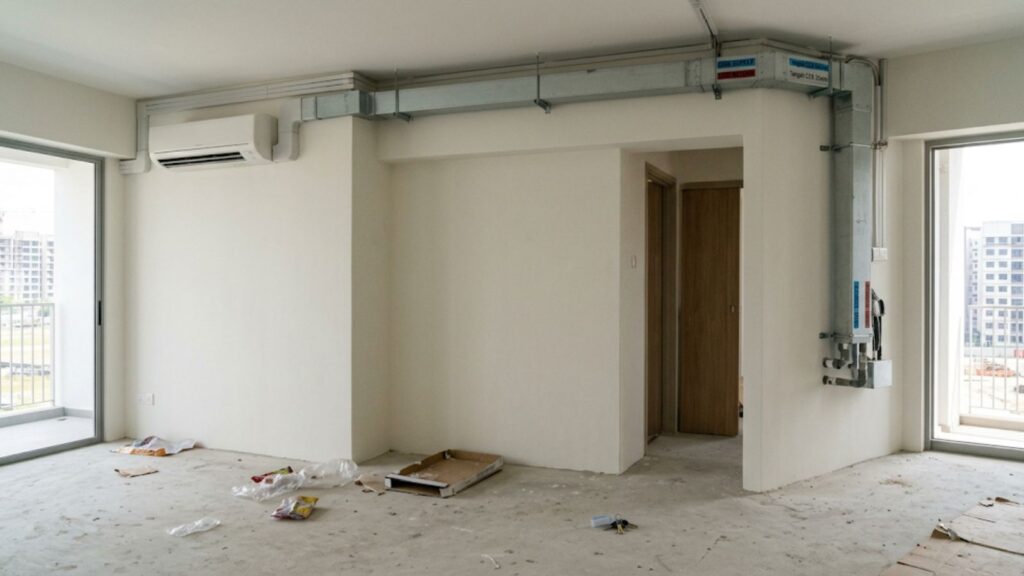
That moment when HDB hands you the keys. Years of waiting, ballot anxiety, construction updates on My HDBPage. Finally over. You’re standing in your empty flat. Bare walls. That new concrete smell. Mind already racing through Pinterest boards and renovation ideas. But here’s what we see happen too often. New BTO owners rush into aircon installation without proper planning. They book the cheapest installer. Skip the defect check. End up with units installed in wrong locations, undersized systems struggling to cool, or worse, HDB compliance issues that force them to redo everything. We’ve been installing aircon in new BTO flats across Singapore for years. The owners who do it right follow a system. Those who rush regret it within months. This 7-day checklist breaks down exactly what to do after collecting your BTO keys, specifically for aircon installation. Not generic advice. Specific steps that prevent expensive mistakes. Day 0: Key Collection Day – What Most People Miss You’ve just completed the appointment at HDB Hub. Keys in hand. Excitement through the roof. Before you do anything else, there’s critical information you need to gather. Most of it is in your HDB Welcome Kit, but people often toss it aside in their excitement. Check Your Flat’s Electrical Loading This determines what aircon system you can install. HDB flats built after January 1, 1994 (or those that underwent the Main Upgrading Programme or Home Improvement Programme) have 40-amp main switches. These flats can handle more powerful aircon systems without electrical upgrades. Older flats have 30-amp main switches. This creates a strict “power budget.” For example, a 4-room flat with 30-amp loading has a total running current cap of around 8.50 amps for all aircon units combined. You might be limited in what systems you can install. Your BTO is almost certainly a newer flat with 40-amp capacity. But verify this. The information is on HDB’s website, or you can check physically at your flat’s distribution board. Locate Your Aircon Ledge All new BTO flats come with a purpose-built concrete aircon ledge. This is the only approved location for your outdoor compressor. No exceptions. Find it. Photograph it. Note its size and position relative to your rooms. Why does this matter? The ledge location affects your piping routes, which affects installation cost and complexity. If the ledge is far from your master bedroom, expect longer pipe runs and higher costs. Get Your SP Services Account Ready You’ll need electricity for the defect inspection and any early work. SP Services requires at least one day to activate your account after application. Apply online before or immediately after key collection. Having power ready from Day 1 means you’re not scrambling later. Day 1: The Defect Inspection (Non-Negotiable) This step happens before any renovation. Before any aircon installation. Before anything. Every new BTO flat in Singapore comes with a 1-year Defects Liability Period (DLP) starting from the date of key collection. During this period, HDB will fix construction defects for free. The 30-Day Rule HDB strongly recommends reporting defects within 30 days of key collection and before renovation begins. Here’s why this matters for aircon. If your contractor drills holes for piping and later discovers a crack in the wall, who’s responsible? If your aircon installation happens first and then water seepage appears, was it the installation or a pre-existing defect? These disputes get messy. Avoid them by completing your defect inspection before any work starts. What to Check (Aircon-Relevant) While doing your full flat inspection, pay special attention to: The aircon ledge. Look for cracks, uneven surfaces, or drainage issues. Water should flow away from the building, not pool on the ledge. Walls where indoor units will be mounted. Tap them. Listen for hollow sounds that might indicate poor plastering. Check for visible cracks. The areas near windows where trunking will run. Any defects here should be fixed before your installer routes pipes through. Ceiling corners where drainage pipes might be installed. Water stains or dampness suggest existing issues. How to Report You’ll receive a Defects Feedback Form within 7 days of key collection. Fill it thoroughly. Take photos of everything. Submit to your estate’s Building Service Centre (BSC) or online through the HDB portal. Keep copies. You’ll need proof that defects existed before your renovation if disputes arise later. HDB typically completes rectification within 2 weeks. Plan your renovation timeline around this. Day 2-3: Planning Your Aircon System With defect inspection done or scheduled, now you plan the actual aircon system. This decision affects your comfort for the next 10-15 years. Choosing System 2, 3, or 4 New BTO flats only have space for one outdoor compressor on the aircon ledge. That’s why multi-split systems (one outdoor unit connected to multiple indoor units) are standard in Singapore HDB flats. The “System” number refers to how many indoor units connect to that single outdoor compressor. For 3-Room BTO (approximately 65-70 sqm): System 2 is typically sufficient. One unit for master bedroom, one for living room. If the second bedroom is regularly used (home office, child’s room), consider System 3. For 4-Room BTO (approximately 90 sqm): System 3 is the most common choice. Master bedroom, second bedroom, living room. Some owners go System 4 if they want all spaces air-conditioned. For 5-Room BTO (approximately 110 sqm): System 3 or System 4 depending on usage. Living rooms in 5-room flats need higher capacity units (12,000-18,000 BTU), while bedrooms work fine with 9,000 BTU. BTU Sizing Matters BTU (British Thermal Units) measures cooling capacity. Get this wrong and you’ll either have a unit struggling to cool (undersized) or one that short-cycles and creates clammy air (oversized). General Singapore guidelines: West-facing rooms need approximately 20-30% more BTU than these guidelines. If your master bedroom faces the afternoon sun, size up. Inverter vs Non-Inverter For 2025, there’s really only one answer: inverter technology. Inverter aircons adjust compressor speed based on room temperature. They use less energy, operate more quietly, and maintain more consistent temperatures. The upfront cost is higher,

Just Got BTO Keys? The 7-Day Aircon Installation Checklist Before You Move In Read More »

Working From Home Why Your Aircon Setup Is Costing You More

Working From Home? Why Your Aircon Setup Is Costing You More

Before 2020, your aircon ran maybe 8 hours a night. Now it runs 8 hours at night plus another 8-10 hours during the day while you work from your spare bedroom turned home office. That’s roughly double the usage. And your electricity bill shows it. We’ve serviced homes across Singapore where the monthly bill jumped from S$80-100 to S$200-300 after switching to permanent work-from-home arrangements. The owners blamed everything from faulty meters to electricity retailers. The real culprit was almost always the same: aircon usage patterns that made sense for nighttime sleeping but were bleeding money during daytime work hours. This guide breaks down exactly why your WFH aircon setup costs more than it should, and what you can do about it without sweating through your Zoom calls. The Real Numbers: What Daytime Aircon Actually Costs Let’s start with the math, because most people underestimate how much their aircon really draws. Singapore electricity rates (2026): Approximately S$0.31 per kWh Typical aircon consumption: The calculation for a typical WFH setup: Running a 9,000 BTU bedroom aircon for 8 hours of work: 0.9 kW × 8 hours = 7.2 kWh 7.2 kWh × S$0.31 = S$2.23 per day That’s S$67 per month just for your work hours. Add your usual nighttime usage (another 8 hours), and you’re looking at S$134 monthly for one room. If you’re cooling your living room while you work (many people do, because that’s where the desk fits), the numbers get worse: 1.5 kW × 8 hours = 12 kWh 12 kWh × S$0.31 = S$3.72 per day S$112 per month for daytime cooling alone. Now compare this to your pre-WFH life. If you only ran the bedroom aircon at night: 0.9 kW × 8 hours × S$0.31 × 30 days = S$67 per month total. The difference: S$67 to S$180+ per month. That’s S$800-1,400 per year in additional electricity costs that didn’t exist when you went to an air-conditioned office. Why Daytime Cooling Costs More Than Nighttime Here’s something most people don’t realise: running your aircon during the day costs significantly more per hour than running it at night, even at the same temperature setting. The reason is ambient temperature differential. At 3am, the outside temperature might be 26-27°C. Your aircon only needs to cool the room by 2-3 degrees to reach 24°C. The compressor cycles on and off, running maybe 40-50% of the time. At 2pm, the outside temperature is 32-34°C. That same aircon needs to cool the room by 8-10 degrees. The compressor runs almost continuously, drawing maximum power for hours. Measured difference: An inverter aircon maintaining 24°C uses roughly 30-40% more electricity during peak afternoon hours (1pm-5pm) compared to nighttime operation. For non-inverter units, the difference can be 50% or more. This is why your electricity bill seems disproportionately high. You doubled your aircon hours, but your costs more than doubled because those additional hours are the most expensive ones. The Temperature Trap: Why 22°C Is Killing Your Bill When you worked in an office, you had no control over the temperature. Now you do. And that’s dangerous. Research from Cornell University found that productivity peaks at 22-25°C. Below 20°C, workers make 44% more typing errors. Above 25°C, concentration starts declining. Armed with this knowledge, many WFH professionals set their aircon to 22°C or lower, thinking colder equals more productive. Here’s the problem: every degree below 25°C increases energy consumption by 3-5%. The real-world impact: Setting your aircon at 25°C vs 22°C: Over 8 working hours: Daily difference: S$0.75. Monthly difference: S$22.50. Annual difference: S$270. And here’s the kicker: most people can’t actually tell the difference between 23°C and 25°C when they’re focused on work. The productivity benefits of extreme cold are largely psychological. You feel like you should be more alert, so you are. But your wallet definitely notices the difference. The Afternoon Heat Problem If your home office faces west, you already know this pain. Between 2pm and 5pm, the room becomes an oven. Your aircon struggles. You crank the temperature lower. The compressor screams. Your meter spins. West-facing rooms in Singapore can experience window surface temperatures exceeding 50°C during peak afternoon sun. The heat radiates into the room faster than most residential aircons can remove it. What happens: This pattern doesn’t just cost money. It destroys your aircon faster, leading to expensive repairs or premature replacement. The fix isn’t colder settings. It’s reducing heat load. Window films that block UV and infrared can reduce solar heat gain by 50-70%. A S$200-400 investment in window film for a west-facing home office can save S$30-50 monthly in electricity and extend your aircon’s lifespan by years. Blackout curtains help too, though they block light. For daytime work, consider dual-layer curtains: a sheer layer for diffused light plus a thermal-backed layer you can close during peak sun hours. The Oversized Unit Problem Many home offices are set up in spare bedrooms with aircon units sized for sleeping, not working. When you sleep, you generate roughly 80 watts of heat. When you work at a computer, you generate 100-150 watts. Your computer adds another 50-200 watts depending on what you’re running. External monitors, desk lamps, and chargers contribute more. A room that stays comfortable at 24°C overnight might struggle to maintain 26°C during work hours with all that additional heat load. But here’s where people go wrong: they assume the solution is a bigger aircon. An oversized aircon doesn’t solve the problem. It cools the room too quickly, then shuts off. The room heats up. The aircon blasts on again. This short-cycling wastes energy and wears out the compressor. What actually works: First, reduce the internal heat load. Use a laptop in low-power mode when possible. Choose LED desk lamps over halogen. Keep devices you’re not using in sleep mode. Second, use a fan to circulate air. A ceiling fan or standing fan costs S$0.02-0.05 per hour to run. It makes 26°C feel like 24°C by increasing air movement across your skin. You can raise

Working From Home? Why Your Aircon Setup Is Costing You More Read More »

Your Aircon is 8 Years Old The Honest Repair vs Replace Calculator

Your Aircon is 8 Years Old: The Honest Repair vs Replace Calculator

Your aircon just broke down. The technician quotes you S$450 for a new compressor. Your aircon is 8 years old, maybe 9, maybe you’re not even sure anymore. A voice in your head says: “Should I just replace the whole thing?” Another voice counters: “But it was working fine until now. Why throw away a perfectly good unit?” Both voices have valid points. Both can be wrong. The repair vs replace decision isn’t about feelings or hunches. It’s about math. Cold, honest math that most people never do because they’re standing in a hot room making a rushed decision while a technician waits for an answer. This guide gives you the actual calculator. Not vague advice like “consider your options” or “it depends on your situation.” Real numbers, real formulas, real decision frameworks based on Singapore’s aircon market in 2025. Let’s figure this out properly. The 8-Year Reality Check Eight years is significant for an aircon in Singapore. Here’s why: The typical lifespan of a well-maintained split-system aircon in Singapore ranges from 7 to 12 years. Some last 15 years. Some fail at 6. Singapore’s climate, with year-round heat and humidity, makes aircons work harder than in temperate countries. That continuous strain accelerates wear. At 8 years, your unit is past the midpoint of its expected life. It’s not ancient, but it’s not young either. Components designed for 50,000-80,000 operating hours are accumulating fatigue. The compressor, capacitors, fan motors, and control boards have all been through thousands of heating and cooling cycles. More importantly, an 8-year-old aircon exists in a different technological era. The energy efficiency standards, refrigerant types, and smart features available in 2025 weren’t standard in 2017. This context matters because the repair vs replace decision isn’t just about fixing what’s broken. It’s about what you’re fixing it into. The Real Repair Costs in Singapore Before you can calculate anything, you need to know what repairs actually cost. Here’s the current pricing landscape: Minor repairs (S$50-200) Moderate repairs (S$200-500) Major repairs (S$400-1,000+) Additional costs often forgotten The first rule of the calculator: always get the full repair cost in writing before deciding. A “S$300 repair” that becomes S$450 after diagnosis fees, GST, and “while we’re here, we noticed…” additions changes the math entirely. The New Aircon Costs in Singapore (2025) For a fair comparison, you need to know what replacement actually costs: System 1 (single room) System 2 (two rooms) System 3 (three rooms, most common for HDB) System 4 (four rooms) These prices include basic installation with standard pipe runs. Add S$200-500 for complex installations (concealed piping, longer runs, condo MCST requirements, or removal of old system). Important: From April 2025, all new multi-split systems (System 2 and above) sold in Singapore must be minimum 5-tick efficiency rating. You can no longer legally buy a cheap 3-tick System 3. The “budget option” for multi-splits has effectively disappeared. The 50% Rule: The Industry Standard The most widely used rule of thumb in the aircon industry is simple: If the repair cost exceeds 50% of a new unit’s price, replace. Here’s how it works: A new System 1 from a decent brand costs approximately S$1,500 installed. If your repair quote is S$800 (more than 50% of S$1,500), replacement makes more financial sense. A new System 3 costs approximately S$3,500-4,500 installed. If your repair quote is S$2,000+ (more than 50%), you should strongly consider replacement. Why 50%? Because the repair only fixes the immediate problem. It doesn’t address the age-related wear on every other component. A unit that needs a S$600 compressor today might need a S$350 PCB in 8 months and a S$200 fan motor 6 months after that. You’ve now spent S$1,150 on a unit that might fail completely within 2 years anyway. The 50% rule protects you from the “repair death spiral” where you keep fixing an aging unit piece by piece until you’ve spent more than a new system would have cost. The Age-Adjusted 50% Rule The basic 50% rule doesn’t account for age. A repair that’s worthwhile on a 3-year-old unit might be foolish on a 10-year-old one. Here’s the adjusted version: Under 5 years old: Repair if cost is less than 50% of new unit 5-7 years old: Repair if cost is less than 40% of new unit 8-10 years old: Repair if cost is less than 30% of new unit Over 10 years old: Repair if cost is less than 20% of new unit For your 8-year-old unit, this means: This adjustment exists because older units have less remaining useful life to spread the repair cost across. A S$600 repair on a unit with 2-3 years left costs you S$200-300 per year of remaining life. The same repair on a unit with 7+ years left costs under S$100 per year. The math favours the younger unit. The Hidden Cost: Energy Efficiency Differential Here’s where most repair vs replace calculations go wrong: they ignore operating costs. An 8-year-old aircon, even when functioning perfectly, uses significantly more electricity than a new 5-tick unit. This isn’t speculation. It’s measured physics. The efficiency gap explained: Your 8-year-old unit was likely a 2-tick or 3-tick model when new (these were common and legal until recently). Even if it was a 4-tick, 8 years of wear has degraded its efficiency by an estimated 15-25%. A new 5-tick system uses 30-40% less electricity than a 2-tick system of the same capacity. Combined with age-related degradation, your old unit might be using 40-50% more electricity than a new replacement. What this costs you: Assume your aircon runs 8 hours daily (typical for a bedroom used at night). At current electricity rates (approximately S$0.31-0.33/kWh), here’s the annual difference: A 9,000 BTU old unit (inefficient): ~S$720/year in electricity A 9,000 BTU new 5-tick unit: ~S$430/year in electricity Annual savings: ~S$290 For a System 3 running in multiple rooms, the savings scale up: Old System 3: ~S$2,000-2,400/year New 5-tick System 3: ~S$1,200-1,400/year Annual savings: ~S$800-1,000 Over a 10-year lifespan, choosing the new unit

Your Aircon is 8 Years Old: The Honest Repair vs Replace Calculator Read More »

The 3AM Aircon Breakdown What to Actually Do (And What Can Wait Till Morning)

The 3AM Aircon Breakdown: What to Actually Do (And What Can Wait Till Morning)

It’s 3am. You wake up sweating. The room feels wrong. You reach for the remote, press the button, and nothing happens. Or worse, the aircon makes a sound you’ve never heard before, then goes silent. Your mind races. Is this an emergency? Should you call someone now? Will you survive the night? How much is this going to cost? Take a breath. Most 3am aircon situations aren’t emergencies. They feel urgent because you’re hot, tired, and not thinking clearly. But very few require immediate action in the middle of the night. Knowing the difference saves you money on emergency call-out fees and prevents panic decisions you’ll regret. This guide walks you through exactly what to do when your aircon fails at the worst possible time, what problems genuinely need immediate attention, what can safely wait until morning, and how to get through the night without air conditioning in Singapore. First: The 60-Second Assessment Before you do anything else, answer these four questions: 1. Is there a burning smell or visible smoke? If yes, this is an actual emergency. Turn off the aircon at the circuit breaker, not just the remote. Open windows. If smoke is significant, leave the room. This is the only aircon situation that might warrant calling emergency services. 2. Is water actively flooding your room? Not dripping. Flooding. If water is pouring out and threatening to damage flooring, furniture, or electronics, you need to act now. Otherwise, a drip can wait. 3. Is the circuit breaker tripping repeatedly? If your aircon keeps tripping the breaker every time you reset it, stop trying. Repeated tripping indicates an electrical fault that shouldn’t be ignored. Leave it off until morning. 4. Is anyone in the household medically vulnerable? Infants, elderly family members, or anyone with heart conditions or respiratory illness may genuinely need cooling. This changes the urgency calculation. If you answered “no” to all four questions, you almost certainly don’t need emergency service tonight. You need a plan to get through the next few hours and a phone call in the morning. What Genuinely Needs Immediate Attention These situations are rare, but they exist. If you’re experiencing any of the following, you have a legitimate reason to seek emergency help: Burning smell or smoke A burning smell from your aircon can indicate electrical problems, overheating motors, or melting components. This is the one situation where the risk of fire makes immediate action necessary. What to do: A burning smell doesn’t always mean fire, but it means something is wrong enough that the unit shouldn’t run until inspected. This can wait until morning for a technician, but the unit must stay off. Repeated circuit breaker tripping If your aircon trips the breaker once, it might be a random fluctuation. Reset it and try again. If it trips the breaker twice in a row, something is wrong. The breaker is doing its job, detecting a fault and cutting power to prevent damage or fire. What to do: Active water flooding A small drip is annoying but not an emergency. Significant water flow that’s damaging property or creating electrical hazards is different. What to do: Most leaks can be managed overnight with towels and containers. The damage from a few hours of dripping is minimal compared to the cost of emergency call-out. Medical necessity For most healthy adults, one night without aircon is uncomfortable but not dangerous. For certain people, it’s different. Who may genuinely need cooling: If someone in your household falls into these categories and there’s no way to keep them cool, consider temporary alternatives before calling emergency service. What Can Definitely Wait Until Morning These situations feel urgent at 3am but genuinely don’t need overnight attention: The aircon simply stopped working No dramatic symptoms. It just stopped. The room is getting warm, but nothing is on fire, flooding, or making scary noises. This is the most common 3am scenario, and it’s not an emergency. Something failed, a capacitor, a sensor, a control board, but the failure itself is complete. Calling someone now versus 8am doesn’t change the outcome. The unit needs repair either way. The aircon is running but not cooling The fan blows, you hear the normal sounds, but the air isn’t cold. This usually indicates low refrigerant, a compressor issue, or dirty coils. None of these get worse overnight. The problem that exists at 3am will be the same problem at 9am. Water is dripping (not flooding) A drip means blocked drainage, often fixable with basic service. Put a container under it, lay a towel, and call in the morning. The volume of water from overnight dripping is typically a litre or two, easily contained. The unit is making unusual noises Clicking, buzzing, rattling, or grinding sounds are concerning but not dangerous. They indicate worn bearings, loose components, or refrigerant issues. Turn the unit off so the noise doesn’t worsen the underlying problem, and address it tomorrow. The remote isn’t working Before assuming the worst, check the batteries. Replace them and try again. If that doesn’t work, try the manual button on the unit itself (usually hidden behind a panel). If the unit responds to manual operation, your problem is the remote, not the aircon. Error codes or blinking lights Modern aircons display error codes when something’s wrong. The unit has detected an issue and shut down to protect itself. This is the system working as designed. Note the error code (photograph it), turn the unit off, and report it to the technician in the morning. The 3AM Troubleshooting Checklist Before you panic, run through these basic checks. Many 3am “breakdowns” have simple causes. Check 1: Power supply Is the aircon the only thing without power? Check: If your whole home or area has lost power, the issue isn’t your aircon. Check 2: Remote control The most common “my aircon won’t work” problem is dead batteries. Check 3: Timer settings Did the unit turn off because it was scheduled to? Check: Check 4: Filter obstruction If

The 3AM Aircon Breakdown: What to Actually Do (And What Can Wait Till Morning) Read More »

Signs Your Aircon Technician is Overcharging You

5 Signs Your Aircon Technician is Overcharging You (From an Insider’s Perspective)

I’ve worked in the aircon industry in Singapore for years. I’ve seen how the best companies operate, and I’ve seen the tactics that give our industry a bad name. Here’s the uncomfortable truth: overcharging happens more than you think. Not because most technicians are dishonest, but because the information gap between service providers and customers is massive. You don’t know what a capacitor costs. You don’t know if you actually need a chemical wash. You don’t know if gas top-ups should be annual or once every five years. That information gap is where overcharging thrives. This article isn’t about scaring you away from aircon servicing. Regular maintenance is genuinely important. But you deserve to know when you’re being taken for a ride. So let me share what I’ve learned, the signs that should make you pause, ask questions, or walk away entirely. Sign #1: The “You Need a Gas Top-Up” Every Single Visit This is the most common overcharge in Singapore, and it preys on a fundamental misunderstanding about how aircon systems work. The truth about refrigerant gas: Your aircon uses refrigerant (commonly R410A or R32) in a sealed, closed-loop system. The gas doesn’t get “used up” like petrol in a car. It circulates continuously, changing from liquid to gas and back again, absorbing and releasing heat. Under normal conditions, refrigerant should last the entire lifespan of your unit, which is typically 8-15 years. Read that again: under normal conditions, you should never need a gas top-up. The only reason refrigerant levels drop is if there’s a leak. Leaks can happen, particularly in older systems or after physical damage, but they’re not routine. A well-maintained aircon shouldn’t need gas refilled every service visit, every year, or even every few years. The overcharging tactic: Unethical technicians tell customers they need gas top-ups at every servicing, or at least annually. They frame it as routine maintenance, like changing oil in a car. It sounds plausible if you don’t know better. Here’s what they’re actually doing: either they’re charging you for gas you don’t need, or they’re adding a tiny amount of gas and charging you full price, or your system has a leak they’re not telling you about (because fixing the leak means more work, while topping up gas means repeat business). I’ve personally seen cases where customers paid for gas top-ups every 6 months for years. That’s not maintenance. That’s either a chronic leak that was never fixed, or outright fraud. What you should know: The red flag script: “Your gas is a bit low, we should top it up.” This vague statement, without pressure readings or evidence, is a classic upsell. A professional shows you the gauge, explains what normal pressure looks like, and demonstrates why top-up is needed. Sign #2: The Sudden “Discovery” of Multiple Problems You called for a simple general service. The technician arrives, starts working, then emerges with grave news: your PCB is failing, your capacitor is weak, your drainage system is compromised, and frankly, he’s surprised the whole thing hasn’t caught fire yet. Suddenly, your S$40 service visit has become a S$600 repair quote. How this scam works: The technician exploits two things: your lack of technical knowledge and the urgency of the moment. You can’t verify what he’s saying. Your aircon is partially disassembled. He’s the expert standing in your home. And the problems he’s describing sound serious. Some technicians carry “evidence” to show you: a visibly burnt capacitor they claim came from your unit (but actually carry around for this purpose), or photos of damaged components that aren’t actually yours. More subtle versions don’t involve fake evidence. They simply exaggerate minor issues into urgent repairs: The psychology at play: You’re caught off-guard. You didn’t budget for repairs. But now you’re being told your aircon might fail, or worse, be dangerous. The technician is there, tools ready, offering to fix everything right now. It feels easier to say yes than to say no, do your research, and schedule another visit. That pressure is deliberate. How to protect yourself: If a quote dramatically exceeds these ranges without clear explanation, something’s wrong. Sign #3: The Chemical Wash Hard Sell General servicing in Singapore runs S$25-50 per unit. Chemical wash runs S$80-150 per unit. Chemical overhaul runs S$130-200 per unit. Guess which one certain technicians push relentlessly? The legitimate need for chemical wash: Chemical wash is genuinely necessary sometimes. If your aircon hasn’t been serviced in over a year, if there’s visible mould, if cooling efficiency has dropped significantly, or if there’s a persistent smell despite regular cleaning, chemical wash makes sense. What chemical wash does: it uses specialized cleaning solutions to remove stubborn buildup from evaporator coils, drainage trays, and blower fans. It’s more thorough than general servicing. The overcharging tactic: Some technicians recommend chemical wash at every visit, regardless of the unit’s actual condition. They have several scripts: The reality is that most residential aircons serviced quarterly only need chemical wash once a year, or even less frequently if usage is moderate and the environment isn’t particularly dusty or humid. Some technicians do an even more questionable version: they quote general service prices to get the booking, then upon arrival, insist that chemical wash is “actually required.” You’re now trapped, the technician is already there, and the only way to get your aircon serviced today is to accept the more expensive option. How to know if you actually need it: Ask the technician to show you the coils and blower. If they’re visibly clean or only lightly dusty, general service is fine. If there’s black grime, mould growth, or heavy buildup, chemical wash is justified. A trustworthy technician assesses first, then recommends. An untrustworthy one prescribes chemical wash before even looking inside your unit. The honest assessment framework: Sign #4: Vague Pricing and “Miscellaneous” Charges Transparent pricing is the simplest indicator of a trustworthy company. If you can’t get clear answers about what you’re paying for, something is wrong. What transparent pricing looks like:

5 Signs Your Aircon Technician is Overcharging You (From an Insider’s Perspective) Read More »

Why You Keep Postponing Aircon Servicing (And the Real Cost of Next Month)

Why You Keep Postponing Aircon Servicing (And the Real Cost of “Next Month”)

You know your aircon needs servicing. You’ve known for a while. Maybe the last technician mentioned it. Maybe you noticed the cooling isn’t quite what it used to be. Maybe there’s a faint musty smell when you first turn it on. And yet. The months slip by. “Next month” becomes “after Chinese New Year” becomes “when work slows down” becomes “definitely before the really hot weather.” Before you know it, a year has passed. Maybe two. You’re not lazy. You’re not irresponsible. You’re just… human. Procrastination around maintenance tasks is one of the most universal human behaviours. Nearly everyone does it. And almost everyone underestimates what it costs them. This article is about two things: understanding why you keep putting off aircon servicing (the psychology is fascinating and completely normal), and calculating the actual financial cost of delay (it’s higher than you think, and the math is sobering). By the end, you’ll either book that service appointment, or you’ll know exactly how much you’re choosing to pay for the privilege of postponing. The Psychology of “Next Month” Let’s start by understanding what’s happening in your brain when you decide, for the fifth time, that aircon servicing can wait. The present-future disconnect When you think about servicing your aircon, two versions of you are involved: present-you and future-you. Present-you has to take action. Present-you has to find a company, compare prices, schedule an appointment, be home during the service window, and pay the bill. Present-you has to expend effort, time, and money right now. Future-you gets all the benefits. Future-you enjoys better cooling, lower electricity bills, cleaner air, and avoided repairs. Future-you is comfortable and financially better off. The problem? Your brain treats future-you almost like a stranger. Neuroscience research shows that when people think about their future selves, the same brain regions activate as when they think about other people. Your brain, in a very real sense, doesn’t fully connect present-effort with future-benefit. So when you weigh “schedule servicing now” against “watch Netflix now,” your brain sees immediate effort versus benefits for someone who feels almost like another person. No wonder Netflix wins. The invisible problem Aircon servicing suffers from a specific challenge: the consequences of skipping it are invisible until they’re catastrophic. Your aircon still works. It still cools the room. It still turns on when you press the button. The gradual efficiency loss, the slowly accumulating dust, the developing mould, the strain on the compressor—none of this announces itself dramatically. Compare this to, say, a flat tyre. A flat tyre makes driving impossible. The consequence is immediate and obvious. You can’t procrastinate fixing it because the problem blocks your ability to function. Aircon neglect is different. The consequences accumulate silently in the background. Your electricity bill creeps up S$10, then S$20, then S$30 per month. But the increase is gradual enough that you don’t notice. You attribute it to rate increases, or hotter weather, or running the aircon more. The actual cause—declining efficiency from lack of maintenance—stays hidden. By the time the problem becomes visible (water leaking, strange noises, complete breakdown), you’re no longer dealing with a servicing issue. You’re dealing with a repair emergency. And emergencies cost much more than prevention. The effort-reward mismatch Behavioural economists talk about “present bias”: we systematically overvalue immediate rewards and undervalue future ones. A S$50 service fee today feels more significant than a S$500 repair bill next year, even though the math clearly favours paying now. This isn’t stupidity. It’s how human brains evolved. For most of human history, immediate threats and rewards mattered more than distant ones. A predator right now was more important than a drought next season. Our brains got very good at prioritising the present. Modern life, unfortunately, is full of situations where this bias works against us. Retirement savings. Health screenings. And yes, aircon servicing. The effort is now, the reward is later, and our brains consistently underweight the future. The friction factor Here’s something interesting: people are much more likely to procrastinate tasks that involve multiple steps, uncertainty, or coordination with others. Servicing your aircon involves all three: Each step is individually small. But the cumulative friction is significant. And at any point, something else can seem more urgent. Compare this to buying something on Shopee: one click, done. No wonder online shopping is easier to do than scheduling services. The optimism trap Finally, there’s optimistic bias: we systematically underestimate the likelihood of bad things happening to us specifically. “My aircon is still working fine.” “It’ll probably be okay for a few more months.” “I’ve never had a breakdown before.” These thoughts feel reasonable. And for any individual month, they’re probably accurate. The problem is cumulative. Each month you postpone, you’re placing a small bet. The odds of a problem in any single month are low. But over 12, 18, 24 months of neglect, those small probabilities compound. It’s like skipping dental check-ups. Any given month, your teeth are probably fine. But string together enough months, and the cavity that could have been a filling becomes the root canal that costs ten times more. The Real Math of “Next Month” Let’s move from psychology to arithmetic. What does procrastination actually cost? Cost #1: Electricity efficiency loss This is the silent killer. You don’t see it on any single bill, but it adds up relentlessly. When your aircon filters and coils are dirty, the system has to work harder to achieve the same cooling. According to the U.S. Department of Energy and multiple HVAC studies, a neglected aircon system can use 15-25% more electricity than a clean, well-maintained one. Let’s calculate what that means in Singapore: A typical bedroom aircon (9,000 BTU) running 8 hours daily consumes roughly S$50-70/month in electricity when operating efficiently. At 15% efficiency loss, that’s an extra S$7.50-10.50/month. At 25% efficiency loss (significant neglect), that’s an extra S$12.50-17.50/month. For a System 3 setup cooling multiple rooms, baseline consumption might be S$150-200/month. The efficiency penalty from neglect: S$22.50-50/month. Here’s the key insight:

Why You Keep Postponing Aircon Servicing (And the Real Cost of “Next Month”) Read More »

What Singapore Homeowners Wish They Knew Before Aircon Installation

What Singapore Homeowners Wish They Knew Before Aircon Installation

Every week, aircon technicians visit homes where the conversation eventually turns to regret. “If only I had known…” “I wish someone had told me…” “Looking back, I should have…” Aircon installation seems straightforward. You pick a brand, choose a system size, schedule the installation, and move on with life. But the decisions you make during those few days have consequences that last 10-15 years. And many of those consequences don’t become obvious until months or years later. This article compiles the most common regrets from Singapore homeowners—the things they wish they had known, the mistakes they’d undo if they could, and the lessons that came at significant cost. Consider it a guide written by everyone who went before you, so you don’t have to learn these lessons the hard way. Regret #1: “I Undersized My System Because I Wanted to Save Money” The decision: A homeowner with a 4-room HDB chooses a System 3 instead of System 4 to save S$800-1,000. They figure the study doesn’t really need aircon—they can always add a fan. The reality: Two years later, the study has become a work-from-home office. It’s unbearably hot from 2pm onwards. The nearest bedroom aircon can’t reach it effectively. Adding a System 1 now would cost more than the original upgrade, plus require new electrical work and trunking. What they wish they knew: The cost difference between System 3 and System 4 is roughly S$800-1,200 during initial installation. Adding an additional System 1 later costs S$1,200-1,800 plus new electrical and trunking work. The math strongly favours installing the larger system upfront. More importantly, room usage changes. The storage room becomes a nursery. The study becomes a home office. The living room becomes the main hangout space when previously everyone stayed in bedrooms. COVID-19 taught millions of Singaporeans that home usage patterns can shift dramatically and permanently. The principle: When deciding between system sizes, lean toward the larger option unless budget absolutely prohibits it. The cost of upgrading later almost always exceeds the cost of initial installation. Regret #2: “I Oversized Individual Units and Now They Short-Cycle” The opposite mistake is equally common and equally frustrating. The decision: A homeowner installs a 12,000 BTU unit in a small bedroom “to make sure it’s cold enough.” After all, bigger is better, right? The reality: The room gets cold in 10 minutes, then the unit shuts off. Then it gets warm, and the unit turns on again. This on-off cycling happens repeatedly throughout the night. The room never feels consistently comfortable. Humidity stays high because the unit doesn’t run long enough to dehumidify properly. And the constant cycling wears out the compressor faster than steady operation would. What they wish they knew: BTU sizing matters in both directions. Undersized units struggle and never cool the room properly. Oversized units short-cycle, which causes discomfort, humidity problems, increased wear, and higher electricity bills. Proper sizing depends on room size, ceiling height, sun exposure, and window area. A standard HDB bedroom (around 10-12 sqm) typically needs 9,000 BTU. A master bedroom (12-15 sqm) might need 12,000 BTU. A living room (20-30 sqm) often needs 18,000-24,000 BTU. West-facing rooms with large windows need higher capacity than the same-sized room facing other directions. High ceilings need more BTU. But the solution for challenging rooms isn’t maximum BTU—it’s appropriate BTU plus better insulation or window treatment. The principle: Trust the calculations, not the instinct that “more is better.” A properly sized unit provides better comfort than an oversized one. Regret #3: “I Cheaped Out on Installation and Now Everything Leaks” The decision: A homeowner gets three quotes. Company A charges S$3,200 for a System 3 installation. Company B charges S$2,800. Company C charges S$2,200. They go with Company C because “it’s the same aircon brand, so the only difference is installation cost.” The reality: Six months later, water leaks from the living room unit onto the TV console. The technician diagnoses improper drainage gradient—the pipes weren’t angled correctly during installation. Fixing it requires re-routing the drainage, which means opening up trunking, re-piping, and patching the wall afterward. Cost: S$400-600, plus the water damage already done. A year later, a bedroom unit develops frost on the pipes. Diagnosis: poor insulation on the refrigerant lines, causing condensation. The cheap installation company used thin insulation and didn’t wrap it properly. More repair costs. What they wish they knew: The price difference between installation companies isn’t just profit margin—it reflects material quality and workmanship time. Cheaper installations often cut corners on: A S$500-800 “savings” on installation can easily become S$1,000-2,000 in repairs over the following years. And some installation problems (like poorly routed pipes inside walls or false ceilings) are extremely expensive to fix later. The principle: Installation quality matters as much as brand quality. A premium aircon poorly installed will underperform a mid-tier aircon installed correctly. Regret #4: “I Didn’t Think About the Trunking and Now It’s Ugly” This is perhaps the most common aesthetic regret among Singapore homeowners, particularly in HDB flats. The decision: The homeowner focuses on aircon brand, BTU sizing, and price. They don’t give much thought to trunking—those white PVC casings that cover the refrigerant pipes. The installer runs the trunking along the most direct route. The reality: The trunking cuts horizontally across the living room wall at eye level. It runs diagonally in the bedroom, creating a visual mess. It blocks where the curtain rod should go. It makes the room look like an industrial space rather than a home. Once installed, the options are limited: paint it to match the wall (helps, but doesn’t hide the bulge), build false walls or boxing to conceal it (expensive), or live with it for the next decade. What they wish they knew: Trunking routing should be discussed explicitly before installation. There are always choices: running along ceiling edges, behind false ceilings, inside walls (during renovation), or along less visible paths. The “direct” route the installer defaults to may not be the aesthetically best route. If you’re renovating

What Singapore Homeowners Wish They Knew Before Aircon Installation Read More »

Why Your Inverter Aircon Isn't Saving You Money (Common Setup Mistakes)

Why Your Inverter Aircon Isn’t Saving You Money (Common Setup Mistakes)

You did everything right. You researched brands. You chose a 5-tick inverter model. You paid the premium—S$400-800 more than a non-inverter unit. The salesperson promised 30-50% energy savings. Your colleagues confirmed their inverter aircons “basically pay for themselves.” Six months later, you’re staring at your SP bill. It’s the same as before. Maybe higher. What went wrong? Here’s the uncomfortable truth: inverter aircons don’t automatically save money. They can save money—significant money—but only when installed correctly, sized appropriately, and used properly. Get any of these wrong, and that expensive inverter technology works against you instead of for you. This article exposes the common setup mistakes that sabotage inverter aircon efficiency in Singapore homes. More importantly, it shows you how to fix them. Part 1: How Inverter Aircons Actually Save Energy Before we discuss what goes wrong, let’s understand what’s supposed to go right. The Traditional Aircon Problem A non-inverter (conventional) aircon has only two modes: full power or off. When you set it to 24°C, here’s what happens: This on-off cycling wastes energy for two reasons. First, starting a compressor from a dead stop requires a surge of electricity—like how a car uses more fuel accelerating from zero than cruising at constant speed. Second, the temperature swings mean you’re sometimes overcooling (wasting energy) and sometimes undercooling (uncomfortable). The Inverter Solution An inverter aircon has a variable-speed compressor. Instead of on/off, it can run at 10%, 30%, 50%, 70%—whatever’s needed. Here’s the ideal scenario: No startup surges. No temperature swings. The compressor cruises at low power, maintaining your temperature with minimal energy. The promised savings: 30-50% compared to non-inverter, under ideal conditions. The Key Phrase: “Under Ideal Conditions” Those laboratory-tested savings assume: Miss any of these, and the savings evaporate. Some mistakes actually make inverter aircons less efficient than their non-inverter counterparts. Part 2: The Seven Mistakes Killing Your Savings Mistake #1: Wrong Size Unit The problem: This is the most common and most damaging mistake. And ironically, Singapore homeowners often make it in opposite directions. Undersized unit (too small for the room): If your aircon can’t produce enough cooling for your room, it runs at maximum power continuously, trying to reach a temperature it can never achieve. The variable-speed technology becomes useless—the compressor is stuck at 100%. An undersized inverter aircon is actually worse than an undersized non-inverter because: Signs your unit is undersized: Oversized unit (too big for the room): Counterintuitively, bigger isn’t better. An oversized aircon cools the room so quickly that it can’t maintain low-speed operation for long enough to achieve efficiency. What happens with an oversized inverter: This short cycling negates inverter advantages. You get: The fix: Match BTU capacity to room size and conditions: Room Size (sqm) Standard Room West-Facing/Top Floor High Ceiling 10-15 9,000 BTU 12,000 BTU 12,000 BTU 15-20 12,000 BTU 12,000-18,000 BTU 18,000 BTU 20-30 18,000 BTU 18,000-24,000 BTU 24,000 BTU 30-40 24,000 BTU 24,000+ BTU 24,000+ BTU For living/dining combinations common in HDB flats (40-50 sqm), you typically need 24,000 BTU minimum, often with a second unit for effective coverage. Singapore-specific consideration: Many HDB bedrooms are 10-12 sqm. A 9,000 BTU unit is usually perfect. Installing a 12,000 BTU unit “just to be safe” often creates the oversizing problem. Mistake #2: Extreme Temperature Settings The problem: Setting your aircon to 16°C or 18°C because you want it cold fast. This is one of the most widespread misconceptions about aircon use, and it completely undermines inverter efficiency. Why it kills savings: When you set 16°C, you’re asking your aircon to create a 16-18°C temperature difference between indoor and outdoor air. Singapore’s ambient temperature is typically 28-34°C. This massive differential means: The math: Setting 24°C versus 18°C = 6 degrees difference 6 degrees × 3-5% per degree = 18-30% more electricity You’ve just wiped out most or all of your inverter savings by using extreme temperature settings. The common excuse: “But I just set it low to cool down fast, then I’ll raise it.” The problem: inverter aircons don’t actually cool faster at lower settings. The compressor runs at maximum speed during initial cooldown regardless of whether you set 16°C or 24°C. Setting it lower just means it stays at maximum speed longer. The fix: Set your aircon to 24-25°C. This is the sweet spot where: If 24°C feels too warm, use a fan. Moving air feels 2-3°C cooler than still air at the same temperature. A ceiling fan costs S$0.01-0.02 per hour; running your aircon at 18°C instead of 24°C costs S$0.10-0.15 per hour extra. Mistake #3: Constant On-Off Switching The problem: Turning the aircon on when you’re hot, off when you’re cool, on again when you’re hot… This directly contradicts how inverter technology works. What happens: Every time you turn off your inverter aircon: You’ve converted your expensive inverter into a non-inverter system. All those startup surges you paid extra to avoid? You’re creating them manually. The false belief: “I’m saving electricity by turning it off when I don’t need it.” For very short periods (under 30 minutes), turning off an inverter aircon and restarting it uses more energy than leaving it running at low speed. The startup surge and the energy to re-cool the warmed room exceeds what you’d use maintaining temperature. When it makes sense to turn off: When to leave it running: The fix: Let the thermostat do its job. Set your desired temperature and let the inverter modulate. If you’re comfortable, the aircon has already slowed to efficient operation. Turning it off interrupts that efficiency. Mistake #4: Poor Room Sealing The problem: Cool air escaping and warm air entering means your aircon works harder than necessary. Common air leaks in Singapore homes: Why it matters more for inverters: An inverter aircon is designed to sense room temperature and adjust compressor speed accordingly. When warm air constantly leaks in: The inverter is responding correctly to the conditions—but those conditions are fighting against efficiency. The worst offender: Open doors That “slightly open door” to the living room? It

Why Your Inverter Aircon Isn’t Saving You Money (Common Setup Mistakes) Read More »

Baby Coming How to Aircon-Proof Your Nursery in Singapore

Baby Coming? How to Aircon-Proof Your Nursery in Singapore

Nine months of waiting. The nursery is painted. Crib assembled. Tiny clothes folded in drawers. But here’s something most expecting parents overlook: the aircon. In Singapore, aircon isn’t a luxury. It’s survival. And for a newborn, getting the nursery cooling right affects everything from sleep quality to skin health to something far more serious, the risk of SIDS. We’ve serviced thousands of homes across Singapore. Many calls come from new parents, panicking because their baby won’t stop crying, the room feels wrong, or the aircon is blowing dust and making everyone sick. Most of these problems could have been prevented with proper preparation before the baby arrived. This guide covers everything you need to know about setting up your aircon for a newborn. Not generic advice. Singapore-specific recommendations that account for our humidity, our housing types, and our around-the-clock aircon usage. Why Aircon Matters More for Babies Than Adults Here’s a fact that surprises many first-time parents: newborns can’t regulate their body temperature the way adults do. Their thermoregulatory system is still developing. They have a higher surface area to weight ratio, meaning they lose heat faster. And they can’t tell you when they’re too hot or too cold. They just cry. This isn’t just about comfort. Research published in Frontiers in Pediatrics found clear links between overheating and Sudden Infant Death Syndrome (SIDS). Profuse sweating was found at the scene of many SIDS cases. Elevated room temperature is now recognized as a risk factor alongside sleeping position and bedding. A study of 60,364 SIDS cases in the United States found that on days when temperatures exceeded 29°C, the risk of sudden infant death was 2.78 times higher compared to 20°C days. Singapore’s ambient temperature regularly hits 32-34°C. Without proper cooling, indoor temperatures can climb even higher. Here’s what this means practically: your aircon isn’t just keeping baby comfortable. It’s performing a safety function. The Temperature Sweet Spot for Singapore Nurseries Ask five paediatricians about the ideal nursery temperature and you’ll get five slightly different answers. But there’s a consensus range. For Singapore, the recommended nursery temperature is 23-26°C. Health Hub Singapore, the national digital health platform, recommends 23-26°C for newborns. This accounts for our tropical climate where maintaining Western-standard temperatures of 18-20°C isn’t practical and would result in enormous electricity bills. Let’s break this down further: 23-24°C: Slightly cooler end. Good for babies who run warm, are swaddled, or sleep in rooms that get afternoon sun. May require warmer clothing. 24-25°C: The middle ground. Works for most Singapore babies dressed in a single layer cotton sleepsuit. This is what most hospital nurseries maintain. 25-26°C: Warmer end of the range. Suitable for babies with lower birth weight, those not swaddled, or during months when the weather is relatively cooler. Here’s an important nuance: the temperature on your aircon remote isn’t necessarily the temperature at your baby’s crib level. Wall-mounted units cool unevenly. The area directly below the unit may be 22°C while the far corner reads 27°C. Invest in a room thermometer placed near the crib. A simple digital thermometer costs under S$20 and gives you accurate readings where it actually matters. How to Tell If Baby Is Too Hot or Too Cold Numbers are useful. But your baby’s body tells you more than any thermometer. Signs your baby is too hot: Signs your baby is too cold: Here’s a trick midwives use: place your hand on the back of your baby’s neck where it meets the spine. This area should feel comfortably warm, not hot and not cold. If it’s damp with sweat, lower the temperature. If it feels cool, add a layer or raise the temperature slightly. Don’t be fooled by cold hands and feet. Babies often have cooler extremities due to developing circulation. This is normal. Focus on the core body temperature. Crib Positioning: The 2-Meter Rule Where you place the crib in relation to the aircon unit matters enormously. Never position the crib directly under or in line with the aircon’s direct airflow. Cold air blowing directly onto a sleeping baby can cause: The general recommendation is to keep the crib at least 2 meters away from the indoor unit. In a typical Singapore HDB bedroom, this usually means positioning the crib against the wall opposite the aircon, or perpendicular to the airflow direction. If your room layout makes this difficult, you can: Adjust the aircon louvers. Most units allow you to direct airflow upward or to the side. Point the airflow toward the ceiling rather than horizontally across the room. The cool air will gradually descend and distribute more evenly. Use a ceiling fan on low speed. This circulates air without creating direct drafts. Research published in Archives of Pediatrics found that fan use during sleep reduced SIDS risk by 72% in certain positions, likely by improving ventilation without creating cold spots. Consider an aircon with adjustable swing settings. Some inverter models allow you to set oscillation patterns that avoid certain areas of the room. The Aircon Servicing Checklist Before Baby Arrives This is critical. Your aircon has likely been accumulating dust, mould, and bacteria for months or years. A newborn’s immune system is underdeveloped, and their smaller airways make them far more susceptible to airborne contaminants than adults. At minimum, schedule a professional servicing 4-6 weeks before your due date. Why so early? You need buffer time in case issues are discovered that require parts replacement or additional work. You also want the chemical residue from cleaning to fully dissipate before bringing baby home. Here’s what the servicing should include: Basic servicing (every 3 months with a newborn in the house): Chemical wash (recommended before baby arrives): Chemical overhaul (if aircon is older than 3 years or has visible mould): For a nursery, we recommend requesting baby-safe or low-toxicity cleaning solutions. Standard chemical washes use effective but strong cleaning agents. Some professional services now offer FDA-approved, eco-friendly alternatives that are safer for households with infants. Ask about this when booking. After servicing, run

Baby Coming? How to Aircon-Proof Your Nursery in Singapore Read More »

The Hidden Dangers of DIY Aircon Chemical Wash

The Hidden Dangers of DIY Aircon Chemical Wash

The can looked so promising. “Professional Chemical Clean in 10 Minutes.” “Removes Mould & Bacteria.” “Fresh Lemon Scent.” At S$18 from the hardware store, it seemed like the perfect solution. Why pay S$80-150 for a professional chemical wash when you could do it yourself for a fraction of the cost? Three weeks later, your aircon smells worse than before. The cool air feels weak. And now there’s a slow drip from the indoor unit that wasn’t there before. You’ve just learned an expensive lesson that Singapore’s humidity teaches every DIY enthusiast eventually: aircon chemical cleaning isn’t what the spray can makes it look like. This article reveals what happens inside your aircon when you attempt a DIY chemical wash, the damage that can result, and why the S$50 you thought you saved might cost you S$500-1,500 in repairs—or an entirely new fancoil unit. Part 1: What Actually Happens During a Aircon Chemical Wash Before understanding what goes wrong with DIY cleaning, you need to understand what a proper chemical wash actually involves. The Professional Process When a trained technician performs a chemical wash, this is what happens: Step 1: Complete disassembly The technician removes: This exposes every surface where dirt, mould, and bacteria accumulate. Step 2: Component-specific cleaning Different parts get different treatment: Step 3: High-pressure rinsing This is critical. The technician uses pressurised water to completely flush out: This rinsing step typically uses 2-5 litres of water per unit. Step 4: Proper drying and reassembly Components are dried, the unit is reassembled correctly, and the system is tested. Total time: 45-90 minutes per unit. The DIY Spray Can Process Now here’s what happens when you use a S$15-25 aerosol spray: Step 1: Surface access only You open the front panel and remove the filters. That’s it. You cannot access: Step 2: Spray application You spray the foam onto the visible front surface of the evaporator coils. The foam expands, appears to be working, and smells pleasantly of lemon or fresh air. Step 3: “No-rinse” evaporation Most DIY sprays are marketed as “no-rinse” or “self-cleaning.” The theory is that condensation from the aircon will wash away the chemical and dissolved dirt. Step 4: Turn on and hope You turn the aircon back on. It smells fresh. Success… right? Total time: 10-15 minutes. The Critical Difference Do you see the problem? Professional wash: Complete disassembly + Industrial chemicals + High-pressure rinse + 60-90 minutes DIY spray: Surface access only + Consumer chemicals + No rinse + 10 minutes The DIY approach addresses perhaps 20-30% of where contamination actually lives. The remaining 70-80% is untouched—and about to get worse. Part 2: The Five Hidden Dangers Danger #1: Chemical Residue That Eats Your Coils This is the most expensive danger, and most homeowners have no idea it’s happening. The chemistry problem: Professional coil cleaners use alkaline solutions (sodium hydroxide, potassium hydroxide) or acid-based solutions to dissolve dirt. These chemicals are highly effective—but they’re also corrosive to aluminium and copper, the metals your evaporator coils are made from. Professional technicians know this. That’s why proper chemical wash includes extensive rinsing: 10-15 minutes of high-pressure water to flush every trace of chemical from the coils. DIY “no-rinse” sprays can’t do this. They rely on condensation to wash away the chemicals. But in Singapore’s humidity, here’s what actually happens: The damage: Sodium hydroxide and similar alkaline cleaners react with aluminium to form aluminium hydroxide. This reaction: The symptom you’ll notice: Your aircon develops a refrigerant leak 6-18 months after DIY chemical cleaning. The technician finds tiny holes in the evaporator coil. The repair quote? S$500-800 for a coil replacement—if your unit’s coil is still available. For older units, you may need an entirely new fancoil: S$800-1,500+. What the manufacturer won’t tell you: They won’t honour warranty claims if they find chemical damage to the coils. And they can tell. Corrosion patterns from improper chemical cleaning are distinctive. Danger #2: Mould You Made Worse, Not Better This danger is invisible until it affects your health. Where mould actually grows: In Singapore’s humid climate, mould colonises your aircon in predictable locations: DIY sprays reach exactly one of these areas: the front surface of the evaporator coils. What happens when you spray: The result: Within 2-4 weeks, you notice the musty smell returning—often worse than before. This isn’t because the spray didn’t work; it’s because the spray created better growing conditions for the mould that was never touched. The health implication: Common mould species found in Singapore aircons include: Every time your aircon runs, it blows air across these mould colonies and directly into your face while you sleep. A professional chemical wash with full disassembly removes 95-99% of mould. A DIY spray might kill 30% while making conditions better for the remaining 70% to multiply. Danger #3: Electrical Damage from Water Exposure Modern aircons aren’t simple machines. They contain sophisticated electronic components that can be destroyed by water in the wrong places. The electronics inside your aircon: How DIY cleaning damages electronics: When you spray foam cleaner into your aircon, the liquid has to go somewhere. Without proper technique, it can: The damage: When water or conductive residue contacts the PCB: The cost: PCB replacement: S$300-800 depending on brand and model For premium brands like Daikin or Mitsubishi Electric, PCB costs can exceed S$1,000. And unlike mechanical parts, PCBs must be brand-specific—there are no generic replacements. The warranty situation: Water damage to electronics is not covered under warranty. If the technician finds moisture damage patterns, your claim will be rejected. Danger #4: Incomplete Cleaning That Accelerates Wear This danger is subtle but ultimately expensive. The filter effect: A partially cleaned evaporator coil is like a partially cleaned water filter. The areas that got sprayed might look cleaner, but the untouched areas continue accumulating dirt. Worse, the dirt in those areas becomes more compacted as airflow is redirected through the “cleaner” sections. What happens to your aircon: The false economy: You saved S$80-150 on a professional chemical wash.

The Hidden Dangers of DIY Aircon Chemical Wash Read More »