Aircon Issues

Find solutions to common aircon problems, from water leaks to cooling issues. Our expert guides help you troubleshoot your air conditioner.

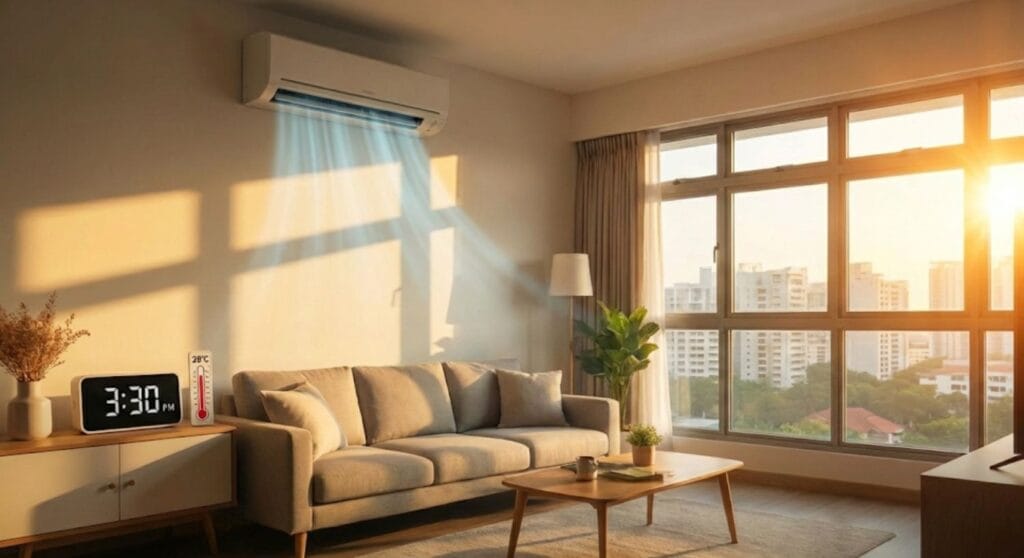
West-Facing HDBCondo The Afternoon Heat Survival Guide for Your Aircon

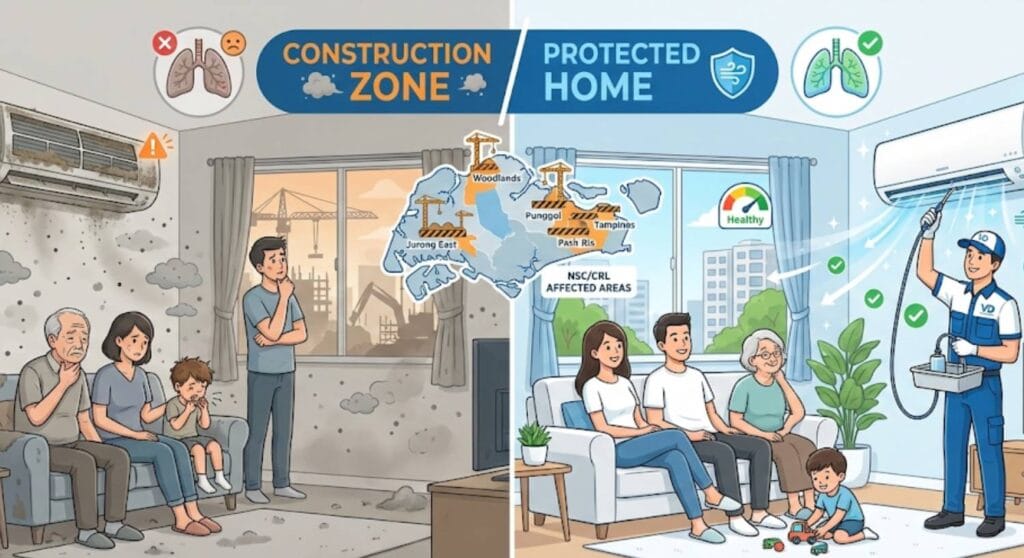
Why Your Aircon Smells Different After Haze Season (And What’s Actually in Your Filters)

Every year, sometime between July and October, the skies over Singapore turn grey. The familiar acrid smell drifts in. PSI numbers climb. You seal your windows, crank up the aircon, and wait it out. Then the haze clears. The skies turn blue again. Life returns to normal. Except your aircon doesn’t smell quite right anymore. It’s not the usual musty aircon smell of a unit that needs servicing. It’s something else. A slight burnt quality. A heaviness in the air that wasn’t there before. Sometimes it triggers sneezing or a scratchy throat that you didn’t have during haze season itself. That smell is telling you something important. Your aircon absorbed weeks of haze pollution, and now it’s releasing it back into your home, one cooling cycle at a time. This guide explains exactly what accumulated in your aircon during haze season, why it smells different from normal dust and mould, and what it takes to properly clean it out. What Actually Happens to Your Aircon During Haze Most people assume their aircon protects them from haze. Seal the windows, turn on the aircon, stay indoors. Safe, right? Partially. But there’s a critical detail most people miss. Your aircon doesn’t pull air from outside. Split-system aircons, which are what virtually every Singapore home uses, recirculate indoor air. The indoor unit draws air from your room, cools it, and pushes it back out. The outdoor unit handles heat exchange but doesn’t pump outdoor air inside. So where does the haze come from? It seeps in. Through gaps around windows. Under doors. Through the gap where your aircon pipes enter the wall. Through the building’s ventilation system. Every time you open your front door, haze particles rush in. Once inside, those particles circulate. Your aircon draws them in, passes them through the filter, and most of the larger particles get trapped. But here’s the problem: the particles that make haze dangerous are the smallest ones, and standard aircon filters don’t catch them effectively. What your filter catches: Dust, hair, larger debris, some pollen What passes through: PM2.5 particles, the fine particulate matter that defines haze pollution Those PM2.5 particles, smaller than 2.5 micrometres, pass through your mesh filter like sand through a tennis racket. They settle on the evaporator coils, accumulate in the drainage tray, and coat the interior surfaces of your aircon unit. Over a typical haze season lasting 4-8 weeks, your aircon accumulates a significant layer of this material. And unlike normal dust, this residue doesn’t just sit there passively. What’s Actually in Haze (And Now in Your Aircon) Singapore’s haze comes primarily from peat and forest fires in Indonesia’s Sumatra and Kalimantan regions. When peat burns, it releases a cocktail of pollutants far more complex and toxic than ordinary wood smoke. The primary component: PM2.5 Fine particulate matter makes up approximately 90% of the particle mass in haze smoke. These particles are small enough to penetrate deep into human lungs and even enter the bloodstream. They’re what makes haze a health hazard, not just a visibility problem. Research on Indonesian peat fire smoke has identified the following components: Gases: Particulate components: Heavy metals: The heavy metals are particularly concerning. Research published in Environmental Science & Technology found that when fires burn through areas with structures, vehicles, or infrastructure, the smoke contains elevated levels of copper, lead, zinc, and nickel. Indonesian fires frequently burn through agricultural areas with equipment, buildings, and treated materials. Why peat smoke is worse than regular smoke: Peat fires are fundamentally different from forest fires. Peat is partially decomposed organic matter that has accumulated over thousands of years. When it burns, it smoulders rather than flames, producing incomplete combustion that releases far more particulate matter and toxic compounds. A study published in Nature Communications found that PM2.5 from wildfire smoke causes 1.3 to 10% increases in respiratory hospitalisations per 10 μg/m³ increase, compared to only 0.67 to 1.3% for the same concentration of non-wildfire PM2.5. The smoke is measurably more toxic than equivalent concentrations of urban air pollution. This is what’s coating the inside of your aircon. Why It Smells Different From Normal Dirt Normal aircon smell, the musty odour you get from a neglected unit, comes from mould and bacteria growing in the damp environment of the evaporator coils and drainage tray. It’s biological. It smells like mildew or a damp basement. Post-haze smell is different. It has a slight burnt quality, sometimes described as smoky, acrid, or chemical. That’s because the residue contains actual combustion products, not just biological growth. The smell comes from: Organic compounds trapped in the residue that slowly off-gas when the aircon runs. These include volatile organic compounds (VOCs) from the original smoke that were absorbed into the particulate matter and are now releasing over time. Tar balls, which are spherical carbonaceous particles that form during biomass burning. They’re essentially tiny droplets of partially burned organic material that continue to release compounds as they age. The interaction between haze residue and the mould that grows on it. Haze residue provides nutrients and surface area for biological growth. The combination produces odours that neither component would produce alone. The timeline matters: Right after haze season ends, you might not notice much change. The residue is fresh and relatively stable. Over the following weeks, as the aircon runs through heating and cooling cycles, as humidity fluctuates, and as biological activity begins, the smell develops. This is why people often notice the problem in November or December, weeks after the haze has cleared. What Happens If You Don’t Clean It Left untreated, haze residue in your aircon creates several problems: 1. Continuous low-level exposure Every time your aircon runs, it circulates air over that contaminated residue. Fine particles that settled on coils become resuspended. Trapped compounds off-gas into your room air. You’re breathing diluted haze pollution months after the haze ended. This isn’t theoretical. Studies have documented that indoor air quality remains compromised long after outdoor haze clears, precisely because HVAC systems retain

Why Your Aircon Smells Different After Haze Season (And What’s Actually in Your Filters) Read More »

The 3AM Aircon Breakdown What to Actually Do (And What Can Wait Till Morning)

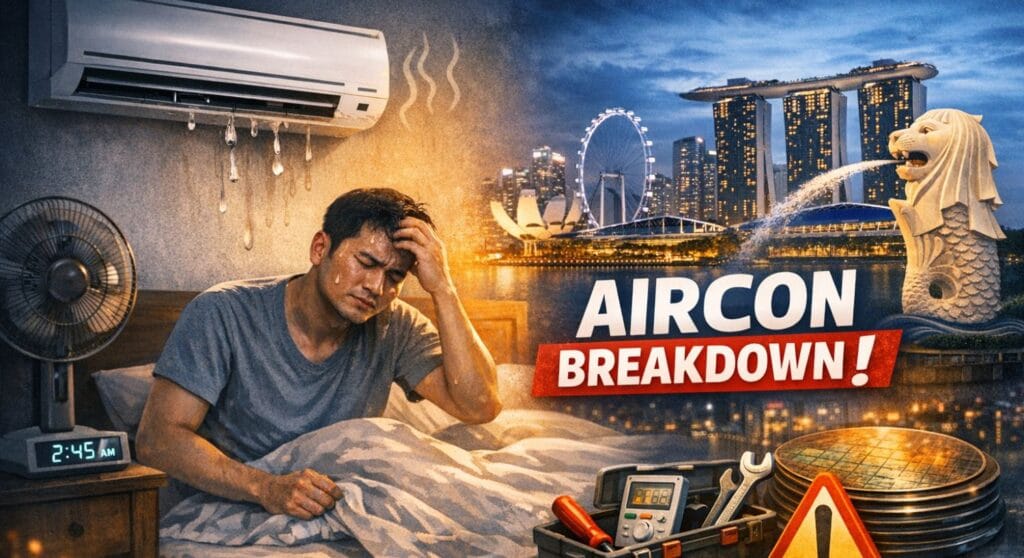
The 3AM Aircon Breakdown: What to Actually Do (And What Can Wait Till Morning)

It’s 3am. You wake up sweating. The room feels wrong. You reach for the remote, press the button, and nothing happens. Or worse, the aircon makes a sound you’ve never heard before, then goes silent. Your mind races. Is this an emergency? Should you call someone now? Will you survive the night? How much is this going to cost? Take a breath. Most 3am aircon situations aren’t emergencies. They feel urgent because you’re hot, tired, and not thinking clearly. But very few require immediate action in the middle of the night. Knowing the difference saves you money on emergency call-out fees and prevents panic decisions you’ll regret. This guide walks you through exactly what to do when your aircon fails at the worst possible time, what problems genuinely need immediate attention, what can safely wait until morning, and how to get through the night without air conditioning in Singapore. First: The 60-Second Assessment Before you do anything else, answer these four questions: 1. Is there a burning smell or visible smoke? If yes, this is an actual emergency. Turn off the aircon at the circuit breaker, not just the remote. Open windows. If smoke is significant, leave the room. This is the only aircon situation that might warrant calling emergency services. 2. Is water actively flooding your room? Not dripping. Flooding. If water is pouring out and threatening to damage flooring, furniture, or electronics, you need to act now. Otherwise, a drip can wait. 3. Is the circuit breaker tripping repeatedly? If your aircon keeps tripping the breaker every time you reset it, stop trying. Repeated tripping indicates an electrical fault that shouldn’t be ignored. Leave it off until morning. 4. Is anyone in the household medically vulnerable? Infants, elderly family members, or anyone with heart conditions or respiratory illness may genuinely need cooling. This changes the urgency calculation. If you answered “no” to all four questions, you almost certainly don’t need emergency service tonight. You need a plan to get through the next few hours and a phone call in the morning. What Genuinely Needs Immediate Attention These situations are rare, but they exist. If you’re experiencing any of the following, you have a legitimate reason to seek emergency help: Burning smell or smoke A burning smell from your aircon can indicate electrical problems, overheating motors, or melting components. This is the one situation where the risk of fire makes immediate action necessary. What to do: A burning smell doesn’t always mean fire, but it means something is wrong enough that the unit shouldn’t run until inspected. This can wait until morning for a technician, but the unit must stay off. Repeated circuit breaker tripping If your aircon trips the breaker once, it might be a random fluctuation. Reset it and try again. If it trips the breaker twice in a row, something is wrong. The breaker is doing its job, detecting a fault and cutting power to prevent damage or fire. What to do: Active water flooding A small drip is annoying but not an emergency. Significant water flow that’s damaging property or creating electrical hazards is different. What to do: Most leaks can be managed overnight with towels and containers. The damage from a few hours of dripping is minimal compared to the cost of emergency call-out. Medical necessity For most healthy adults, one night without aircon is uncomfortable but not dangerous. For certain people, it’s different. Who may genuinely need cooling: If someone in your household falls into these categories and there’s no way to keep them cool, consider temporary alternatives before calling emergency service. What Can Definitely Wait Until Morning These situations feel urgent at 3am but genuinely don’t need overnight attention: The aircon simply stopped working No dramatic symptoms. It just stopped. The room is getting warm, but nothing is on fire, flooding, or making scary noises. This is the most common 3am scenario, and it’s not an emergency. Something failed, a capacitor, a sensor, a control board, but the failure itself is complete. Calling someone now versus 8am doesn’t change the outcome. The unit needs repair either way. The aircon is running but not cooling The fan blows, you hear the normal sounds, but the air isn’t cold. This usually indicates low refrigerant, a compressor issue, or dirty coils. None of these get worse overnight. The problem that exists at 3am will be the same problem at 9am. Water is dripping (not flooding) A drip means blocked drainage, often fixable with basic service. Put a container under it, lay a towel, and call in the morning. The volume of water from overnight dripping is typically a litre or two, easily contained. The unit is making unusual noises Clicking, buzzing, rattling, or grinding sounds are concerning but not dangerous. They indicate worn bearings, loose components, or refrigerant issues. Turn the unit off so the noise doesn’t worsen the underlying problem, and address it tomorrow. The remote isn’t working Before assuming the worst, check the batteries. Replace them and try again. If that doesn’t work, try the manual button on the unit itself (usually hidden behind a panel). If the unit responds to manual operation, your problem is the remote, not the aircon. Error codes or blinking lights Modern aircons display error codes when something’s wrong. The unit has detected an issue and shut down to protect itself. This is the system working as designed. Note the error code (photograph it), turn the unit off, and report it to the technician in the morning. The 3AM Troubleshooting Checklist Before you panic, run through these basic checks. Many 3am “breakdowns” have simple causes. Check 1: Power supply Is the aircon the only thing without power? Check: If your whole home or area has lost power, the issue isn’t your aircon. Check 2: Remote control The most common “my aircon won’t work” problem is dead batteries. Check 3: Timer settings Did the unit turn off because it was scheduled to? Check: Check 4: Filter obstruction If

The 3AM Aircon Breakdown: What to Actually Do (And What Can Wait Till Morning) Read More »

HDB corner unit aircon

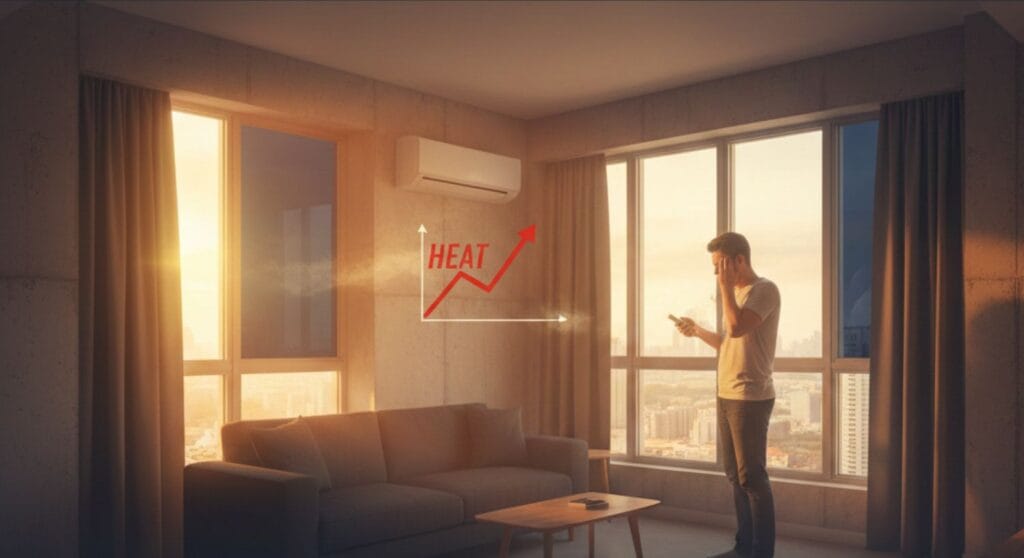
Aircon for Corner Units: Why Your HDB Corner Flat Gets Hotter (And What to Do About It)

You paid more for that corner unit. Extra windows. Better views. More natural light. What nobody told you? Your flat turns into a sauna by 2pm. We talk to HDB owners every week. Corner unit complaints come up again and again. “My aircon runs non-stop but room still warm.” “Electricity bill jump $80 last month.” “The bedroom facing west is impossible after 3pm.” Sound familiar? Here’s the thing. Your corner flat isn’t broken. Your aircon probably isn’t faulty either. The problem is physics. And most aircon setups don’t account for it. Why HDB Corner Units Heat Up More Than Middle Flats A middle unit HDB flat shares walls with neighbours on both sides. Those shared walls act like insulation. Your neighbour’s aircon keeps their flat cool, and that coolness actually helps your walls stay cooler too. Corner units don’t get this benefit. You have two or three walls directly exposed to outside. Sun hits these walls from morning till evening. By afternoon, the concrete has absorbed hours of heat. That heat radiates into your rooms even after the sun moves away. Building and Construction Authority data shows external walls in Singapore can reach 45°C to 50°C on hot afternoons. That’s not the air temperature. That’s your wall temperature. And that wall is pushing heat into your living room while your aircon fights to push it back out. The numbers are rough but real: corner units receive approximately 20-30% more heat load than equivalent middle units. Your 9000 BTU aircon that works perfectly fine in your friend’s middle-unit bedroom? It’s struggling in yours. Not because it’s weak. Because it’s undersized for your actual conditions. The West-Facing Problem (It’s Worse Than You Think) Corner unit facing west? You got the hardest combination. Afternoon sun in Singapore is brutal. We’re talking peak UV hours between 2pm to 5pm hitting your walls and windows directly. The sun angle during these hours means maximum heat penetration through glass. I’ve seen bedrooms where the aircon is set to 18°C and the room still feels 25°C. Owner thinks compressor is dying. Actually the unit is working at full capacity. It just cannot overcome the heat coming through that west-facing window faster than it can remove it. One Tampines flat we visited last year had this exact situation. Master bedroom with floor-to-ceiling windows facing west. They were running a 12000 BTU unit and still sweating. The issue wasn’t the aircon. The issue was 4 hours of direct afternoon sun on 8 square metres of glass. What Actually Happens to Your Aircon When your aircon works harder than designed, several things happen. None of them good for your wallet. The compressor runs longer cycles. Instead of cooling the room and resting, it keeps running trying to reach your set temperature. This means higher electricity consumption. We’re talking 15-25% more energy usage compared to same unit in a middle flat. Components wear out faster. The compressor, being the most expensive part, takes the most stress. Normal lifespan for a well-maintained compressor is 10-12 years. In an overworked corner unit setup, I’ve seen them fail at 6-7 years. Your servicing needs increase too. Filters clog faster because the unit runs more hours. Coils work harder and accumulate dirt quicker. That quarterly servicing schedule? Corner unit owners should consider doing it every 2-3 months during peak hot season. Fixing the Corner Unit Heat Problem So what works? Let me go through the options from simple to more involved. Get Your BTU Sizing Right Standard calculation says 65 BTU per square foot for Singapore bedrooms. That formula assumes middle unit conditions. For corner units, bump it up. West-facing corner bedroom? Calculate for 80-90 BTU per square foot. A 120 square foot room that would normally need 9000 BTU now needs 10000-11000 BTU minimum. Yes, this means your existing unit might be undersized. Doesn’t mean you must replace immediately. But when upgrade time comes, size up. Window Films and Curtains Actually Help I know, I know. Everyone says this. But hear the numbers first. Quality solar window film blocks 40-70% of heat coming through glass. A $200-400 investment for a bedroom window can reduce your aircon workload noticeably. Your unit cycles less. Your bills drop. The film pays for itself within a year for most corner unit owners. Blackout curtains add another layer. Not as effective as film but they help, especially for west-facing rooms. Close them by 1pm before the worst heat hits. Strategic Aircon Placement Matters Where your indoor unit sits affects performance more than people realise. Worst placement: directly opposite your hottest window. The unit blows cold air that immediately hits the hot glass surface, warms up, and rises. You feel warm air circulating instead of cooling. Better placement: on a wall perpendicular to your window. Cold air circulates around the room before hitting the hot surfaces. More efficient cooling pattern. If your unit is already installed in a bad spot, redirecting the louvers can help somewhat. Point them away from windows, let cold air flow along the ceiling first. Maintenance Cannot Be Skipped A dirty filter in a corner unit is worse than a dirty filter in a middle unit. Because your system is already working harder, any efficiency loss hits you more. Chemical cleaning once a year is not optional for corner units. The coils need to be properly cleaned to maintain heat transfer efficiency. Skipping this means your already-stressed system becomes even less effective. Gas levels matter too. Low refrigerant means your compressor works harder to achieve less cooling. In an already hot corner unit, this becomes a compounding problem. The Honest Truth About Expectations We need to be straight with you. No aircon setup will make your west-facing corner unit feel like an underground basement. Physics has limits. What proper setup and maintenance can do: make your space comfortable, keep your bills reasonable, and extend your equipment lifespan. You won’t be sweating in your own bedroom. Your aircon won’t sound like it’s dying every afternoon. The

Aircon for Corner Units: Why Your HDB Corner Flat Gets Hotter (And What to Do About It) Read More »