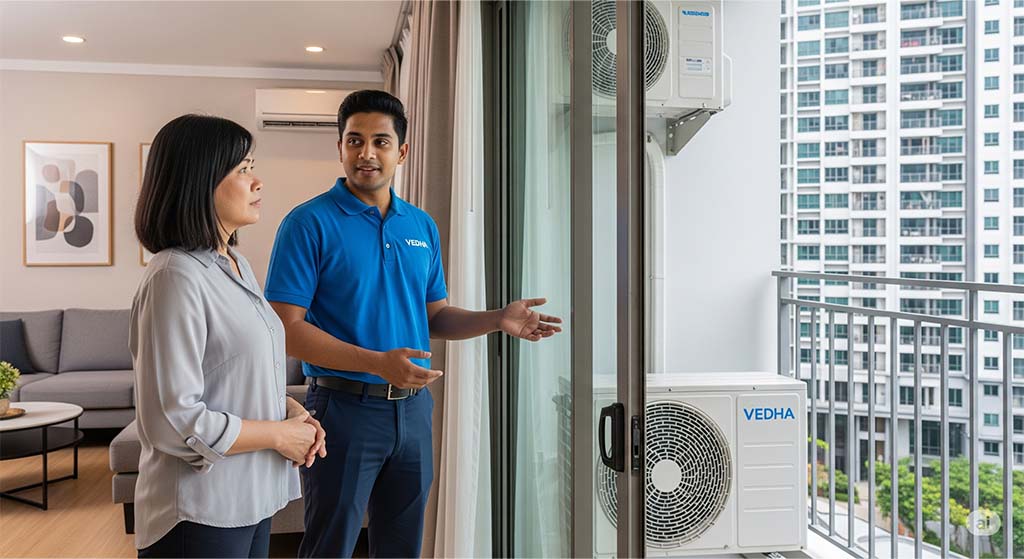
Singapore is asking everyone to set the aircon to 25°C. The Go25 movement, backed by NEA and the Building and Construction Authority, is the reason you have started seeing 25°C on office walls and in the news. The advice is sound and it saves real money. We ran those numbers in our piece on what 25°C does to your bill.
This article is about the other half. Because the honest truth is that for a lot of people, 25°C feels warm at first, and they give up and drop it back to 21. That is a comfort problem, and comfort problems have fixes that have nothing to do with the temperature number. We fix these in homes every week, usually with no parts and no big bill. Here is exactly how to stay cool at 25°C.
Start with a fan. It is the whole trick.
If you take one thing from this article, take this. Moving air makes your skin feel about 2 to 3 degrees cooler than the actual room temperature, because it helps your sweat evaporate. A room at 25°C with a fan running feels like 22 or 23°C with still air. And a fan costs a few cents a day to run, next to nothing beside the compressor.
So the base setup for a comfortable Singapore room is simple. Aircon at 25°C, fan on low or medium. That pairing beats 22°C with no fan, for comfort and for cost, every time.
Use the fan properly. A ceiling fan should push air down and out across the room, not sit idle. A standing fan works best angled across the sofa or the bed where people actually are, not pointed at a wall. In a bedroom, a fan on low aimed along the bed carries the cool air over you instead of letting it pool on the floor. Cold air sinks, so without something to move it, the coolest air in your room ends up around your ankles while your upper body feels warm.
Learn your Dry mode. Most people never touch it.
Your remote has a Cool mode, a Fan mode, and a Dry mode, usually a water-drop symbol. Almost nobody uses Dry mode, and that is a mistake in a climate like ours.
Here is the difference in plain terms. Singapore rarely feels hot because the air is truly hot. It feels hot because it is wet. On a grey, rainy evening the temperature outside drops to 26 or 27°C, but the humidity climbs toward 90 percent, and the room feels sticky and heavy even with the aircon on. That is a humidity problem, not a heat problem, and Cool mode is the wrong tool for it.
Dry mode is built for exactly that. It runs the compressor in short bursts and the fan on low, and it pulls water out of the air while barely cooling. It draws far less power than Cool mode, often only a third to a half, and it removes roughly twice as much moisture for every unit of electricity. Strip a muggy room down to drier air and it feels cool at 26°C, because dry air lets your body shed heat. Use Dry mode on rainy days, muggy evenings, and early mornings when the air is damp but not baking.
Now the honest limit, because this is where cheaper advice online gets it wrong. Dry mode does not cool a genuinely hot room. At 2 or 3 in the afternoon with the sun on your wall and the room at 32°C, Dry mode cannot shift that much heat fast enough. That is a job for Cool mode at 25°C with the fan on. Match the mode to the weather. Dry for sticky, Cool for hot.
Aim the air. Cold air falls, so point it right.
We get called to homes where the aircon “does not reach the sofa,” and half the time the unit is fine. The airflow is just aimed wrong.
Cold air is heavy and drops. If your louvres are pointed straight down, the cold air falls to the floor right under the unit and never crosses the room. Set the horizontal louvres flat or slightly upward so the air throws out across the room and mixes as it settles. Many newer units help with this on their own. Daikin’s Coanda airflow on the iSmile Eco+ series lifts the air along the ceiling before it drops, and most brands have a wide or comfort airflow setting that does something similar. Turn it on.
A family in Woodlands told us their new Daikin could not cool the living room. Nothing was broken. The louvres were aimed straight at the floor, and a tall curtain was hanging across half the unit, soaking up the airflow. We flattened the louvres, switched on the wide airflow mode, and moved the curtain rail. The room cooled evenly that afternoon, no parts, no charge beyond the visit. People pay for a repair when they needed the air pointed the right way.
Set it and let it settle. Do not chase the cold.
The most common mistake we see is the panic drop. The room feels warm, so the setpoint goes to 18, and twenty minutes later it is freezing near the unit and still warm across the room, so someone turns it off, and then it is warm again. Stop doing that.
Set 25°C and give it fifteen to twenty minutes to bring the whole room down and pull the humidity out. Comfort comes from the room reaching a steady, dry state, not from a blast of cold air on your side of the sofa. At night, use the sleep or timer mode. Your body needs less cooling after the first couple of hours of sleep, so a unit that eases off through the night keeps you comfortable and cuts the bill at the same time. For most people 25 to 26°C with a fan on low is the sweet spot for sleeping.
Seal and shade the room you are cooling
An aircon fighting a leaky, sun-baked room will always struggle, whatever the setpoint.
Close the door of the room you are cooling, and block the gap under it if there is a big one. Draw the curtains on any window taking direct sun, especially west-facing rooms that cook from about 3pm. A light blackout curtain or a reflective window film cuts the heat coming in and makes 25°C hold easily. Do not cool rooms nobody is in. Shut them off and let the aircon do a smaller job well.
A retiree in a Bukit Timah landed home could not get her west-facing study below stuffy in the afternoon, even on Cool mode. Two things were wrong. The window had full sun and no shade, and the outdoor condenser had been boxed in behind a storage rack with no room to breathe, so it ran hot and weak. We cleared the space around the condenser, and she added a reflective film and a curtain. The room holds 25°C now through the afternoon. Shade and airflow did what a colder setpoint never could.
Keep the unit able to do its job
Here is the part that ties back to the machine on your wall. Everything above assumes your aircon actually dehumidifies. A unit with a coil choked in grime, or one low on gas, does not pull water out of the air properly. It just blows cool, damp air, and the room feels clammy no matter what mode you pick. When that happens, no fan or curtain will save it.
If your room stays sticky at 25°C even with the fan on and the door shut, the unit needs attention, not a colder setting. A general service at $30 to $40 a unit clears a dusty coil. A chemical wash at $110 to $130 restores a coil that has stopped dehumidifying. And furniture matters too. A sofa or a shelf pushed up against the fan coil chokes its airflow, so give the indoor unit clear space to throw air, and keep the outdoor condenser clear of clutter so it can dump heat.
What we will not do
People call us clammy and ready to pay for a chemical overhaul, and often they do not need one. We will not sell you a big service when re-aiming the louvres, switching to Dry mode on a wet evening, and adding a $40 fan fixes the comfort for free. We tell you the free fixes first. If the unit genuinely is not dehumidifying, we say so and show you the coil. Either way you get the truth, not the biggest invoice.
The short version
Staying cool at 25°C in Singapore comes down to a handful of habits. Run a fan so the air feels 2 to 3 degrees cooler than it reads. Use Dry mode on muggy, rainy days and Cool mode when the room is truly hot. Aim the louvres flat so the cold air crosses the room instead of falling at your feet. Give the room a chance to settle, use sleep mode at night, and shade the windows that cook in the afternoon. Do those, and 25°C feels genuinely cool and dry, not warm.
If you have tried all of that and your room still feels sticky, that is your unit telling you it cannot dehumidify anymore. Call or WhatsApp us on 9654 0044 or 9644 0652, or email sales@vdairconservices.com, and we will get it back to pulling the moisture out, so 25°C feels the way it is meant to.
VD Aircon Services has installed and serviced more than 40,000 units across Singapore since 2016. We are BCA-registered and NEA-registered for refrigerant handling, and we service every major brand for HDB, condo, landed and commercial properties islandwide. Office: 11 Mandai Estate #02-04 ELDIX, Singapore 729908. Call or WhatsApp 9654 0044 or 9644 0652, or email sales@vdairconservices.com.

We specialize in Aircon installation, repair, and service. We have all type & model of recon compressor, full set & fancoil. Our technicians are highly proficient in their respective field and repairs and fixes aircon of various brands.