On 28 May 2026 NEA announced a new set of measures to cut greenhouse gas emissions from refrigeration and air-conditioning equipment. Within days we started getting the question, usually some version of the same one. Is R32 being banned. Will my unit become illegal. Should I replace it before the rule kicks in.
No, no, and no.
Here is what the announcement actually covers, and then the part of this story that does concern you, which nobody has written about.
What changed, and for whom
NEA sets a ceiling on the Global Warming Potential of the refrigerant that equipment uses. GWP is a number comparing how much a gas warms the atmosphere against carbon dioxide, which sits at 1. Lower is better.
| Equipment | GWP limit | In force from |
|---|---|---|
| Household split aircon up to 17.6 kW, inverter and non-inverter | 750 | 1 October 2022 |
| Household refrigerators up to 900 litres | 15 | 1 October 2022 |
| Water-cooled chillers of 1,055 kW and above | 15 | 1 October 2022 |
| Centralised commercial refrigeration, the kind supermarkets run | 150 | 1 July 2027 |
| Passenger cabin aircon in new cars, taxis and light goods vehicles | 150 | 1 July 2028 |
Read the first row again. The limit on your home aircon came into force nearly four years ago. Nothing about it changed in May.
What NEA announced were the last two rows, plus transport refrigeration, plus a registration and disposal framework for the companies that install, maintain and decommission those systems, starting 1 July 2027.
Supermarket chillers. Cold rooms. Refrigerated trucks. Car aircon.
None of that is on your ledge.
Why your unit already complies
The GWP limit for a household split system is 750. R32 has a GWP of 675, so it clears. R410A, the refrigerant that dominated before, sits at 2,088, so it does not.
That is the entire reason R32 took over the Singapore market. Not because anyone mandated R32 specifically, whatever you may have read. NEA set a number and R32 is the refrigerant the manufacturers reached for that comes in under it. If someone develops something cheaper with a GWP of 400 tomorrow, that clears the same bar.
This distinction matters, because the version going around, that NEA mandates R32 for new single-split installations, is wrong in a way that leads people to the wrong conclusion. A ceiling on GWP is not a ban on everything except one gas. It is a ceiling.
There is also a line on NEA’s own page that settles the anxiety completely. Goods supplied before the effective date are not affected. Your R410A unit from 2018 is legal, it stays legal, and you can keep servicing it and topping it up for as long as it makes sense to.
So if someone quotes you for a refrigerant compliance upgrade
They are selling you something that does not exist.
We have not seen this yet in Singapore, but we have seen the equivalent after every regulatory announcement for the past decade. A rule lands, it gets summarised badly, and somebody turns the confusion into a job. If a technician tells you your home aircon needs converting, retrofitting or replacing because of the May announcement, ask them which row of that table applies to a residential split unit.
There isn’t one.
Now the part that does concern you
Here is what we found reading NEA’s framework properly, and it is not what we expected.
NEA has a category called regulated GHG works. If your company installs, maintains or decommissions certain equipment, you must register with NEA as a GHG entity, follow set procedures, recover the spent refrigerant instead of releasing it, send it to an NEA-authorised treatment facility, and keep records that NEA can inspect. Fines run to $10,000 and, for some offences, up to three months’ imprisonment.
Which equipment is on that list? Water-cooled chillers, since October 2022. From July 2027, centralised commercial refrigeration, industrial cold rooms, car and LGV aircon, and transport refrigeration units.
Household air-conditioning is not on that list.
There are obligations further down the chain. Under the Resource Sustainability Act, e-waste recyclers have to remove refrigerants with a GWP above 15 from the equipment they process. Refrigerant treatment facilities need a Toxic Industrial Waste Collector licence from NEA. So the destination is regulated.
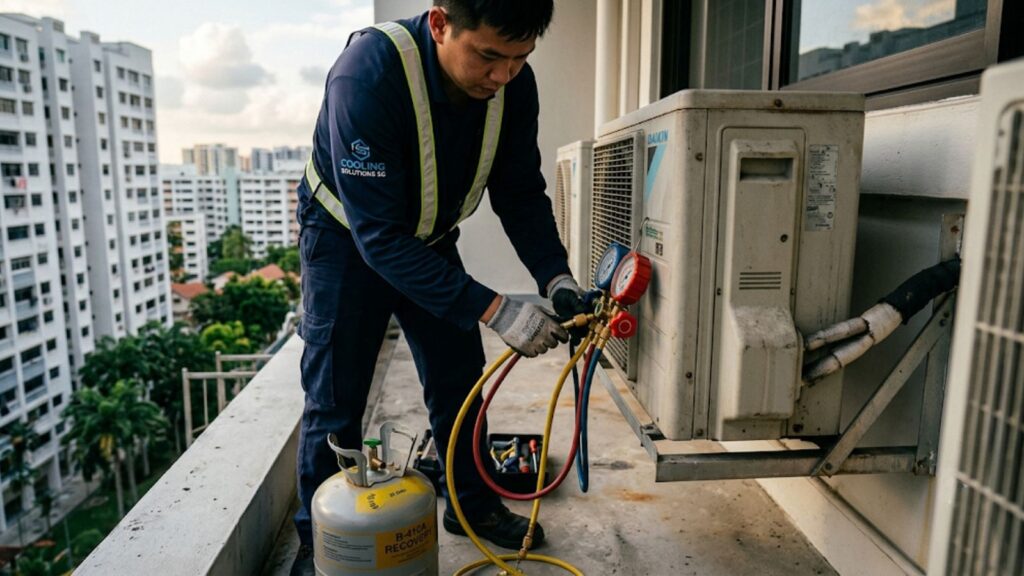
The step before that is not. When a technician removes your old System 3 from the ledge, no registration requirement, no recovery obligation and no record-keeping duty attaches to that company the way it does to a chiller contractor. Whether the R32 in your unit gets pumped into a recovery cylinder or vented into the air above the carpark comes down to that company’s own standards and the equipment in their van.
We recover it. Recovery kit costs money and takes time on a job, which is exactly why not everyone does. We are not going to pretend the whole trade is disciplined about this, because it is not, and the regulation that would force the issue stops short of us.
If that sounds like an odd thing for an aircon company to put on its own website, fair enough. But you asked what the news means, and this is the honest answer. The rules tightened around commercial refrigeration and left residential servicing where it was.
The one thing you can actually check
This is the practical takeaway and almost nobody knows it exists.
R32 is mildly flammable. Because of that, SCDF requires manufacturers to ensure that service personnel working on R32 systems have completed training run by ITE, specifically the Certificate of Competency in Residential Air-Conditioning System (Refrigerant).
NEA publishes the list of technicians who have completed that course. It sits on their website as a PDF, updated periodically, most recently in July 2026.
You can look up the person standing in your living room.
We are not suggesting you demand certification papers from every technician who walks through your door. But if you have had a bad experience, if a quote feels wrong, or if you are handing a stranger a job that involves opening a pressurised system in your home, that list is public and it takes two minutes.
What to ask before someone touches your refrigerant
Three questions, and you can tell a lot from how they are answered.
Are you recovering the gas or venting it? A company that recovers will say so immediately, because they are proud of it and because the cylinder is in the van.
Is anyone on this job ITE-certified for R32 handling? A straightforward yes or no.
What refrigerant is currently in my system, and how do you know? If the answer is a guess rather than a look at the nameplate, that tells you what kind of job you are about to get.
None of this is about the May announcement. That is our point. The regulation that made headlines does not reach your home, and the things that actually affect the work done on your unit were never in the headlines to begin with.
If you are getting your unit removed or replaced and you want to know what happens to the refrigerant, ask us before you book anyone, including us. WhatsApp 96540044.

We specialize in Aircon installation, repair, and service. We have all type & model of recon compressor, full set & fancoil. Our technicians are highly proficient in their respective field and repairs and fixes aircon of various brands.