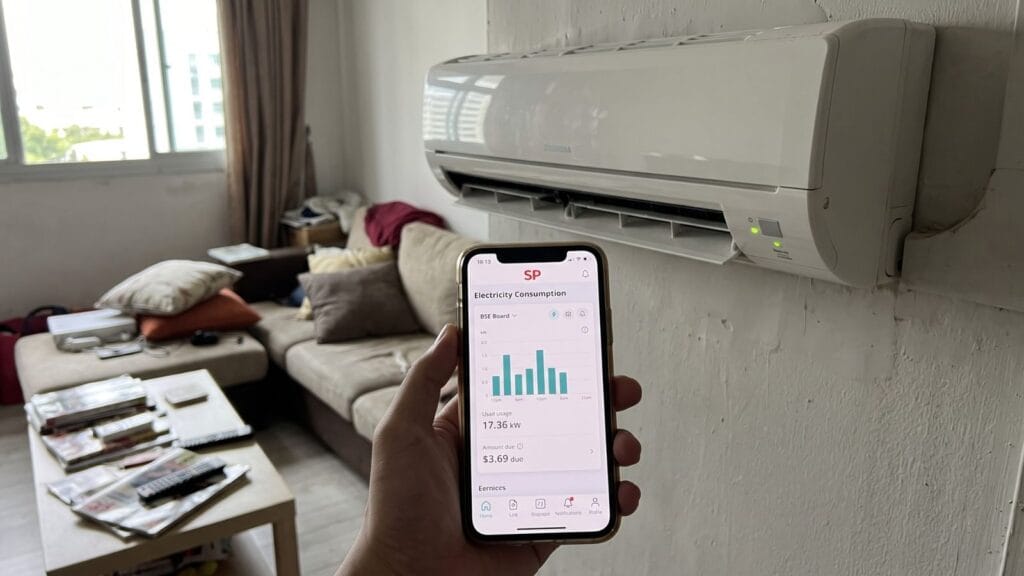
SP Group announced on 30 June that household electricity tariffs would rise 17 per cent for the quarter running 1 July to 30 September 2026. That is 4.64 cents more per kilowatt hour before GST. The regulated household rate is now 31.91 cents per kWh, or 34.78 cents once you add the 9 per cent GST.
Highest it has ever been.
We started getting calls in the third week of July, when the first affected bills landed. Most followed the same script. The bill jumped, the aircon is the obvious suspect, and someone at work or in a Facebook group has already suggested the unit is old and inefficient and should be replaced.
Before you spend two thousand dollars on that theory, here is the arithmetic.
What actually changed
| 1 Apr to 30 Jun 2026 | 1 Jul to 30 Sep 2026 | Change | |
|---|---|---|---|
| Rate before GST | 27.27 cents/kWh | 31.91 cents/kWh | +4.64 cents |
| Rate with 9% GST | 29.72 cents/kWh | 34.78 cents/kWh | +5.06 cents |
Five cents. That is the whole story, repeated across every unit of electricity your home uses.
SP’s own figure is that the average monthly bill for a four-room HDB household goes up by $17.14 before GST, so about $18.68 with it. That covers everything in the flat, not just the aircon.
One thing worth checking before you read further. This tariff is the regulated rate. If you signed up with a retailer under the Open Electricity Market and you are on a fixed price plan, your rate did not move on 1 July. Plenty of people who called us about their July bill were on retailer plans and looking at a completely different cause. Check which one you are on before you blame the aircon.
What it costs on your aircon specifically
These are estimates built from typical power draw on modern split systems in Singapore homes. Your unit will differ depending on room size, insulation, how many people are in the room and what temperature you set. Treat them as a range, not a reading.
| How you run it | Rough aircon use per month | Cost before 1 July | Cost from 1 July | Extra per month |
|---|---|---|---|---|
| One 9,000 BTU fancoil, 8 hours a night | around 145 kWh | $43 | $50 | about $7 |
| Two fancoils, 8 hours a night | around 240 kWh | $71 | $83 | about $12 |
| Older non-inverter single unit, 8 hours a night | around 215 kWh | $64 | $75 | about $11 |
| System 3 running hard across three rooms | around 350 kWh | $104 | $122 | about $18 |
So for most HDB households the tariff hike costs the aircon somewhere between seven and eighteen dollars a month.
That is real money. It is also nowhere near what people think it is when they open the bill, and it is nowhere near enough to justify a replacement system.
The part nobody explains: why July and not March
Here is the bit that confuses everyone, and it is worth understanding because it tells you what happens next.
The Middle East conflict started on 28 February this year. Global fuel prices went up almost immediately. So why did the April tariff barely move, rising only 2.1 per cent, and then July jump 17 per cent?
Because of how the tariff is calculated. SP sets the energy cost portion using average natural gas prices from the first two and a half months of the preceding quarter. The April to June tariff was priced off gas from 1 January to 15 March, which only caught about two weeks of the spike. The July to September tariff was priced off gas from 1 April to 15 June, which caught all of it.
Your July bill is not showing you today’s fuel market. It is showing you what gas cost back in spring.
That lag cuts both ways, and it is the reason we are telling customers not to make a big decision this month.
Where the rebates went
Eligible HDB households got a double tranche of GST Voucher U-Save in July, up to $190 depending on flat type, on top of the double tranche already paid in April. Across the full financial year that comes to up to $570.
It lands automatically in your SP account, which is exactly why most people miss it. There is no notification that feels like money arriving. It just quietly reduces the amount owed, and then the tariff increase eats into it, and the net effect on the bill looks like nothing happened.
If you want to know whether you actually received it, look at the deductions line on your bill rather than the total. Two households can have identical usage and very different final numbers depending on flat type and eligibility.
Our verdict: do not replace a working unit over this
We service aircon for a living. Selling you a new system is the most profitable thing we could do off the back of this news, and we are telling you not to do it. Here is why the numbers do not support it.
A new system does not reverse the tariff. You still pay 34.78 cents per kWh. All a new unit does is change how many kWh you use. If you are replacing a reasonably healthy inverter system with a newer inverter system, the consumption difference is modest, and against a System 2 replacement at two thousand dollars and up, you are looking at a payback period that runs past the point where you would have replaced the unit anyway.
The replacement maths does work in two situations. If you are running a non-inverter unit, or a system past roughly ten to twelve years old where the compressor is drawing well above its rated current, the consumption gap is large enough to be worth acting on. That was true in June and it is still true now. The tariff did not change that decision, it just made it slightly more urgent.
For everyone else, the honest answer is that a fifteen dollar monthly increase is not a capital expenditure problem.
The thing that costs you more than the tariff
Here is what we see on service jobs, and it is the reason we get slightly impatient with the tariff panic.
A fouled evaporator coil and a blocked filter reduce airflow across the coil. Less airflow means the room takes longer to reach your set temperature, which means the compressor runs longer for the same result. A condenser sitting on a ledge caked in dust and lint cannot reject heat properly, so the compressor works harder against higher head pressure and draws more current. Both of these happen slowly enough that you never notice the day it started.
We do not publish a percentage figure for this, because anyone who quotes you a clean number is guessing. Every unit is different. What we do is measure it on site. We check the temperature split between the air going into the fancoil and the air coming out, and we clamp the compressor’s running current. On a neglected System 2 or 3 those readings are usually visibly worse than the nameplate before a chemical overhaul, and visibly better after.
That difference is almost always bigger than five cents per kWh.
Put it this way. The tariff raised your cost per unit of electricity by about 17 per cent, and you cannot do anything about it. A dirty system raises the number of units you consume, and you can. One of those is worth your attention this month.
On the “one degree saves ten per cent” rule
You will see this quoted everywhere, including by people who should be more careful with it. Raising your set temperature by one degree saves around ten per cent on your cooling energy.
It is a reasonable rule of thumb and the direction is right. Every degree closer to the outdoor temperature is less heat your system has to move. But it is a rule of thumb, not a measurement of your flat, and the actual saving depends on your starting temperature, how well your room holds cool air, and whether your unit is short cycling.
The version we would actually stand behind: if you are running at 21 or 22 degrees, moving to 24 or 25 will make a noticeable difference to your bill and most people sleep better for it. If you are already at 25, chasing 26 to save money is not where your remaining savings are.
What we are watching at the end of September
SP said something in the 30 June release that got very little coverage. If the situation in the Middle East improves, global fuel prices and the fourth quarter tariff may come down.
Apply the same lag rule and you can work out roughly when you will know. The October to December tariff will be priced off natural gas prices from 1 July to 15 September. That means the number is effectively already being set right now, and SP will announce it at the end of September.
We are not going to predict it. Nobody sensible would. But if you are sitting on a decision about your aircon and the only thing pushing you is the electricity bill, waiting six weeks costs you very little and gives you actual information instead of a guess.
If your July bill went up by considerably more than the figures in that table, the tariff is not what happened to you. Something changed in how your system is running, and a service visit will tell you what it was faster than a replacement quote will. WhatsApp us at 96540044 with a photo of your bill and your unit’s model number and we will tell you honestly whether it is worth a callout.

We specialize in Aircon installation, repair, and service. We have all type & model of recon compressor, full set & fancoil. Our technicians are highly proficient in their respective field and repairs and fixes aircon of various brands.