Parliament passed the Energy Conservation (Amendment) Bill on 8 April 2026. Enforcement started on 1 July. If you bring an air-conditioner into Singapore for your own use, you now have to register it with NEA first, make sure it meets Minimum Energy Performance Standards, and make sure it carries the energy label. Get it wrong and the fine reaches $10,000 per import.
That sounds alarming. For most people reading this, it changes nothing at all.
Here is the part the headlines have been skipping.
What was actually broken
MEPS and the energy labelling scheme have been running since 2009. They applied to importers, manufacturers and suppliers, meaning the shops and the distributors. If a business wanted to sell you an aircon in Singapore, that model had to be registered and had to clear a minimum efficiency bar.
Nothing covered the person who bought the unit themselves and shipped it in.
Speaking at the second reading on 7 April, Senior Minister of State Dr Janil Puthucheary put it plainly. Regulated goods from local suppliers faced compliance requirements while identical goods imported for own use did not. He also said the volume of such imports may currently be small, but that online marketplaces have made it much easier for consumers to bring goods in directly.
He mentioned something else worth knowing. Since 2023, NEA has been working with Lazada and Shopee to voluntarily take down listings of non-compliant regulated goods. That has been happening quietly for three years. What changed on 1 July is that it now has teeth, and the Minister can make regulations compelling platforms with a Singapore business presence to remove non-compliant listings.
Who this hits and who it does not
| Your situation | Does the new rule apply to you? |
|---|---|
| Buying from a local shop, showroom or aircon company | No. The supplier carries the obligation, same as always. |
| Buying from a Singapore-based seller on Shopee or Lazada | No. They are the supplier. |
| Buying from a cross-border seller who ships direct to you from overseas | Yes. You are the importer. |
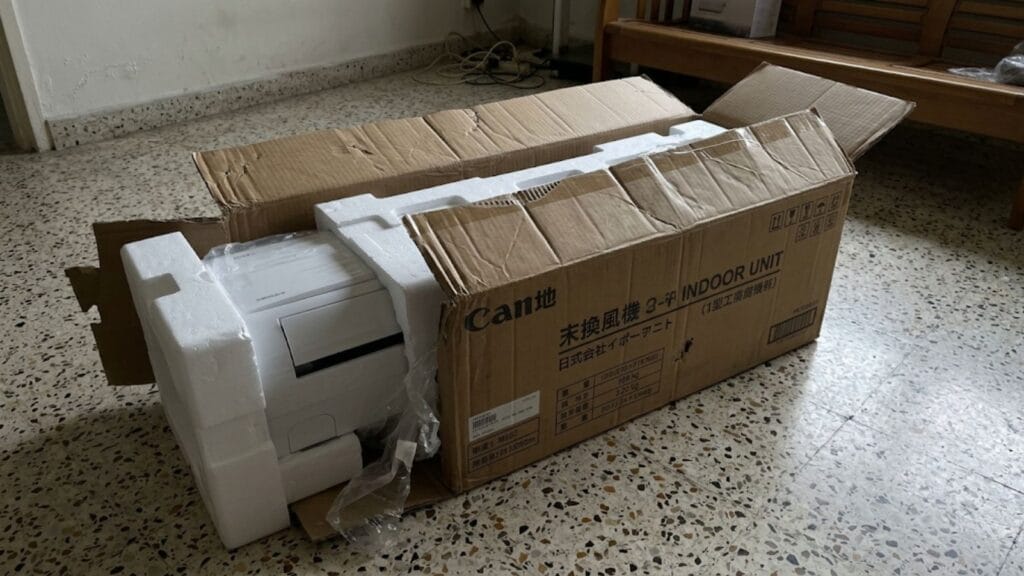
| Ordering from Taobao, or shipping a unit down from Malaysia or Japan yourself | Yes. |
| Buying a second-hand or used unit | No. NEA has excluded second-hand goods, because assessing MEPS compliance on them is impractical. |
| Bringing in a unit for a business you own, to use in your own premises | Yes. Companies importing for own use are covered too. |
Read that table again if you skimmed it. The distinction is not what you bought. It is whether you were the one who brought it into the country.
What registration actually involves
NEA has made this deliberately cheap. Local suppliers pay around $70 per model to register. For end users the fee is waived entirely, because a household cannot spread that cost across hundreds of units. Dr Janil put the effective compliance cost at roughly $1 per unit.
You register online through NEA’s ELS portal using your Singpass. You need a test report on NEA’s own template, and you can rely on test reports from the overseas supplier or manufacturer rather than paying for fresh testing. If a third-party lab did the testing, you need their ISO/IEC 17025 certificate and their accreditation to the relevant test standards. Where the unit uses a flammable refrigerant you may also need in-principle approval from SCDF.
The certificate of registration lasts three years.
Everything on that list is doable. Notice, though, how much of it depends on the overseas seller giving you a proper test report. That is where this quietly falls apart, and we will come back to it.
Our verdict: the paperwork is not the reason to skip this
We have been asked about imported units for years, long before this rule existed, and our answer has not changed. The registration requirement is the least of your problems.
Here is what actually goes wrong.
The unit may not run on Singapore power. Japanese domestic models are built for a 100 volt supply. Singapore runs at 230 volts. That unit does not work here without a transformer, and even with one you are running equipment outside what the manufacturer designed for. Units from China and Malaysia are electrically compatible at 220 to 240 volts, so this one only catches people buying from Japan, but it catches them badly.
The unit was tuned for a different climate. A split system sold in northern China or Japan is designed to spend part of its year heating. Its control logic, its defrost behaviour and its compressor mapping all assume a temperature range Singapore never sees. Running that hardware at 32 degrees ambient, twelve months a year, at high humidity, is not what the engineers had in mind.
Nobody will warrant it. The Singapore agent’s warranty covers units supplied through the Singapore agent. A parallel import is not that. When the compressor fails in year three you are dealing with a seller in another country, in another language, with a shipping bill for a part that weighs more than the shipping is worth.
Parts take weeks, or never arrive. This is the one that bites hardest. We service Daikin, Mitsubishi Electric, Panasonic and the rest because parts for the Singapore models sit in local stock. A PCB for a model that was never sold here is a special order at best.
Your installer may decline the job. Ours does, on some units, and we tell customers why rather than quietly overcharging for the risk. If we cannot get parts and cannot stand behind the equipment, taking the installation job means taking responsibility for something we cannot fix.
So the honest read on this regulation is that it protects buyers more than it restricts them. It closes a gap that was mostly being used by people who did not understand what they were taking on. The government’s own framing is about energy efficiency and life-cycle cost, and that is fair, but the practical effect is that fewer people end up with a unit nobody in Singapore can service.
The second-hand gap
Worth noting, because it is the one genuine hole in the rule. Second-hand and used regulated goods are excluded, on the reasonable grounds that you cannot meaningfully test an old unit against MEPS.
If you are eyeing a used aircon on Carousell, the new rule is not your concern. Something else should be. You are buying a sealed refrigerant system with no service history from someone who has no reason to tell you why they are selling it, and the cost of removing, transporting and reinstalling it lands somewhere near what a new budget unit costs. We have been called out to more than a few of those.
What to check before you buy anything online
Go to NEA’s Database of Registered Goods and search the exact model number. Not the brand, not the series name, the model number as printed on the unit. If it is not there, either it is not registered or the listing is not what it claims to be.
Look for the energy label in the listing photos. Suppliers selling legitimately in Singapore have to show it.
Then ask yourself the question that matters more than any of this. If this unit fails in four years, who is fixing it, and where is the part coming from?
If you have found a listing and you are not sure what you are looking at, send us the model number on WhatsApp at 96540044. We will tell you whether it is a Singapore model, whether we can get parts for it, and whether we would install it. Costs you nothing and takes us a minute.

We specialize in Aircon installation, repair, and service. We have all type & model of recon compressor, full set & fancoil. Our technicians are highly proficient in their respective field and repairs and fixes aircon of various brands.