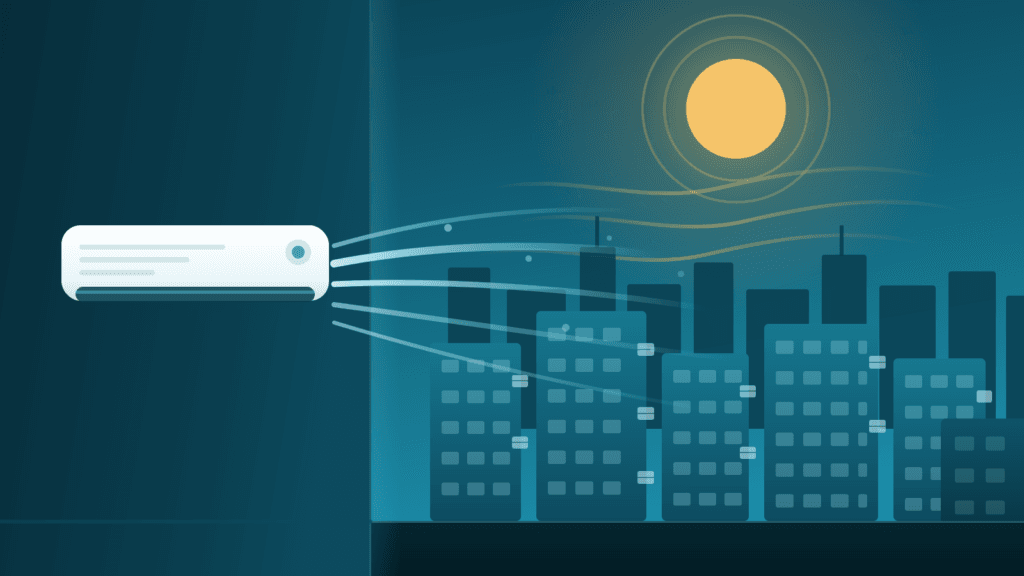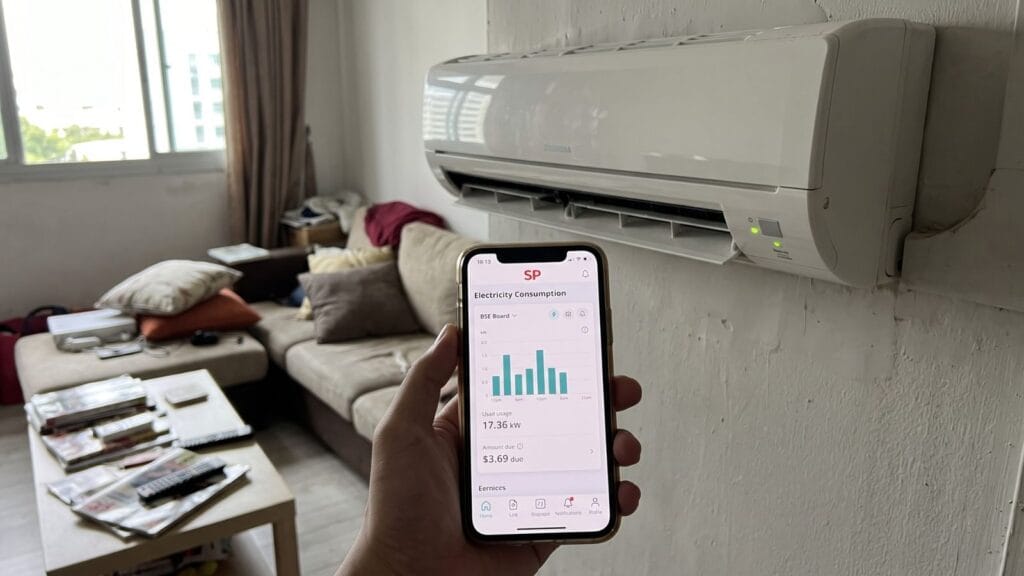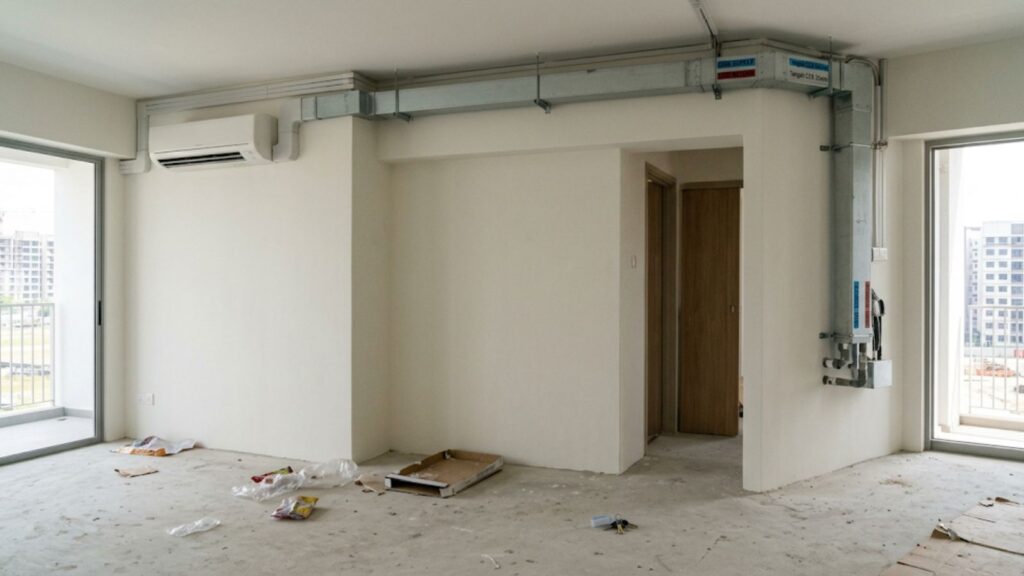
HDB awarded Keppel a second chilled water supply contract on 15 April 2026, covering nine more Build-To-Order projects in Tengah’s Brickland, Park and Forest Hill districts. That is roughly 10,000 more households, on a 20-year contract. Add the three projects Keppel won in September 2024 and about 14,000 households across 12 Tengah projects will be offered a Centralised Cooling System instead of a conventional aircon.
The number that gets repeated in every writeup is that CCS uses up to 30 per cent less energy.
We went and checked what that actually costs a household, using the published rates, and the answer is not the one the number implies.
What CCS is, quickly
Rooftop chiller plants make chilled water. That water is piped down risers, into your flat, and through fan coil units mounted on your walls. A valve opens, water flows through the coil, a fan blows across it, the room gets cold. The warmed water goes back up to the plant.
There is no condenser. Nothing on your ledge. No refrigerant in your flat at all.
If you take CCS, HDB still builds you an aircon ledge, so opting out and installing a conventional system remains possible.
The 30 per cent is real. It is also not your electricity bill.
A big centralised chiller plant is more efficient than fifty small condensers. That is straightforward engineering and we have no quarrel with it.
The catch is who that efficiency belongs to.
You do not buy electricity for your cooling under CCS. You buy chilled water, at a rate the operator sets and publishes quarterly. Whatever the plant saves on energy, what lands on your bill is that rate multiplied by how much cooling you used. The efficiency of the plant is an input to how the rate gets calculated, not a discount applied to your invoice.
So the honest comparison is not efficiency against efficiency. It is dollars per unit of cooling.
The comparison, at today’s published rates
Chilled water is metered in kilowatt-hours refrigeration, written kWrh. One kWrh is one unit of cooling delivered into your flat.
SP Group’s residential chilled water rate for Tengah in Q3 2026 is 10 cents per kWrh, or 10.90 cents with GST.
For a conventional aircon, the cost of one unit of cooling is the electricity price divided by the system’s coefficient of performance. COP is how many units of cooling you get per unit of electricity. Since 1 July the household electricity tariff has been 34.78 cents per kWh including GST.
| How the cooling is produced | Cost per unit of cooling, with GST |
|---|---|
| CCS chilled water, SP rate, Q3 2026 | 10.90 cents |
| New 5-tick multi-split at its rated COP of 5.5 | 6.32 cents |
| The same system running at a real-world COP of 4.5 | 7.73 cents |
| An older or poorly maintained system at COP 3.5 | 9.94 cents |
| A neglected non-inverter system at COP 3.0 | 11.59 cents |
The break-even sits at a COP of about 3.19. Above that, a conventional system delivers cooling more cheaply than CCS. Below it, CCS wins.
Every multi-split system legally sold in Singapore today is rated at a COP of at least 5.50, because that is the minimum performance standard. Real-world performance is always below the rated figure, sometimes well below, but a maintained modern system does not fall to 3.19.
Two things make that comparison slightly kinder to CCS than the table shows. Your fan coil unit’s fan still draws electricity, billed separately on your own account, so add a little to the CCS side. And rated COP is a lab number.
Two things make it harsher. A conventional system’s COP already includes its own fans. And the tariff cuts both ways, which brings us to the interesting bit.
The rate did not move on 1 July
Electricity went up 17 per cent on 1 July 2026. Every household on the regulated tariff felt it.
SP’s chilled water rate did not move at all.
| Period | Rate before GST | With GST |
|---|---|---|
| Q4 2023 | 20.38 cents (as reported at the time) | |
| Q1 2024 | 13.20 cents | 14.39 cents |
| Q2 2024 | 12.20 cents | 13.30 cents |
| Q3 2024 through Q3 2026 | 10.00 cents | 10.90 cents |
Eight consecutive quarters at 10 cents, straight through a 17 per cent jump in the electricity price.
That is genuinely notable, because SP’s own published formula says the rate reflects, among other things, the prevailing residential electricity energy charge. It has not tracked it. CCS subscribers in Tengah were insulated from the tariff hike that everyone else absorbed.
Before 1 July, the break-even COP was about 2.73. Now it is 3.19. The tariff rise closed a chunk of the gap without CCS households paying anything for it.
But look at how that rate got to 10 cents
In October 2023 the rate was 20.38 cents per kWrh. More than 150 Tengah residents signed a petition to the Prime Minister on 27 October that year, raising both the charges and the fees for cancelling.
SP waived usage charges to 31 December, cut the rate to 13.2 cents from 1 January 2024, then to 12.2 cents, then to 10 cents. SP had also revised its published life-cycle savings estimate from 30 per cent down to 17 per cent before restoring the 30 per cent figure once the rate came down.
One resident quoted in The Straits Times at the time made the point better than we can. If the operator can move the rate that far that fast, what stops it moving again.
Nothing does. The rate is reviewed quarterly and the formula includes electricity, water prices, water borne fees, the Consumer Price Index, and the capital and operating cost of the plant. That is a lot of moving parts, and unlike the electricity tariff, there is no EMA sitting over it setting the methodology in public.
The stability since mid-2024 has been good for subscribers. It is not the same thing as a guarantee.
If you are buying now, you are not dealing with SP
This is the part most coverage gets wrong, and it matters.
SP Group runs the CCS for the original Tengah estates. The 2024 and 2026 BTO contracts went to Keppel, and Keppel is a separate commercial relationship. Keppel says its Energy Charge Rate will be published on its own website and updated quarterly. HDB has been explicit that it is not a party to the contract between you and the operator.
So the 10 cents per kWrh figure in the table above is SP’s rate. Do not assume it is Keppel’s. If you are looking at Brickland Weave, Plantation Edge, Plantation Verge, or any of the nine newer projects, get Keppel’s current published rate and its contract terms before you sign anything, and run the same division we did.
Why the leaks happened, explained properly
Tengah’s condensation and leak problems have been reported since 2024 and residents were still describing them in 2026. Shin Min and The Straits Times covered flats with dripping ceilings, blistered paint and water pooling on floors, in some cases with the aircon switched off. Daikin, which installed the fan coil units in the early estates, tripled its rectification team in March 2024. SP has attributed most of the issues to workmanship under a compressed installation timeline.
That is the reporting. Here is the physics, which nobody has bothered to explain.
Any surface colder than the surrounding air will collect water on it in Singapore’s humidity. In a conventional split system, the only cold thing inside your flat is the fan coil itself and a short run of insulated refrigerant pipe, usually on an external wall in trunking. Everything else that gets cold lives outside on the ledge.
Under CCS, chilled water at low temperature runs through your flat to every room that has a fan coil. Flow and return, so two pipes. Through ceilings, along trunking, around corners, past joints. Many more metres of cold surface inside your living space, every centimetre of it needing continuous, correctly fitted insulation.
Get the insulation right and nothing happens. Miss a joint, compress the lagging at a bend, leave a gap where a pipe passes through a wall, and that spot sweats. Then it drips. Then it stains the ceiling above your $60,000 renovation.
This is not an argument that CCS is bad technology. It is an argument that CCS is far less forgiving of rushed workmanship than a conventional installation, because a conventional installation keeps almost all of its cold surfaces outside the flat. That difference is structural, not a teething problem, and it will apply to the nine new projects exactly as it applied to the first three.
Getting out is expensive
Under SP’s terms as reported in 2023, you could cancel within 30 days of signing the installation agreement at no cost. After that but before installation, 35 per cent of the installation charge, which SP halved as a goodwill gesture at the time. Once installed, the full installation fee. The installation charge for four fan coil units was quoted then at $3,992.
Note what that number does to the “lower upfront cost” argument. Four fan coil units at $3,992 is not obviously cheaper than a conventional System 4, which lands in a broadly similar range installed.
Those were SP’s 2023 terms. Keppel’s will be its own. Read them.
Our verdict
CCS is not the money-saver the 30 per cent figure implies, and anyone telling you it is has confused plant efficiency with your bill. On pure running cost per unit of cooling, a well-maintained modern multi-split beats it at today’s rates, and it is not close.
What CCS actually buys you is different, and worth something to some households. No condenser, so no ledge unit to fail, no compressor noise, no neighbour disputes about hot air. Nothing in your flat to service beyond the fan coils. No refrigerant, no gas top-ups, no compressor replacement in year eleven. Cooling working on the day you collect keys. And, on the evidence of the last two years, a rate that has been remarkably steady while electricity has not.
What you give up is control. You cannot change operator, cannot shop the price, cannot get a second quote, and cannot fix a condensation problem yourself or hire anyone who can, because it is inside a system you do not own. If something goes wrong, your recourse is a contract with a utility company rather than a call to a technician who can be on your ledge that afternoon.
That trade is fine if you value not thinking about it. It is a bad trade if you are the sort of person who wants options.
One thing we would say to anyone balloting: do not treat this as an environmental decision on one side and a cost decision on the other. Run the division. Take the operator’s current published rate, divide the electricity tariff by 5.5, and see which number is smaller before you decide.
If you already have CCS
Your fan coil units still need cleaning. Coils foul, filters block, drain pans grow the same things they grow in every other flat in Singapore, and a blocked drain line still ends up on your floor. The absence of a condenser does not make the indoor half self-maintaining, and a fouled coil costs you the same way it costs everyone else, just billed in kWrh instead of kWh.
We service fan coil units, including in CCS homes, and we will tell you plainly if something is the operator’s problem rather than a cleaning problem. Sending you back to Keppel or SP with a clear description of what we found is more use to you than us pretending we can fix it. WhatsApp 96540044.

We specialize in Aircon installation, repair, and service. We have all type & model of recon compressor, full set & fancoil. Our technicians are highly proficient in their respective field and repairs and fixes aircon of various brands.