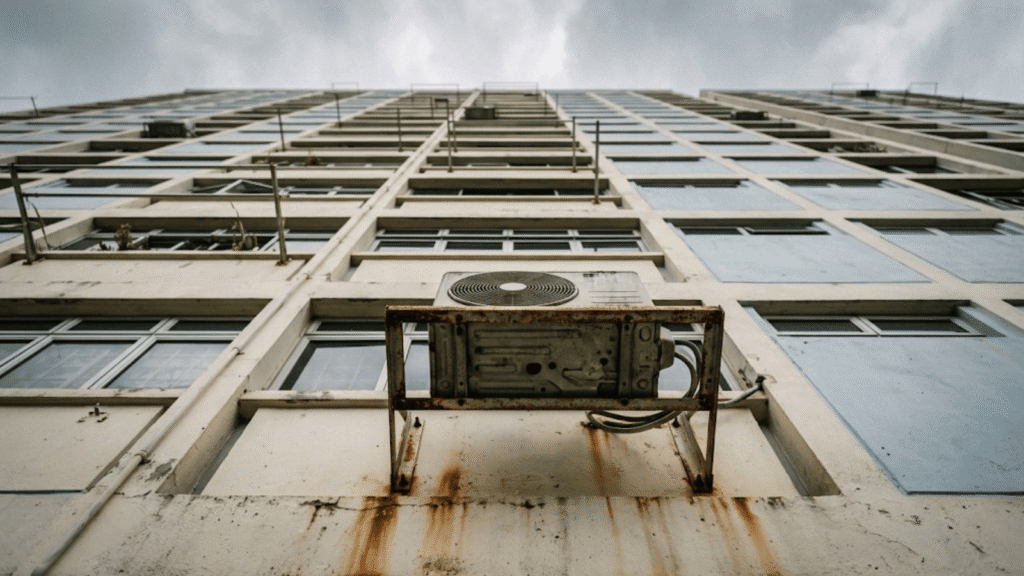
On Sunday afternoon, 13 September 2026, an air-conditioner bracket and compressor came loose from a fifth-floor flat at Block 732 Tampines Street 71. Photographs shared with AsiaOne show the compressor hanging by its pipes and cables, with only one of the bracket’s two arms still fixed to the facade. The town council netted off the ground area below. A police fast response car arrived at about 3.30pm. By 5.20pm both the bracket and the compressor had been removed, in urgent rectification works arranged with the flat owner.
The report ended where almost every report like this ends, with a penalty figure. Flat owners face a maximum fine of $20,000, jail of up to a year, or both, under the Building Control Regulations, if a condensing unit or its structural supports fall due to a lack of maintenance.
We tried digging deeper into the issue. Two things came out of it. The first is that the figure and the legislation usually quoted in these stories do not match what we could actually verify. The second is the question nobody in this industry seems willing to answer: what if the unit above you is a condo, not an HDB flat?
A note before we start. This explains the general legal framework. It is not legal advice. If you have received a notice or you are already in a dispute, get advice on your own facts.
The Act that applies is not the one usually quoted
There are two separate regimes here, and they do different jobs.
The Building Control Regulations 2003 govern installation. Regulation 41B(2) says only a BCA-trained air-conditioning unit installer may fit a unit on a building’s exterior or on a surface projecting outwards. Regulation 41C sets out that installer’s duties, including installing a structural support system that complies with the Seventh Schedule to those Regulations, and submitting an installation report within 14 days. Those obligations sit mainly on the installer, not on you.
What happens after something falls is governed by a different Act. The Building Maintenance and Strata Management Act 2004, the BMSMA, contains a section headed “Unsafe exterior feature”. It makes it an offence for the person responsible for an exterior feature to fail, without reasonable excuse, to keep it securely fixed to the building so as to prevent collapse. The penalty in the text we reviewed is a fine not exceeding $10,000, imprisonment not exceeding 12 months, or both.
We could not verify a $20,000 figure anywhere. BCA’s own public statements about fallen windows, which are governed by the same section of the same Act, have consistently stated $10,000 and up to one year for years.
More directly on point: in a written answer to Parliament on 10 October 2016, the Ministry of National Development was asked how many homeowners had been penalised for air-conditioners falling off flats. The answer was three cases in the previous five years, and the homeowners in those cases were issued composition fines under the BMSMA. Not under the Building Control Regulations.
So treat the dollar figure with care, whichever version you have seen. What is not in doubt is the shape of it. This is a criminal offence, it carries a jail term on paper, and the Act puts a presumption against you. If the feature has fallen, and there is damage or deterioration that was not caused by an accident or an act of nature, you are presumed to have failed to maintain it unless you can prove otherwise.
HDB: it is the flat owner, not the town council
HDB is blunt about this on its own site. Its renovation guidance for air-conditioner installation works states that you are responsible for the proper installation, safety, and stability of your air conditioner.
The town council’s role at Block 732 was cordoning and coordination. That is not legal responsibility for the bracket.
The BMSMA’s definition of “person responsible” explains why. Where an exterior feature forms part of the common property of an HDB estate, the person responsible is the town council or its appointed contractor. Your compressor and your bracket are not common property. They are yours, bolted to the outside of your flat. You are the person responsible.
The enforcement route runs to you as well. MND’s 2016 answer confirmed that BCA can issue a notice requiring improvement works where there is evidence of disrepair, and said this specifically includes the metal brackets holding the units in place.
BCA’s published guidance tells you what to do about it. Inspect the supports for corrosion or damage at least once every six months. Have a trained air-conditioning unit installer inspect the supports during routine servicing. Replace badly corroded brackets with new stainless steel ones. Repair cracks or deterioration in concrete ledges or casings. MND’s parliamentary answer gave the same six-month interval.
That six-month interval is the most useful number in this entire article, and it is the one nobody quotes.
Condo: the same Act, a harder question
This is the part that surprised us.
A condo does not fall under a different Act for this. The relevant Part of the BMSMA applies to any building, subdivided or otherwise. The “unsafe exterior feature” offence applies to a condo aircon ledge exactly as it applies to an HDB bracket.
What changes is who counts as the person responsible, and in a condo that is genuinely contestable.
The definition sets a default and then an exception. The default is the owner of the premises the feature is installed on, or whoever has charge and control of its management and maintenance. The exception is that where the feature forms part of the common property, the person responsible is the owner of that common property or the managing agent appointed for it. In a condo, that points at the MCST.
The ledge and the facade are common property. The compressor and bracket you bought and had installed are not. They sit on common property. That is not the same thing as being part of it.
The three ways a condo case splits
The ledge itself fails. Spalling concrete, a cracked casing, corrosion in a steel casing that came with the building. That is common property. Maintaining it and keeping it in good and serviceable repair is the MCST’s duty under the BMSMA, and on the statutory definition the MCST or its managing agent is the person responsible.
Your bracket or your compressor fails. You bought it, you engaged the installer, it is your fixture. You are the person responsible, and the statutory presumption runs against you once it has fallen. Your condo’s by-laws will usually say much the same thing in plainer language.
Mixed or contested. A ledge in poor condition, a bracket carrying more weight than it was specified for, an installer who anchored into the wrong substrate. In practice these get worked out through the MCST, through mediation, or at the Strata Titles Boards under the BMSMA’s dispute provisions. There is no clean rule here, and anyone who tells you there is has not read the Act.
Two provisions are worth knowing if you are on the receiving end. There is a defence where the defect was caused by materials or work supplied by someone other than the person responsible. And there is a route out of the offence if, within seven days of being served notice, you furnish a statutory declaration naming the contractor or managing agent you appointed to maintain the feature, and you satisfy the court that you relied on them in good faith after proper inquiry.
Seven days is short. Keep your installer’s paperwork somewhere you can find it.
What the courts have actually said about compressors on common property
This is unsettled, and it is worth being honest about that rather than pretending otherwise.
In Choo Kok Lin v MCST Plan No. 2045 (Kentish Lodge) and Prem N Shamdasani v MCST Plan No 920 (Hawaii Tower), the courts treated compressors mounted on external walls as ordinary use of common property, and declined to order removal.
In MCST Plan No. 508 v Loh Sook Cheng, the District Court took the same view. The High Court then reversed it, holding that the compressors, additional cables and water pipe were permanent structures installed on common property for the sole benefit of one subsidiary proprietor, which deprived other proprietors of the use and enjoyment of it. Following Wu Chiu Lin v MCST Plan No. 2874 (Sunglade), that puts such installations in exclusive-use territory requiring a resolution under section 33 of the BMSMA.
Writing in the Singapore Law Gazette in November 2024, Toh Kok Seng of Lee & Lee sets out the inconsistency between these two lines of authority and says a decision of a higher court to resolve it would be helpful. He is right, and it has not happened yet.
The practical takeaway for a condo owner is straightforward. Do not assume that because six of your neighbours have compressors on the external wall, yours is automatically safe. Get the MCST’s written consent, keep it, and keep the installation records with it.
How often does this actually happen
Rarely, on the only public numbers we could find. Three dislodged air-conditioners in the five years to October 2016, per MND. We could not find a more recent published figure for fallen aircon units specifically, and we are not going to invent one.
For scale, BCA recorded 35 fallen windows in the first 11 months of 2023. Windows come down far more often than compressors do. That is not a reason to relax about brackets. It is a reason to notice that when a compressor does come down, it is a much heavier object, and the response from the agencies is correspondingly serious.
What this means in practice
If you own an HDB flat, the bracket is yours and the six-month check is on you. Rust streaks running down the facade below the bracket, flaking or blistering at the weld points, and hairline cracks in the concrete around the anchor bolts are the things worth a second look before they become a news story.
If you own a condo unit, the ledge may be the MCST’s problem, but the compressor and bracket sitting on it are yours. Both of those are true at the same time.
If you sit on an MCST council, your maintenance obligation covers the ledge and the facade. It does not extend to every subsidiary proprietor’s bracket. Knowing exactly where that line sits is worth more than a blanket policy of inspecting everything.
Getting the supports checked
VD Aircon inspects brackets, ledges and supports as part of routine servicing, in HDB flats and condos alike, across every estate listed on this site. We do 10 to 15 jobs a month in Tampines alone, mostly older blocks running split systems where access to the condenser on the higher floors is tight.
If nobody has looked at your bracket in the last six months, that is the job to book.
For the installation side of this, see our guide on HDB aircon installation rules in Singapore.

We specialize in Aircon installation, repair, and service. We have all type & model of recon compressor, full set & fancoil. Our technicians are highly proficient in their respective field and repairs and fixes aircon of various brands.