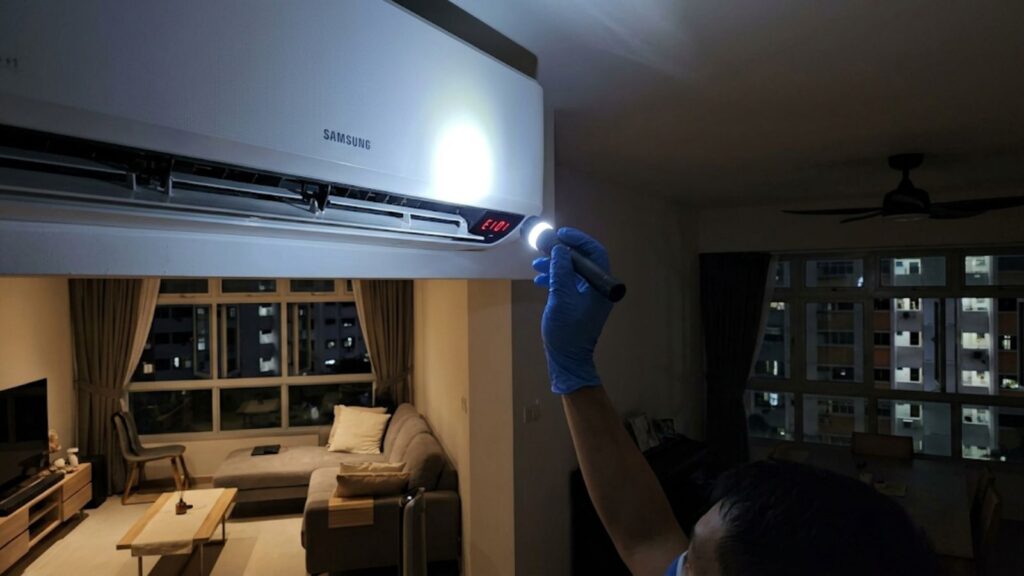
Your Samsung aircon has stopped, and there is a code sitting on the indoor display or blinking on the panel. Some of these codes mean nothing is wrong at all. Others mean the compressor is seconds away from real damage and the unit shut itself down on purpose. Below is every code we get asked about in Singapore, in plain language, with what is genuinely safe to check yourself, what a fair repair costs here in 2026, and where the line is that only a licensed technician should cross. (If your unit is a Daikin or a Mitsubishi instead, the code logic is different enough that it’s worth reading our separate guide to Daikin and Mitsubishi error codes rather than guessing from this one.)
Find your code
| Code | What it means | Urgent? | Can you check it yourself? |
|---|---|---|---|
| CF | Filter cleaning reminder | No | Yes, wash the filters and reset |
| CI | Auto Clean cycle running | No | No, let it finish |
| dF | Defrost cycle running | Usually no | Watch if it keeps repeating |
| E101 / C101 | Indoor-outdoor communication lost | Yes | Power cycle only |
| E201 / C201 | Units failed to sync on start-up | Yes | Power cycle only |
| E461 / C461 | Compressor failed to start | Yes | Power cycle only |
| E462 / C462 | Total input current exceeded | Yes | Power cycle only |
| E464 / C464 | Compressor overcurrent (IPM) | Yes | Check the outdoor coil is clear |
| E466 / C466 | DC link voltage fault | Yes | Power cycle only |
| C154 / E154 | Fan motor fault, tied to overvoltage protection | Yes if it returns | Power cycle once |
| E162 / E163 | Indoor board lost its configuration data | Yes | No, needs a technician’s remote procedure |
| E121 / C121 | Room temperature sensor fault | Low | No |
| E122 / C122 | Coil temperature sensor fault | Low | No |
| E554 / C554 | System believes refrigerant is low | Yes, but check first | Check nothing was recently moved/serviced |
| E422 / C422 | Refrigerant flow blocked | Yes | No |
A note on the two columns of codes above. Samsung’s own support documentation confirms that the same fault can appear with either an “E” or a “C” prefix depending on the model and display generation, for example E101 and C101 mean the same thing. If your unit shows a number that isn’t listed here, it likely still falls into one of the categories below. Codes checked against Samsung’s official support pages and service literature as of September 2026.
The three codes that don’t mean anything is broken
CF is a filter reminder, nothing more. Samsung sets it to trip after a fixed number of running hours, not because a sensor detected dirt. In Singapore, dust and haze particulates clog a filter mesh fast enough that the reminder is usually fair when it appears. Pull the filters, wash them, dry them properly, and reset the code through the remote (the exact button sequence is in your model’s manual, usually a long press on a filter or reset key). It will not clear on its own.
CI shows when Auto Clean is running. After the compressor stops, the indoor fan keeps turning at low speed for a while to dry out the evaporator coil. Skip this step and a warm, wet coil in Singapore’s humidity turns into the classic sour smell within days. Leave it alone. The unit powers itself down when the cycle finishes.
dF means the system is defrosting the outdoor coil. On a heat pump running in heating mode this is completely normal. On an ordinary Singapore cooling-only split, it should be rare. If dF keeps coming back on a unit that only ever cools, that is not a fault code doing its job quietly, it is the compressor working around a coil that cannot absorb heat properly, usually from a blocked filter or a refrigerant charge that has drifted low. One or two dF cycles a week is fine. Several a day is worth a proper look, and if you’re seeing visible ice on the indoor coil rather than just the dF code, our guide to aircon freezing up covers that specific situation in more depth.
None of these three need you to call anyone.
The reset test, before you call anyone
For every code below this point, do this first. Switch off the unit at the wall isolator or trip the circuit breaker, and leave it off for a full ten to fifteen minutes. That is long enough for the capacitors on the outdoor board to discharge completely and for both the indoor and outdoor microprocessors to reboot from a clean state. Then restore power.
If the code does not come back, what you saw was most likely a power grid hiccup or a one-off software confusion, and the unit is fine. If the same code reappears immediately, or within a few minutes of the compressor trying to start, there is a real fault behind it and the reset has told you as much as it can. Go to the relevant section below.
When the indoor and outdoor units stop talking to each other
E101/C101 and E201/C201 both come from a breakdown in the low-voltage data link between the indoor fan coil and the outdoor compressor unit, running over two wires labelled F1 and F2. E101 means the indoor board stopped receiving valid data from the outdoor board for more than about a minute. E201 is closely related and shows up mainly at start-up, when the outdoor unit is trying to identify and sync with the indoor unit and gets no reply in time.
In Singapore this is disproportionately a pest problem. House lizards climb into the warm outdoor electrical box seeking heat off the components, and if one bridges a high-voltage trace it can vaporise instantly, taking out the delicate low-voltage circuitry that carries the F1/F2 signal in the process. Rats chewing through PVC-insulated cabling in outdoor trunking is the other repeat offender, along with corroded terminal connections after years of coastal humidity, and a simply dead outdoor board if a fuse has blown from a grid surge.
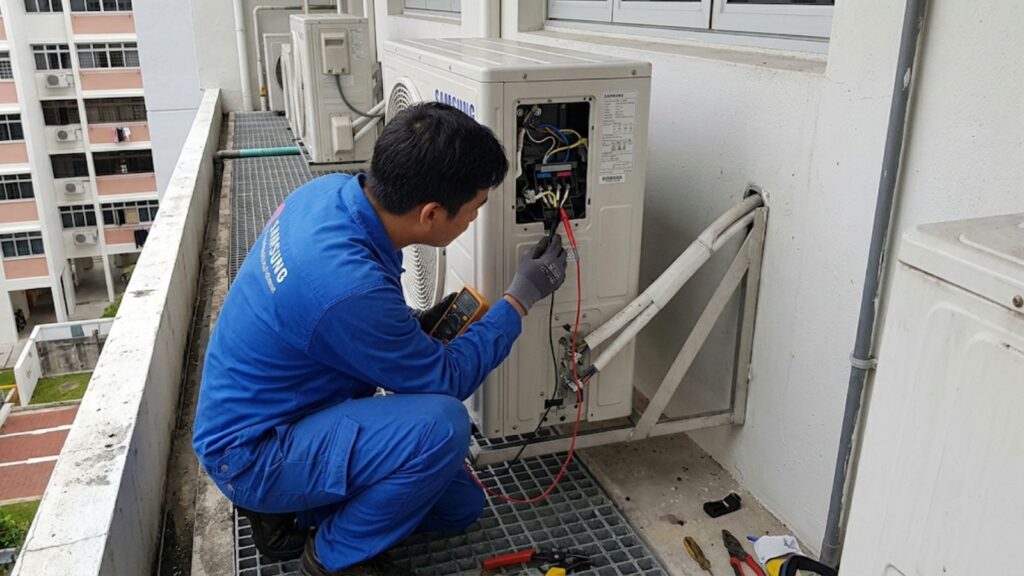
A technician confirms which of these it is with a multimeter on the F1/F2 terminals rather than by guessing. If the reading is a flat, unmoving voltage instead of the fluctuating signal of live data, the communication chip on one side has failed. This is not a job for a screwdriver and a YouTube video: it means opening a live electrical enclosure, and that is licensed work in Singapore, not a homeowner task.
Need a technician for this one? VD Aircon’s emergency and same-day repair service covers this islandwide with no area surcharge, and you can reach us on WhatsApp or call at 9654 0044 or 9644 0652.
Overcurrent and start-up faults
E461/C461, E462/C462, E464/C464 and E466/C466 all sit in the same family: the outdoor board’s Intelligent Power Module, the chip that converts and switches power to run the compressor motor, has detected current or voltage outside a safe range and shut down before something melted.
The detail that matters for your wallet is that E464 in particular does not automatically mean a dead board. Very often it means the compressor is being asked to push refrigerant against a heat exchanger that cannot get rid of heat fast enough, because the outdoor unit is sitting on a cramped HDB ledge with dust-caked fins, or because the hot discharge air is bouncing off a nearby wall and recirculating straight back into the intake. The compressor draws more and more current trying to compensate, and eventually trips the overcurrent protection that E464 reports. Clean, well-ventilated coils fix this without touching a single electrical component.
There is also a well-known bad habit in the trade worth naming plainly: technicians who “top up” refrigerant by feel rather than weighing it on a scale, because cold pipes feel like a job well done. Overcharging floods the compressor with liquid refrigerant it cannot compress properly, and that too shows up as an overcurrent trip. It is one of the more expensive mistakes a homeowner can inherit from a previous, less careful service.
Only after the coil is confirmed clean and the charge confirmed correct does it make sense to test the compressor windings and the IPM chip electrically. Skipping straight to a full outdoor PCB replacement because a code says “overcurrent” is how homeowners get charged for parts they didn’t need.
Voltage and fan motor faults
C154/E154 is officially a fan motor fault, but Samsung’s own technical service literature ties it specifically to overvoltage protection on the indoor board. If Singapore’s incoming household supply spikes well above its normal 220 to 240 volt range, even briefly during a thunderstorm, the logic board cuts the fan and compressor rather than let a surge cook the motor windings.
There are two very different outcomes worth telling apart. If the code appears once, the unit is powered down and rested, and C154 does not return, the protection did exactly what it was designed to do and no repair is needed. If C154 comes straight back within seconds of the next start-up, the surge was severe enough to have already damaged the fan motor or the drive circuitry, and the unit will not recover on its own.
Older HDB blocks that haven’t gone through the Home Improvement Programme can make this worse. Where the flat’s main supply is still capped at 30 amps, running an aircon compressor at the same time as an instantaneous water heater or an induction hob can sag and spike the local voltage enough to trip C154 or the related E466 intermittently, even with no fault in the unit itself.
When the board forgets what it is
E162/E163 is one of the odder codes on this list, and one of the least expensive to fear. It means the indoor unit’s configuration memory, an EEPROM chip that stores the unit’s operating parameters, has been corrupted or wiped, usually by a severe voltage spike or a lightning-adjacent power event. It also appears, entirely normally, straight after a technician installs a brand-new replacement PCB, because a factory-fresh board arrives blank and has to be told which model and capacity it is controlling before it will run.
This is not a compressor problem and not usually a parts problem. Samsung technicians clear it in the field using a manufacturer engineering procedure entered through the unit’s remote control, which rewrites the board’s configuration data without opening the electrical compartment at all. The exact sequence is model-specific and undocumented for homeowner use, and getting it wrong can leave the board in a worse state than before, so this is squarely a technician job, just not usually an expensive one.
Gas leak, or something pretending to be one
E554/C554 tells you the system has concluded refrigerant is low. What it doesn’t tell you is how it reached that conclusion. Residential Samsung splits don’t carry a physical pressure sensor. Instead the logic board watches temperature at the evaporator inlet and outlet and infers a leak if the coil isn’t cooling the way a correctly charged system should.
That inference is right more often than not, but it can be fooled, and this is where a homeowner can end up paying for gas they never lost. If a unit has just been moved, reinstalled, or serviced and a technician forgot to fully open the brass service valve on the outdoor unit, refrigerant flow is mechanically choked even though nothing has leaked. A badly clogged indoor coil produces the same temperature signature as a real leak, because heat transfer has failed for a completely different reason. Our position on this one is simple and it costs us nothing to say: nobody should connect a refrigerant cylinder to a unit showing E554 without first confirming the coils are clean, the service valves are fully open, and a gauge has actually measured the system’s pressure. We’ve written more on why a pressure test beats a straight gas top-up if you want the fuller version of this argument.
When E554 turns out to be a genuine leak, the repair is regulated, not optional extras. Modern Samsung units run on R32, which cools more efficiently than the R410A it replaced but is classified as mildly flammable (A2L), so NEA and the Singapore Civil Defence Force set rules around how it is handled. A proper repair recovers the remaining gas into a cylinder rather than venting it, pressure-tests the system with dry nitrogen to find the actual leak point, pulls a vacuum to remove moisture, and recharges to the exact weight on the unit’s data plate, work that should be done by a technician holding the ITE Certificate of Competency in R32 handling. This applies just as much when a unit is being taken out of service entirely: VD Aircon recovers the remaining refrigerant with proper recovery equipment whenever we decommission a unit, rather than venting it to atmosphere to save time, which is still a shortcut some operators take.
E121/C121 and E122/C122 are a different, cheaper story: a faulty room or coil temperature sensor, not a system-wide fault. E422/C422 means flow is mechanically blocked, most often the same closed-valve or kinked-pipe cause as a false E554. None of these three point to a failing compressor.
One extra check for WindFree owners
Samsung’s WindFree panels disperse air through thousands of tiny holes rather than a single vent, which is genuinely more comfortable but also more exposed to Singapore’s dust and humidity than a conventional louvre. When those micro-holes clog with damp particulate over time, airflow across the coil drops enough to occasionally trigger the same sensor and overcurrent faults described above, without any part actually failing. If you own a WindFree unit and see recurring faults, a proper cleaning of the front fascia is worth ruling out before anything else.
What a struggling unit does to your SP bill
An outdoor unit fighting a blocked coil toward an E464 shutdown isn’t failing quietly. It’s drawing close to its maximum current the whole time it runs, for less cooling than a healthy unit gives you. With SP Group’s regulated tariff sitting at roughly 34.78 cents per kWh (with GST) for the July to September 2026 quarter, a household already spending somewhere between S$180 and S$340 a month on electricity can see a struggling compressor add another S$50 to S$100 to that bill before it ever throws a code you’d notice. Letting a fault run rather than diagnosing it early is rarely the cheaper option, even before you count the risk of it taking the compressor with it.
What the fix typically costs in Singapore
These are indicative market ranges for Singapore as of September 2026, not a quote, and they move with unit capacity, model generation and site access.
| Repair | Typical range (SGD) | What decides it |
|---|---|---|
| Chemical overhaul, per indoor unit | S$80 – S$150 | The real diagnostic step before assuming a part is faulty |
| Basic sensor diagnosis or swap | S$50 – S$120 | Covers E121, E122, most E123-type faults |
| Indoor fan motor replacement | S$120 – S$300 | Needed once C154 stops clearing on reset |
| Outdoor inverter PCB replacement | S$150 – S$350 | Only after the coil and charge are confirmed clean |
A chemical overhaul is not just a cleaning service in this context. On a unit throwing E464 or E554, it’s the step that tells you whether the electronics are actually faulty or were simply reacting correctly to a suffocated coil. Spending S$150 on that first frequently avoids a S$350 board replacement that was never needed. If a board really is damaged, by the way, the industry default is to replace it outright rather than attempt a component-level repair: in Singapore’s humidity, a patched short circuit on a multi-layer PCB tends to fail again within weeks, so a direct swap is the more reliable route once damage is confirmed.
HDB and condo limits that can change the fix
If a Samsung system keeps tripping overcurrent faults and the honest answer is that it needs replacing rather than repairing, older HDB flats that haven’t been through the Home Improvement Programme carry a hard ceiling: total air-con current on the non-upgraded 30A supply cannot exceed 8.5A. A higher-capacity multi-split that would otherwise solve the problem can simply be unable to run within that limit, which changes the conversation from “which unit” to “what your electrical supply can actually support.” Outdoor units also sit on ledges with a maximum load rating, commonly around 110kg per wall panel, which matters for a System 4 or System 5 outdoor unit with a second compressor. Both of these get checked and submitted as part of an HDB Form AC-02 installation, and they are worth knowing about before you’ve picked a replacement unit, not after.
What to actually do right now
If your code is CF, CI, or dF appearing once or twice a week, you don’t need us. Clean the filter, let the auto-clean cycle finish, and move on with your day. For every other code on this page, do the ten to fifteen minute power reset first. If it clears and stays clear, you’ve dodged a repair entirely. If it comes straight back, that’s the unit telling you the fault is real, and from there the only thing worth spending money on first is confirming what’s actually wrong, not guessing at a part.
We’re islandwide, no area surcharge, and we’ll tell you honestly when the answer is “clean the coil” instead of “replace the board.” See how we handle Samsung servicing and repair generally, or WhatsApp or call 9654 0044 or 9644 0652, any day, 9am to 11pm.

We specialize in Aircon installation, repair, and service. We have all type & model of recon compressor, full set & fancoil. Our technicians are highly proficient in their respective field and repairs and fixes aircon of various brands.