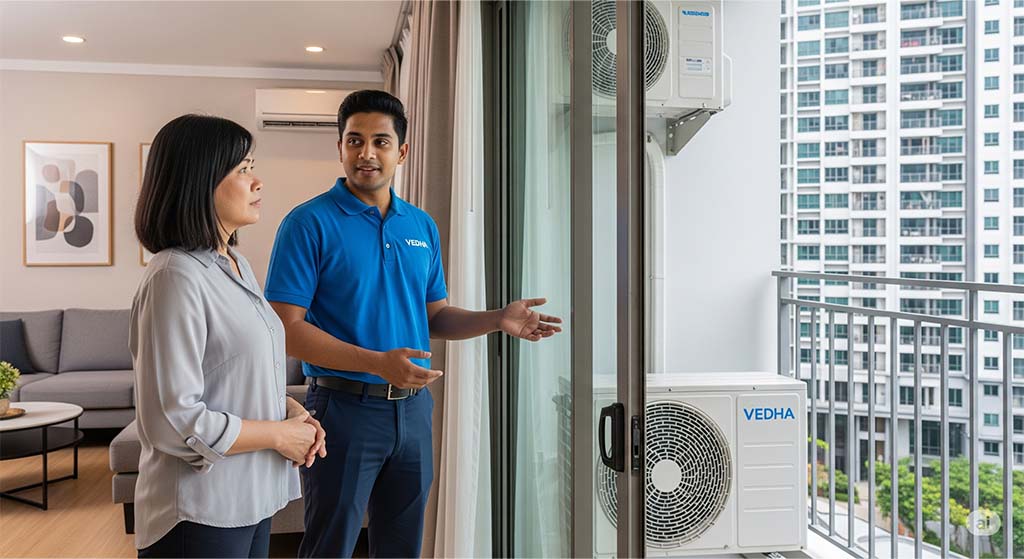
A first-time BTO owner in Punggol called us last week with a question we hear almost daily. She had spent three weekends reading HardwareZone threads, Reddit r/singapore posts, and product pages. The recommendations contradicted each other. Her in-laws swore by Mitsubishi. Her colleague had Daikin and loved it. The Panasonic salesperson at Courts had convinced her that nanoe X was the only sensible choice for her newborn’s bedroom. She wanted us to settle it.
We do not settle it. The honest answer is that all three brands make excellent aircons in 2026 and the right pick depends on what you actually care about. What we can do is tell you what each brand is genuinely best at, based on hundreds of installs and the patterns we see when customers call us back for service two to four years later.
This article covers what current Daikin, Mitsubishi Electric, and Panasonic 2026 models actually do, where they differ, and which one fits which kind of household. It also covers Mitsubishi Heavy Industries because customers regularly confuse it with Mitsubishi Electric and the two brands are completely separate.
The Three 2026 Flagships in One Paragraph Each
Daikin iSmile Eco+ Series. Daikin’s current flagship for the Singapore residential market. 5-tick energy rating. R32 refrigerant. Streamer Discharge Technology that decomposes airborne viruses, allergens, and chemical pollutants. Coanda airflow that pushes air along the ceiling for even distribution. Intelligent Eye sensor that raises the setpoint by 2°C after 20 minutes of no motion. Built-in Wi-Fi with the Daikin Smart Control app. Minimum noise around 21 dB. Daikin’s January to March 2026 promo bundles 36 months of extended warranty (42 months through Daikin Proshop dealers).
Mitsubishi Electric Starmex FN Series. The current 2nd-generation FN series. 5-tick energy rating. R32 refrigerant. Dual Barrier Coating on internal surfaces that resists dust and biofilm adhesion. Minimum noise of 19 dB, the quietest among mainstream models in Singapore. Easy-clean design (two screws to access internals versus three on the older FJ series). Standard 5-year compressor warranty plus 1-year parts. The model most often specified for master bedrooms and infant rooms.
Panasonic XU Series. Panasonic’s premium inverter line. 5-tick energy rating. R32 refrigerant. nanoe X air purification using hydroxyl radicals that actively neutralise airborne bacteria, viruses, mould, allergens, pollen, and odours. nanoe X can run independently of cooling at 25 watts per hour for continuous air purification. Built-in Wi-Fi via the Comfort Cloud app. iAUTO-X fast cooling mode. AEROWINGS dual flap for airflow control. ECONAVI occupancy sensor. Minimum noise around 21 dB.
All three are excellent. Each is best at something different.
Daikin vs Mitsubishi — The Comparison Most Buyers Actually Care About
This is the comparison Singapore searches more than any other. The honest answer is that Mitsubishi Electric and Daikin sit at the same quality tier for HDB and condo installations. The differences are real but narrow.
Noise. Mitsubishi Starmex FN measures 19 dB at lowest fan speed. Daikin iSmile Eco+ measures around 21 dB. Two decibels does not sound like much but the dB scale is logarithmic. In a small BTO bedroom with the door closed, the 2 dB difference is audible if you are a light sleeper. If everyone in your household sleeps through anything, the difference does not matter.
Energy efficiency. Both are 5-tick rated. Real-world consumption on a System 3 cooling a typical 4-room BTO living plus two bedrooms runs around 280 to 340 kWh per month for both brands, depending on usage. Pick by other criteria. The energy savings argument between Daikin and Mitsubishi is marketing.
Smart features. Daikin has Intelligent Eye occupancy detection that adjusts the setpoint. Mitsubishi Electric Starmex FN has basic Wi-Fi but no equivalent occupancy logic. Daikin is the smarter system on paper. Whether the smart features matter to you depends on how much you actually use the Daikin Smart Control app after the first month.
Internal cleanliness over time. Mitsubishi Electric’s Dual Barrier Coating keeps internal surfaces meaningfully cleaner between services. We see this when we open units for chemical wash. A 3-year-old Starmex FN has noticeably less biofilm on the coil than a 3-year-old Daikin iSmile Eco+ at the same usage profile. Translates to one fewer chemical wash across the life of the unit.
Air purification. Daikin Streamer is a single-pass system — air passes through the unit, gets exposed to the Streamer discharge, exits cleaner. Mitsubishi Starmex FN uses passive PM2.5 filtration only, no active purification. If air quality is the priority, Daikin wins this round, but Panasonic wins it overall (more on that below).
Price. Daikin runs around 5 to 8 percent more expensive than equivalent Mitsubishi systems in 2026. A System 3 Daikin iSmile Eco+ runs around $3,400 to $3,700 fully installed. A System 3 Mitsubishi Starmex FN runs around $3,200 to $3,500. Premium worth paying if you want the extra features. Skip if not.
After-sales network. Both have wide service networks in Singapore. Daikin Proshop dealers and Mitsubishi authorised service centres are accessible across the island. Parts availability is reliable for both. Slight edge to Daikin for after-sales response time based on our experience escalating warranty cases.
Verdict. If you want the quietest possible bedroom aircon, pick Mitsubishi Starmex FN. If you want smart features and a bit more cleaning between services, pick Daikin iSmile Eco+. If you cannot decide, the household with light sleepers picks Mitsubishi and the household without picks Daikin. Both will serve you 10 to 14 years if installed properly.
Daikin vs Panasonic — When Air Quality Is the Tiebreaker
This comparison comes up most often from families with infants, elderly parents, or members who have asthma, eczema, or allergic rhinitis. The decision usually comes down to which technology you trust to handle air quality.
Air purification. Panasonic nanoe X generates hydroxyl radicals that actively neutralise airborne pollutants. It runs continuously, including in nanoe X standalone mode without cooling at 25 watts per hour. Daikin Streamer is a single-pass system that requires air to flow through the unit. The Panasonic approach genuinely produces measurably cleaner air in long-term operation. Independent third-party tests of nanoe X effectiveness against common allergens and SARS-CoV-2 have been published by Panasonic and the methodology holds up.
Cooling performance. Both are 5-tick rated. Both use R32. Real-world cooling is equivalent. iAUTO-X on Panasonic and Powerful mode on Daikin both deliver fast cooling on hot afternoons. No meaningful difference.
Noise. Both around 21 dB at lowest fan. Equivalent.
Smart features. Daikin Intelligent Eye versus Panasonic ECONAVI — both detect occupancy and adjust output. Daikin Smart Control versus Panasonic Comfort Cloud — both are decent apps. Even.
Reliability. Daikin has the slight edge on long-term reliability based on our service callout data. Panasonic units do well in the first 5 years and start to need more parts attention in years 6 to 8. Daikin parts demand is more evenly distributed across the life of the unit.
Price. Roughly equivalent at the premium tier. A System 3 Panasonic XU runs $3,200 to $3,800 fully installed. A System 3 Daikin iSmile Eco+ runs $3,400 to $3,700.
Verdict. For families with health-driven priorities — infants, elderly, allergy sufferers — Panasonic XU wins because nanoe X delivers active air purification that Daikin Streamer does not match. For families without these priorities, Daikin iSmile Eco+ is the slightly more reliable long-term pick.
Mitsubishi vs Panasonic — The Health vs Silence Choice
Noise. Mitsubishi Starmex FN wins at 19 dB versus Panasonic XU at 21 dB.
Air quality. Panasonic wins decisively. nanoe X is genuinely active purification. Mitsubishi Starmex FN has passive filtration only.
Energy efficiency. Both 5-tick. Equivalent in real-world use.
Reliability. Mitsubishi edges ahead. The Dual Barrier Coating reduces internal contamination, meaning fewer service issues over 8 to 12 years.
Smart features. Roughly equivalent. Panasonic Comfort Cloud app is more polished. Mitsubishi Wi-Fi is functional.
Price. Equivalent. System 3 around $3,200 to $3,500 fully installed for both.
Verdict. Mitsubishi if quiet bedrooms are the priority. Panasonic if air quality is the priority. Households with both light sleepers AND health concerns face a real trade-off — most of these households go with Panasonic for the master bedroom (air quality wins) and Mitsubishi for the common bedrooms.
All Three Side by Side
| Factor | Daikin iSmile Eco+ | Mitsubishi Starmex FN | Panasonic XU |
|---|---|---|---|
| Energy rating | 5 ticks | 5 ticks | 5 ticks |
| Refrigerant | R32 | R32 | R32 |
| Minimum noise (indoor) | ~21 dB | 19 dB | ~21 dB |
| Air purification | Streamer (single-pass) | PM2.5 filter only | nanoe X (active 24/7) |
| Smart features | Wi-Fi + Intelligent Eye | Wi-Fi | Wi-Fi + ECONAVI |
| Fast cooling mode | Powerful | None named | iAUTO-X |
| Internal anti-fouling | Standard | Dual Barrier Coating | Inside Cleaning |
| Compressor warranty | 5 years (10 with promo) | 5 years | 5 years |
| Parts warranty | 1 year | 1 year | 1 year |
| System 3 install price (2026) | $3,400 to $3,700 | $3,200 to $3,500 | $3,200 to $3,800 |
| System 4 install price (2026) | $4,200 to $4,500 | $4,400 to $4,800 | $4,100 to $4,800 |
| Strongest at | Smart + reliable | Quietest + cleanest | Active air purification |
Mitsubishi Electric vs Mitsubishi Heavy Industries — They Are Different Companies
The most common factual mistake we hear from customers is treating Mitsubishi Electric and Mitsubishi Heavy Industries as the same brand. They are not. Both belong to the broader Mitsubishi Group keiretsu but they are independent corporations with separate manufacturing, separate engineering teams, separate product lines, separate service networks, and different pricing.
Mitsubishi Electric (often called ME) makes the Starmex series for residential Singapore. Quieter operation. More smart features. Higher price. Dominant brand for HDB BTO bedrooms.
Mitsubishi Heavy Industries (often called MHI) makes the SRK and Aero series for residential. Faster initial cooling. Lower noise floor is around 22 to 24 dB, noticeably louder than Starmex. Fewer smart features. Lower price — usually $300 to $600 less than equivalent Starmex configuration. Parts inventory in Singapore is smaller because fewer MHI units are installed in homes, so a PCB or expansion valve sometimes needs to be ordered from the regional distributor with 1 to 2 weeks lead time.
For most HDB BTO owners, Mitsubishi Electric Starmex is the practical pick because the Singapore service ecosystem is built around it. MHI makes sense if you want fast initial cooling, do not care about smart features, and want to save several hundred dollars. We install both. We install far more Starmex.
Daikin iSmile vs Mitsubishi Starmex — The Specific Model Comparison
Customers often ask about the iSmile versus the iSmile Eco versus the iSmile Eco+. Quick clarification.
The Daikin iSmile is the entry-level smart series — 4 ticks, basic features, no Streamer. Around $400 to $600 cheaper than the iSmile Eco+ for a System 3. Worth considering only if budget is tight and you do not need the 5-tick efficiency.
The Daikin iSmile Eco is the mid-tier — 5 ticks, R32, no Streamer. Bridges the gap. Around $200 to $400 cheaper than the iSmile Eco+.
The Daikin iSmile Eco+ is the current flagship. 5 ticks, R32, Streamer, Coanda airflow, Intelligent Eye, Wi-Fi. This is what we recommend when customers ask for Daikin.
The Mitsubishi Starmex FN is the current 2nd-generation 5-tick model. There is no “Starmex Eco” or “Starmex Plus” — the FN is the line. Previous generation was the FJ. The FN has improvements over the FJ including the easier 2-screw cleaning access and improved Dual Barrier Coating.
So the apples-to-apples comparison is Daikin iSmile Eco+ versus Mitsubishi Starmex FN. Everything covered in the Daikin vs Mitsubishi section above is this comparison.
Sizing — Get This Wrong and the Brand Choice Does Not Matter
Picking the wrong cooling capacity wastes money on any brand. The standard guidelines that apply across all three brands:
A common bedroom of about 9 to 11 square metres needs 9,000 BTU. Anything bigger is oversized — the unit short-cycles and the room feels clammy because the unit shuts off before it dehumidifies properly.
A master bedroom of 11 to 14 square metres needs 9,000 BTU as standard, 12,000 BTU if the room gets direct afternoon sun through a west-facing window or you keep the room very cold.
A 4-room BTO living and dining area of 15 to 20 square metres needs 18,000 BTU as a minimum. We have replaced too many undersized 12,000 BTU units in living rooms after the homeowner realised the unit could not keep up. The cost of replacing an undersized unit at year 2 is around $1,800 versus paying $400 to $600 more upfront for the right capacity.
A 5-room BTO living and dining of 20 to 30 square metres needs 24,000 BTU. Going below this is the most common sizing mistake we see in 5-room flats.
These apply to all three brands equally. Daikin, Mitsubishi, and Panasonic all sell their indoor units in 9,000 / 12,000 / 18,000 / 24,000 BTU configurations within their System 3, System 4, and System 5 lineups.
Three Installation Patterns We See
Recent jobs that illustrate which brand fits which household.
A young couple in a Tengah BTO chose Mitsubishi Electric Starmex FN System 3. Two bedrooms (9,000 BTU each) and living room (18,000 BTU). They picked Mitsubishi specifically because the wife was a light sleeper. After 4 months, she reports she sleeps through the unit running. Total install: $3,425 including GST. They would have spent $250 to $400 more on the equivalent Daikin iSmile Eco+ and the noise difference would have been audible to her. Right call.
A family in a Punggol resale 5-room flat chose Panasonic XU System 5. Three bedrooms, master, and living and dining. Their 4-year-old has asthma. They picked Panasonic specifically for nanoe X in the bedrooms. After 6 months, the parents report fewer nighttime asthma episodes. Total install: $5,820 including GST. Daikin and Mitsubishi would have been similar in price but neither offers comparable active air purification.
A retired couple in a River Valley condo chose Daikin iSmile Eco+ System 4. Two bedrooms, living, and dining. They valued the Daikin Smart Control app because they travel often and want to pre-cool the flat before arriving home. Intelligent Eye was a bonus — neither of them wakes up at night so the auto setpoint adjustment works for them. Total install: $5,180 including GST. Right brand for their use pattern.
The pattern across all three is that the brand decision followed from a specific household need. None of them picked the brand because of generic “best aircon” advice.
By Use Case — A Quick Decision Matrix
If your main concern is a sleeping infant or a light-sleeping adult, pick Mitsubishi Electric Starmex FN. The 19 dB noise floor matters here.
If your main concern is a household member with asthma, severe allergies, eczema, or respiratory sensitivity, pick Panasonic XU. Active nanoe X air purification is the only feature in this comparison that genuinely cleans air rather than just filtering it.
If your main concern is smart home integration and pre-cooling control from your phone, pick Daikin iSmile Eco+. The Smart Control app and Intelligent Eye combination is more sophisticated than what Mitsubishi or Panasonic offers at this price point.
If your main concern is lowest possible electricity bill, pick any of the three. All are 5-tick. Real-world differences are within 5%.
If your main concern is lowest upfront cost without dropping to a non-premium brand, look at Mitsubishi Heavy Industries SRK series instead of Mitsubishi Electric Starmex. Saves $300 to $600 per system at the trade-off of louder operation and fewer smart features.
If your main concern is future resale value of the flat, pick Daikin or Mitsubishi Electric. Both names carry stronger recognition with future buyers than Panasonic, although the difference is small.
What “Best Aircon Brand Singapore” Actually Means
Searches for “best aircon” and “best aircon brand” generate the most volume in Singapore but they are the wrong question. There is no single best aircon. There are three excellent premium brands and one or two mid-tier brands that each win at something specific.
Daikin wins on smart features and overall reliability over 10 to 14 years of operation.
Mitsubishi Electric wins on noise and internal cleanliness between services.
Panasonic wins on active air purification.
Mitsubishi Heavy Industries wins on price within the premium tier and on fast initial cooling.
LG Multi V and Samsung DVM win for high-end condo VRV applications but are not typically considered for HDB BTOs.
Mid-tier brands like Midea, Europace, Gree, and Hisense save $600 to $1,000 versus the premium tier and deliver 7 to 10 years of service. Worth considering for rental units or properties you plan to sell within 5 years.
The “best” answer is the brand whose strongest feature matches your most important need. There is no winner across all criteria.
Pricing Reality for 2026
What you should expect to pay for a fully installed system from a legitimate Singapore installer in 2026:
| System Type | Daikin iSmile Eco+ | Mitsubishi Starmex FN | Panasonic XU |
|---|---|---|---|
| System 2 | $2,400 to $2,800 | $2,300 to $2,700 | $2,300 to $2,750 |
| System 3 | $3,400 to $3,700 | $3,200 to $3,500 | $3,200 to $3,800 |
| System 4 | $4,200 to $4,500 | $4,400 to $4,800 | $4,100 to $4,800 |
| System 5 | $5,200 to $5,800 | $5,400 to $6,000 | $5,000 to $5,900 |
Quotes significantly below these ranges are using mid-tier brand units, parallel-import grey market stock, or cutting corners on installation materials. Quotes significantly above are charging premium service margins or using upgraded materials beyond standard scope.
Warranty Reality
All three brands offer 5-year compressor warranty as standard on premium models in Singapore. All three offer 1-year parts warranty.
Daikin’s 2026 first-quarter promotion bundles extra extended warranty up to 42 months total when bought from a Daikin Proshop dealer. Worth checking the promo period when you buy.
Mitsubishi Electric does not run frequent promos on warranty extension but their standard service network response time is consistent.
Panasonic warranty processing through Comfort Cloud is the most streamlined of the three for app-driven service requests.
For all three brands, the warranty applies only to units bought through authorised Singapore distributors. Parallel imports and grey market stock carry no manufacturer warranty regardless of brand.
Common Mistakes BTO Buyers Make
The most expensive mistake is going for a cheap installation of a premium brand. A $700-cheaper installation that uses thin SWG 23 copper pipe and quarter-inch insulation undermines the premium unit you just bought. The compressor lasts longer than the pipework. We end up with a working compressor and leaking joints in year 5.
The second mistake is sizing the living room aircon to 12,000 BTU because the salesperson recommended it. A 4-room BTO living-dining needs 18,000 BTU minimum. Undersized units in living rooms run at 100% load forever and the homeowner replaces them at year 6.
The third mistake is paying for premium features the household will never use. The Daikin Intelligent Eye is brilliant in theory but in a family of four who are always home in the evenings, it never triggers. The Wi-Fi app is great if you actually use it from the office to pre-cool the flat — useless if you only switch the aircon on after walking through the door anyway.
The fourth mistake is the wrong brand for the household. A family with a newborn buying Panasonic for the master bedroom thinking they need air purification when actually they need silence for the baby’s nursery. We have switched Panasonic out for Mitsubishi in year 1 for two households this year.
Frequently Asked Questions
Is Daikin or Mitsubishi better in Singapore?
Mitsubishi Electric Starmex FN is quieter and has the Dual Barrier Coating advantage. Daikin iSmile Eco+ has Intelligent Eye and slightly better long-term reliability. Both are excellent. Light-sleeper households pick Mitsubishi. Smart-feature households pick Daikin.
Is Daikin better than Panasonic?
For general use, Daikin has the slight reliability edge. For households with respiratory sensitivity, allergies, or young children, Panasonic XU wins because of nanoe X active air purification.
Is Mitsubishi or Panasonic better for HDB?
Mitsubishi Starmex FN if quietness is the priority. Panasonic XU if air quality is the priority. Both work equally well in HDB layouts.
Mitsubishi Electric or Mitsubishi Heavy Industries — which is better?
They are different companies. Mitsubishi Electric Starmex is quieter, has more smart features, and costs more. Mitsubishi Heavy Industries SRK cools faster initially, has fewer features, and costs less. For HDB bedrooms, Mitsubishi Electric is the standard recommendation.
What is the difference between Daikin iSmile, iSmile Eco, and iSmile Eco+?
iSmile is the 4-tick entry model. iSmile Eco is the 5-tick mid-tier without Streamer. iSmile Eco+ is the 5-tick flagship with Streamer, Coanda airflow, Intelligent Eye, and Wi-Fi. The iSmile Eco+ is what most Singapore households buy.
Are all three brands suitable for 9-room and 12-room flats and landed homes?
Yes. Daikin and Mitsubishi Electric also offer VRV and VRF systems for larger residential properties above System 5 capacity. Panasonic offers ECOi for the same applications. For landed homes above 5 air-conditioned rooms, talk to an installer about VRV or VRF instead of multiple split systems.
Which is the best aircon for BTO in 2026?
There is no single best. Mitsubishi Starmex FN for quiet bedrooms. Daikin iSmile Eco+ for smart features. Panasonic XU for air quality. Pick the one whose strongest feature matches your most important household need.
Does the brand matter if I am replacing my aircon in a flat I plan to sell within 5 years?
Less than you think. A mid-tier brand like Midea V8 or Europace saves $800 to $1,200 versus the premium tier and lasts comfortably past the 5-year horizon. The premium brand premium only pays back if you own the flat for 8+ years.
Daikin or Panasonic for a young couple’s first BTO?
If both work standard office hours and care about smart features for pre-cooling, Daikin. If one or both work from home and value air quality, Panasonic. If neither matters strongly, Mitsubishi Starmex FN at a slightly lower price is the safe pick.
Are R32 refrigerant units safe?
Yes. R32 is the current Singapore industry standard for residential aircon. Lower global warming potential than older R410A. All three brands (Daikin, Mitsubishi Electric, Panasonic) use R32 on current models. Older R22 systems are obsolete and refrigerant is hard to source.
What about LG, Samsung, Hitachi, and Toshiba?
LG and Samsung have decent residential lines but smaller market share in Singapore HDB. Hitachi and Toshiba are reliable mid-premium options that often sell at 10 to 15% below Daikin pricing. Worth considering if you want premium-grade build at a slightly lower price. Less common in Singapore so the service network is smaller.
Closing — How to Actually Decide
The honest closing advice we give every BTO customer who calls us paralysed by this choice is this. List the three things that matter most to your household. Quiet bedrooms. Air quality. Smart control. Resale value. Lowest price. Long warranty. Pick the brand whose strongest feature matches your number one priority.
If quiet bedrooms is your number one, Mitsubishi Starmex FN.
If air quality is your number one, Panasonic XU.
If smart features and overall reliability is your number one, Daikin iSmile Eco+.
If lowest premium-tier price is your number one, Mitsubishi Heavy Industries SRK.
You will not regret any of these decisions if the installation is done properly. The installation matters more than the brand choice. A premium Mitsubishi installed with thin SWG 23 copper pipe and 1/4-inch insulation will fail before a mid-tier Midea installed with SWG 22 copper and 1/2-inch Armaflex.
If you want a quote from VD Aircon, we install all three brands as authorised dealers and we do a free site survey before quoting. The technician spends 30 to 45 minutes at your flat, measures the rooms for proper BTU sizing, checks your main switch rating, inspects the aircon ledge, and tells you which brand and capacity actually fits your specific flat layout and household pattern. Written quote within 24 hours. No obligation.
Call 9654 0044 or WhatsApp the same number. Email sales@vdairconservices.com.
VD Aircon Engineering is a BCA-registered installer and authorised dealer for Daikin, Mitsubishi Electric, Mitsubishi Heavy Industries, Panasonic, Hitachi, Toshiba, LG, and Samsung in Singapore. Over 40,000 units installed and serviced since 2016.

We specialize in Aircon installation, repair, and service. We have all type & model of recon compressor, full set & fancoil. Our technicians are highly proficient in their respective field and repairs and fixes aircon of various brands.