By the VD Aircon service team. Based on rental-property servicing across Districts 9, 10 and 15 from 2016 to 2026.
A landlord called us in March about a unit on Amber Road, two streets back from the sea. The tenant, a Dutch family on a two-year lease, had stopped getting cold air from the living-room Daikin. The tenant had quarterly receipts. Every one of them. The landlord assumed neglect and braced for a fight over the security deposit.
We opened the outdoor unit. The fight was pointless. The aluminium fins on the condenser had turned to powder, and the copper had pitted through at two joints. The refrigerant had bled out slowly over months. By the time the cooling failed, the compressor had been running hot against a half-empty system and was finished. That was a Tier 4 job. Compressor and refrigerant work on a unit that age runs $1,500 to $4,200, and on a corroded coastal condenser we recommended a full outdoor replacement instead of throwing a compressor into a rusted shell.
Nobody was lying. The tenant serviced the unit. The landlord still paid. The receipts proved a box was ticked, not that the aircon was maintained. That gap is the whole subject of this article, and it costs landlords in Districts 9, 10 and 15 more than any other single thing we see.
Why these three districts behave differently
Singapore’s rental market firmed up in early 2026. Private residential rents rose 0.3% in the first quarter, with high-end Core Central Region rents up 0.5%, after a soft patch in late 2025. Islandwide vacancy sat at 6.2%. For a landlord, a firmer market with vacancy above 6% means one thing: an empty unit during a dispute costs real rent, and tenants have enough choice to walk over maintenance problems.
District 9 covers Orchard and River Valley. District 10 covers Bukit Timah, Holland and Tanglin. District 15 covers East Coast, Katong, Amber Road and Meyer Road. These are not HDB rentals. The tenants are expats, executives, and families used to property managers in London, Frankfurt and Sydney who answer the phone. They document everything, and they know Singapore law does not hold them liable for fair wear and tear.
The aircon problems split by geography, and the fixes are not interchangeable.
District 15: the coast eats your condenser
Salt is the problem, and it is a chemical one, not a cleanliness one. Coastal air off the East Coast carries chloride. It settles on the outdoor condenser, where copper tubes sit pressed into aluminium fins. Add Singapore humidity and you get galvanic and pitting corrosion: the two metals and the salt form a tiny battery, and the aluminium dissolves. Unprotected condensers in the worst front-line positions corrode within one to two years. The fins crumble, the joints leak refrigerant, and the compressor dies downstream.
A unit two blocks inland fails far slower than one facing the sea on a high floor. The Amber Road job above was a front-line unit. We now treat any condenser within a few hundred metres of the water as a different machine from the same model in Bukit Timah.
Standard quarterly servicing does nothing about this. The fix is physical. We rinse salt off the outdoor coil with fresh water on a tighter cycle, and on exposed units we apply anti-corrosion coating. Gold Fin coatings carry a salt-spray resistance rating of 1,500 to 3,000 hours, which is the difference between a condenser that lasts a few monsoon seasons and one that lasts a decade. If you own along Amber, Meyer or Marine Parade, this is not optional maintenance. It is the maintenance.
Districts 9 and 10: noise, ceilings and heat
Different district, different failure. Here the calls are about noise and about cassette units hidden in false ceilings.
Expat tenants from temperate countries do not tolerate a rattling fan coil at 2am. We have been called out twice in Leonie Hill condos for a vibration the landlord could not hear and the tenant could not sleep through. NEA caps outdoor aircon noise at residential boundaries at 55 dBA at night. An aging compressor on a worn mount breaches that easily, and one neighbour complaint pulls in the managing agent. A second pulls in NEA.
The luxury stock in these districts hides another cost. Many living-room and bedroom units are ceiling cassettes or ducted systems, not wall-mounted splits. Servicing those means dropping false-ceiling panels, sheeting the room, and working overhead in a tight void. A proper chemical overhaul on a cassette takes far longer than on a wall unit and costs more for that reason. We had a Holland Road condo where a budget outfit had “chemically washed” three concealed cassettes by spraying foam cleaner through the return-air grille without opening anything. The tenant’s children kept coughing. When we dismantled the units, the drain pans were full of black bio-slime the foam never reached.
The quarterly servicing clause that protects nobody
Almost every tenancy agreement in these districts contains a line like this: the tenant shall service the aircon at least once every three months. Landlords read that as protection. It is not. The clause mandates frequency. It says nothing about quality.
A tenant paying their own bills searches for the cheapest provider and finds $12 to $15 a unit. At that price, the technician has twenty minutes. He rinses the filter, wipes the casing, and leaves. He does not check refrigerant pressures, clean the blower wheel, flush the drain line, or look at the coil. That is compliance servicing. The receipt is real and the maintenance is fake.
Our general service runs $30 to $40 a unit, and $30 a unit at four units or more. The price difference buys the work that actually prevents failure: pressure checks, blower and coil cleaning, and a flushed drain. The cheap version skips exactly the steps whose absence shows up two years later as a warped parquet floor under a blocked drain, or a PCB cooked by a dust-clogged coil.
What the Small Claims Tribunal actually needs
When the deposit fight goes formal, it lands at the Small Claims Tribunal. The limit is $20,000, or $30,000 if both sides sign a Memorandum of Consent, and it hears residential tenancy disputes on leases up to two years.
To win a claim that a tenant’s neglect killed the aircon, a landlord needs three things. Condition evidence from the start of the tenancy showing the unit worked. A maintenance timeline showing what was and was not done. And a causal link between the failure and the lack of maintenance rather than age. Most landlords have the first, sometimes. They have receipts for the second, with no detail beyond “general service done.” They never have the third, because paying for a diagnostic report to chase a few hundred dollars makes no sense.
So the claim fails, not because the tenant was right, but because handwritten receipts do not prove anything about what work happened. The Tribunal cannot read neglect into “general service done.” This is the single reason documented servicing matters more than the servicing itself in a dispute.
The void period nobody schedules around
The diplomatic clause is standard for expat leases in these districts. After twelve months, the tenant terminates with two months’ notice and proof of transfer or job loss, usually with a clause to reimburse the agent fee pro-rata. The practical result is empty units, sometimes for weeks.
An idle aircon is not a safe aircon. Seals dry out, drain trays grow mould in standing water, and a slow refrigerant leak develops with nobody there to notice the weak cooling. A unit that worked the day the tenant left has three faults by the next viewing. We did a River Valley apartment last year that sat empty for six weeks after a diplomatic-clause exit. The drain pans had gone septic and the smell hit you at the door. The owner needed a full chemical overhaul on three units before the place could be shown, at $160 to $200 a unit. Booked during the void on purpose, that work is cheap insurance. Discovered at a viewing with a prospective tenant standing there, it costs you the tenant.
What we will not do at a lower price
Landlords ask us to match the $12 quote. We do not, and here is exactly what the cheap quote leaves out.
We will not “chemical wash” a concealed cassette by spraying through the grille and calling it done. A real overhaul means dropping the panels, removing the fan coil, and soaking the coil, blower and drain pan. We will not skip the freshwater coil rinse on coastal units to save a site visit, because that is the step that keeps a District 15 condenser alive. We will not pump R32 into a system that is leaking without finding the leak first, at $90 a kilo, because that is selling gas, not fixing an aircon. And we will not hand you a receipt that says “general service done.” Every visit comes with a dated report of what we checked, what we cleaned, and what we replaced.
The model that fits a rental, not a home
A homeowner books servicing when they remember. A landlord cannot afford to, because the person using the aircon has no incentive to maintain an asset they do not own. That is why we run premium rentals on a maintenance subscription rather than ad-hoc callouts.
For a typical three-unit condo, the subscription runs in the region of $80 to $140 a month depending on district and scope. A coastal District 15 package sits at the top of that band because it adds the freshwater rinse cycle and coating inspection. A District 9 or 10 package adds acoustic checks and cassette-panel work. An inland standard package sits at the bottom.
Every package covers quarterly servicing by the same technicians, a dated digital report after each visit, and an annual chemical overhaul booked into a void period where one exists. The point is not the convenience. The point is that you end a tenancy with a documented service history instead of a stack of someone else’s receipts.
On tax: routine servicing and like-for-like repairs are deductible against your rental income, and IRAS also lets individual landlords take a flat 15% deemed deduction on gross rent instead of itemising. Replacing a working system with a higher-end model is treated as an improvement and is not deductible. So the servicing subscription is a clean recurring expense. A premium upgrade is not, and any provider who tells you otherwise is wrong.
Equipment choices that prevent the next callout
When a unit needs replacing, the brand decision changes by district.
In noise-sensitive District 10 bedrooms, Mitsubishi Electric Starmex is the quiet benchmark. The current FN series runs at a 19 dB minimum, the lowest we install, and carries a five-year compressor warranty. Expat tenants notice silence, and silence prevents complaints.
For tenants who want app control, Daikin’s iSmile Eco+ series has built-in Wi-Fi, a five-tick rating, and strong parts availability here. The smart angle has a landlord benefit too: usage data shows when a unit runs at 16°C with the windows open, which is the usual cause of condensation and mould you later pay to clean.
For District 15 coastal units, the brand matters less than the protection. Insist on factory anti-corrosion treatment and add a coating on exposed condensers. The coating cost is recovered well before the unprotected version would have failed.
The bottom line for premium-district landlords
A condo in District 9, 10 or 15 is an asset earning tens of thousands a year, not a hobby. Cheap quarterly servicing at $12 a unit reads as a saving and ends as a dead compressor, a warped floor, and a deposit dispute you cannot win on handwritten receipts. Documented maintenance reads as a cost and ends as a fifteen-minute handover and a unit that lasts its full life. The numbers are not close.
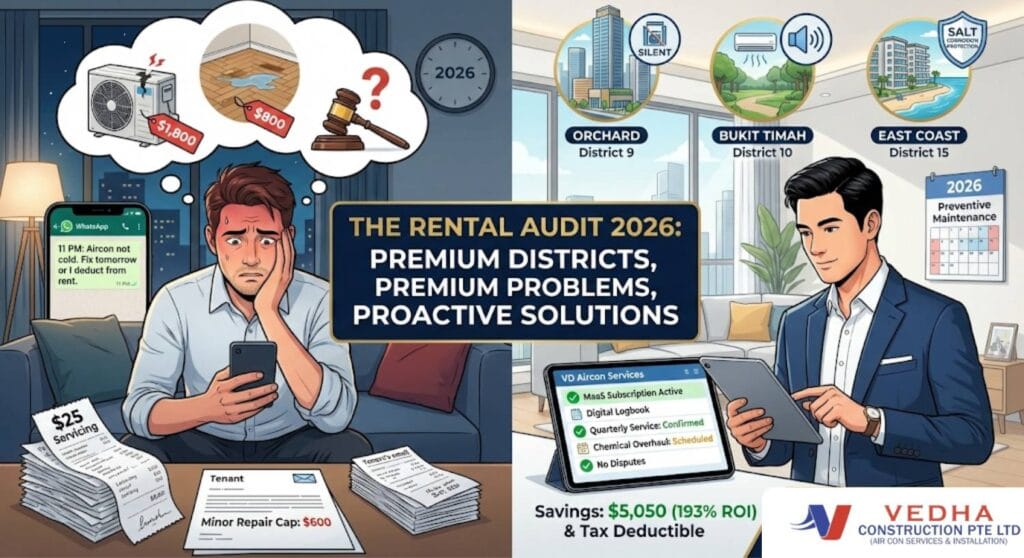
We have serviced rental properties in these three districts since 2016, and the pattern has not changed in ten years. The landlords who treat aircon as something to document, not just something to tick off, keep their tenants, their floors, and their deposits. If you own in these districts and want your units on a maintenance schedule that actually holds up at handover, talk to us before the next tenant moves in, not after the WhatsApp at 11pm.
VD Aircon Services has installed and serviced more than 40,000 units across Singapore since 2016. We are BCA-registered and NEA-registered for refrigerant handling, and we service every major brand for HDB, condo, landed and commercial properties islandwide. Office: 11 Mandai Estate #02-04 ELDIX, Singapore 729908. Call or WhatsApp 9654 0044 or 9644 0652, or email sales@vdairconservices.com.

We specialize in Aircon installation, repair, and service. We have all type & model of recon compressor, full set & fancoil. Our technicians are highly proficient in their respective field and repairs and fixes aircon of various brands.