As the familiar greyish-brown shroud settles over Singapore once again, a collective sense of unease follows. For every family — especially those with young children or elderly parents — the number one priority becomes protecting the air they breathe inside their own homes.
The first instinct is always the same: rush indoors, seal the windows and doors, and turn on the air-conditioner. But as you sit inside your cool room, a critical question lingers: are you truly safe from the harmful pollutants outside? Can your aircon actually filter out the haze?
As experienced aircon technicians based in Singapore, we believe it is our job to give you the honest, science-backed answer. In 2026, the situation is more nuanced than a simple yes or no — and the steps you take in the next few days could have a serious impact on your family’s respiratory health for years to come.
What’s in the Air Right Now? Singapore Haze in 2026
This is not a hypothetical threat. The Ministry for Sustainability and the Environment has already flagged an increased haze risk in the first quarter of 2026, driven by drier-than-average conditions during the Northeast Monsoon season. Hotspot activity in Sumatra and Kalimantan is intensifying, and Singapore’s PSI readings have been sitting in the Moderate range since early February.
Understanding what is actually in that haze is the first step to defending against it.
Recent PSI Readings (2026)
| Date (2026) | Peak 24-Hour PSI | Air Quality Status | Primary Pollutant |
| Early February | 69 | Moderate | PM2.5 |
| Mid-February | 52 | Moderate | PM2.5 |
While these readings may look manageable, the science tells a more alarming story. Climate experts warn that Singapore is in a period of “climate-induced volatility,” with the probability of large-scale “mega-fire” haze events increasing between 2027 and 2030.
The Dangerous Chemistry of Haze Particles
Unlike ordinary urban dust, transboundary haze from peat fires is a complex toxic cocktail. Research conducted between 2024 and 2026 has revealed that these particles are far more hazardous than most people realise:
- Organic Carbon: Organic Carbon (OC) makes up 58% to 89% of total particle mass, giving haze its characteristic acrid smell and whitish-grey colour.
- Heavy Metals: Heavy Metals including Chromium, Nickel, Cadmium, and Lead are released when peatlands — natural metal sinks — are burned.
- PAHs: Polycyclic Aromatic Hydrocarbons (PAHs), including the highly carcinogenic Benzo[a]pyrene, are by-products of incomplete peat combustion.
- Ionic Species: Ionic species like sulphate and nitrate ions continue to form additional aerosol mass as the smoke drifts across the ocean toward Singapore.
The Health Consequences Are Real
The 2026 IPEC umbrella review has consolidated alarming evidence on what PM2.5 does to the human body:
- Even short-term exposure (measured in days) raises the relative risk of myocardial infarction and heart failure, even at concentrations that meet current WHO standards.
- Long-term exposure is linked to an increased risk of 12 site-specific cancers, including lung, oesophageal, and breast cancer.
- For elderly residents, vascular and cognitive impacts can manifest far more rapidly than in younger adults.
- For children, their higher breathing rate relative to body size means they inhale proportionally more PM2.5 than adults in the same room.
- Hospital admissions for asthma and COPD in Singapore increased by 22% during the 2023 haze peak week.
The Government’s current advisory framework reflects this urgency:
| PSI Range | Status | For Healthy Individuals | For Vulnerable Groups |
| 0–50 | Good | Normal activities | Normal activities |
| 51–100 | Moderate | Normal activities | Normal activities |
| 101–200 | Unhealthy | Reduce prolonged outdoor exertion | Minimise all outdoor exertion |
| 201–300 | Very Unhealthy | Avoid prolonged outdoor exertion | Minimise all outdoor activity |
| 301+ | Hazardous | Minimise outdoor activity | Avoid all outdoor activity |
What Your Standard Aircon Actually Does
It’s a Recirculation Machine — Not an Air Purifier
The most persistent misconception among Singapore homeowners is that the outdoor compressor unit “pumps in” fresh air. It does not. The outdoor unit serves only one purpose: to reject heat. The indoor fan coil unit (FCU) draws air from your room, cools it across an evaporator coil, and pushes it back out. It is a closed loop.
This means a standard aircon will not import haze from outside. But critically, it also does very little to clean the polluted air already trapped inside your home.
Your Filter is a “Mosquito Net” Against PM2.5
The standard nylon or plastic mesh filter in most aircons is designed for one job: protecting the machine’s internal components from large debris like hair, lint, and dust bunnies. The science on its limitations is stark:
- Standard mesh filters have a typical pore size of 110 to 250 microns.
- PM2.5 particles are 2.5 microns or smaller — between 40 and 100 times smaller than the holes in that filter.
- To put it in perspective: a PM2.5 particle is approximately 30 times smaller than the diameter of a human hair.
The “mosquito net” analogy is scientifically accurate. If a human hair were a three-lane highway, a PM2.5 particle would be a motorcycle — small enough to weave straight through without touching the sides. A standard filter offers virtually zero protection against the particles that actually matter during a haze episode.
Your aircon’s primary benefit during haze is therefore containment, not filtration. By keeping you cool, it enables you to keep windows and doors sealed, which prevents more haze from infiltrating your home. But it does almost nothing to remove the pollutants already inside.
The “Lung Infection” Danger – What a Dirty Aircon Does to You
During a haze episode, your aircon faces a threat that most homeowners never consider. The fine PM2.5 particles that sail straight through the mesh filter do not simply disappear inside the unit.
They settle on the damp evaporator coils. They mix with condensation. They create a sticky, oily sludge — a biofilm rich in the organic carbon, heavy metals, and carcinogenic PAHs found in peat fire smoke.
On a damp aircon coil during haze conditions, mould can establish a colony within 12 to 24 hours. Once established, species like Aspergillus and Penicillium — known triggers for asthma attacks and chronic bronchitis — can be aerosolised directly into your sealed room every time the unit is switched on.
The medical analogy is deliberate and accurate: a neglected aircon during a haze episode develops the functional equivalent of a lung infection. Every blast of “cooled” air becomes a delivery mechanism for mould spores, bacterial endotoxins, and trapped haze toxins. You sealed your room to keep the haze out — and your dirty aircon is blowing it back in your face.
Singapore’s average humidity of 84% makes this a near-certainty, not a possibility. And during the Northeast Monsoon (November to March), which overlaps with some haze risk periods, new mould cases in Singapore homes increase by 280%.
Warning Signs That Your Aircon is Already Compromised
Watch for these red flags during the haze season:
- A musty or foul smell when the unit is running — mould has colonised the blower wheel, feeding on trapped haze particles.
- Weak airflow despite a clean-looking filter — clogged internal fins can reduce air passage by 30% to 50%.
- Water leaking or dripping from the indoor unit — haze dust frequently blocks the drainage pipe.
- A sudden spike in your electricity bill — a unit fouled with haze sludge can consume up to 20% more electricity to achieve the same cooling effect.
If you notice any of these signs, your unit is not protecting you. It is actively working against you.
Aircons That Actually Fight PM2.5
The good news is that not all aircons are equal. The 2026 Singapore market has seen widespread adoption of multi-stage and active filtration technologies that go far beyond the standard mesh filter.
Panasonic: nanoe™ X and nanoe-G
Panasonic’s nanoe-G system releases negative ions that attach to airborne PM2.5 particles, charging them so they are then trapped inside the unit’s filter rather than recirculated. The more advanced nanoe™ X technology generates hydroxyl radicals (⋅OH) encapsulated in water, which are capable of neutralising adhered mould, viruses, and odours. The 2026 XU Series Multi-Split systems can run this purification mode independently of the cooling function, consuming only 25 watts.
Daikin: Streamer Technology and Electrostatic HEPA
Daikin’s 2026 iSmileEco series uses a high-speed electron discharge to oxidise and decompose pollutants trapped on the filter. High-end Daikin models also feature Electrostatic HEPA filters, which use static electricity to attract and hold 99.97% of particles as small as 0.3 microns — well below the PM2.5 threshold.
Mitsubishi Electric: Plasma Quad Plus
The 2026 Starmex GP and FP series features Plasma Quad Plus, an electrical discharge system targeting PM2.5, bacteria, viruses, and allergens. Independent laboratory tests have demonstrated a 99% reduction in PM2.5 levels in controlled environments.
Samsung and LG: AI-Powered Filtration
Samsung’s 2026 WindFree™ AI series features a Tri-Care Filter with a Zeolite coating that neutralises up to 99.9% of bacteria. LG’s Dual Inverter AI models use Plasmaster Ionizer+, which emits over 3 million ions to sterilise air and surfaces, claiming 99% bacteria removal within 60 minutes.
2026 Price Guide: 5-Tick Multi-Split Systems (System 4, 3-Bedroom HDB)
| Brand | Model Series | Key PM2.5 Technology | Estimated Installed Price |
| Daikin | iSmileEco (R32) | Streamer + Electrostatic HEPA | S$4,800 – S$5,500 |
| Mitsubishi Electric | Starmex GP / FP Series | Plasma Quad Plus | S$4,700 – S$5,300 |
| Panasonic | XU Premium Inverter | nanoe™ X + nanoe-G Ion | S$4,300 – S$4,900 |
| LG | ArtCool Inverter AI | Plasmaster Ionizer+ | S$4,600 – S$4,800 |
The Ultimate Defence Strategy: Aircon + Air Purifier
Scientific evidence is unambiguous on this point: the most effective indoor PM2.5 management strategy during a haze episode is the concurrent use of a modern aircon and a dedicated HEPA air purifier.
The aircon handles heat and humidity, maintaining a sealed environment and preventing respiratory distress caused by overheating. The air purifier handles the fine particulate load that even the best aircon cannot fully address.
| Specification | Standard 2026 Aircon | Active-Filter 2026 Aircon | HEPA Air Purifier (H13) |
| Filter Type | Nylon Mesh | Mesh + Ionizer / Plasma | Multi-layer HEPA + Carbon |
| PM2.5 Removal | Near zero | 80–99% (model dependent) | >99.97% |
| VOC Removal | None | Limited | High (Activated Carbon) |
| Primary Purpose | Cooling & Dehumidifying | Cooling + Active Filtration | Particulate & Odour Removal |
Top 2026 Air Purifier Options in Singapore
For a standard HDB bedroom of approximately 15m², a Clean Air Delivery Rate (CADR) of around 200m³/h is recommended to achieve 5 air changes per hour. Target indoor PM2.5 levels below 12μg/m³.
- Local favourite: Sterra Breeze Pro — HEPA-14 filtration; can purify a 15m² room in under 5 minutes.
- Best value: Xiaomi Smart Air Purifier 4 Pro — High CADR (500m³/h) at a budget-friendly price point.
- Premium option: Dyson Purifier Big+Quiet — Premium option for large living areas (100m²+), with permanent HEPA filters requiring replacement only every 5 years.
Seal Your Home Properly
Even the best filtration system is undermined by air infiltration. In a typical Singapore apartment, outdoor air seeps in through gaps in window frames and under doors even when everything appears closed.
- Use weather stripping or “door snakes” to seal the bottom of your main entrance and windows.
- Monitor indoor CO₂ levels. In a fully sealed room, CO₂ can rise above 1,000 ppm within a few hours. Air the room out for 15 minutes only when the 1-hour PM2.5 readings drop significantly.
- Ignore the myth of indoor plants. Matching the filtration performance of a single mid-range HEPA purifier would require between 680 and 5,000 plants per room.
Your Haze Maintenance Protocol: What You Must Do Now
Since your standard filter is not protecting you from PM2.5, the most impactful action you can take is aggressive maintenance. A clean, well-serviced aircon will always perform better — and be far less dangerous — than a dirty one.
1. Clean Your Filters Every 1 to 2 Weeks During Haze
The science is straightforward: PM2.5 particles combined with Singapore’s high humidity form a sticky, oily film on the filter mesh. This accelerates blockage, reduces cooling efficiency, and creates a breeding ground for mould.
- Turn off the power to the unit first.
- Gently vacuum the loose dust from the filter before washing — do not skip this step.
- Wash the filter under a gentle stream of lukewarm water with mild soap to break down the oily residues from peat smoke.
- Allow the filter to air dry completely before re-inserting. A damp filter is the primary cause of sudden mould outbreaks in aircon units.
2. Schedule a Professional Chemical Wash Immediately If You Notice Red Flags
Standard filter cleaning cannot remove the microscopic particles that lodge deep within the evaporator coils, drain pan, and blower barrel. A professional Chemical Wash uses specialised alkaline or acidic cleaners to dissolve the “jelly-like” biofilm buildup that standard cleaning misses.
Experts recommend a professional chemical service immediately following any prolonged haze period to remove all haze-borne toxins from the air path and prevent permanent damage to the unit’s efficiency.
If your unit shows any of the red-flag warning signs listed above, do not wait. Every hour a bio-fouled unit runs is another hour of contaminated air being blown into your sealed home.
5-Year Total Cost of Ownership
| Cost Item | Frequency | Estimated 5-Year Cost |
| Mid-range HEPA Air Purifier | One-time + annual filters | ~S$900 |
| Professional Chemical Wash | Twice per year | ~S$1,000 |
| Electricity savings (5-tick vs 3-tick system) | Annual saving of S$100–200 | −S$500 to −S$1,000 |
Protecting Your Most Vulnerable Family Members
Children
Children have a higher breathing rate relative to their body size, meaning they inhale more PM2.5 per kilogram than adults in the same environment. Doctors advise keeping children indoors when the PSI exceeds 100, even if the child appears healthy. For children, the increased “work of breathing” associated with N95 masks can sometimes be counterproductive, making indoor air purification the preferred medical solution.
The Elderly
PM2.5 has a direct and rapid impact on vascular inflammation in older adults, increasing stroke risk within 24 hours of exposure. The “sensitive window” for exposure is significantly shorter for the elderly, with cognitive and vascular impacts manifesting far more quickly.
Those With Pre-Existing Respiratory or Cardiac Conditions
Research shows there is no “safe” level of PM2.5 exposure for individuals with pre-existing heart or lung conditions. For extremely high-risk individuals, relocating to a centrally air-conditioned public facility — such as a library or community centre — during Hazardous PSI periods is a recognised medical protocol.
The VD Aircon Solution: Breathe Easier This Haze Season
Your family’s health is your top priority. But a dirty aircon is not a neutral piece of furniture — it is an active hazard during haze season, capable of aerosolising mould, bacteria, and trapped pollutants directly into the sealed room where your family is sheltering.
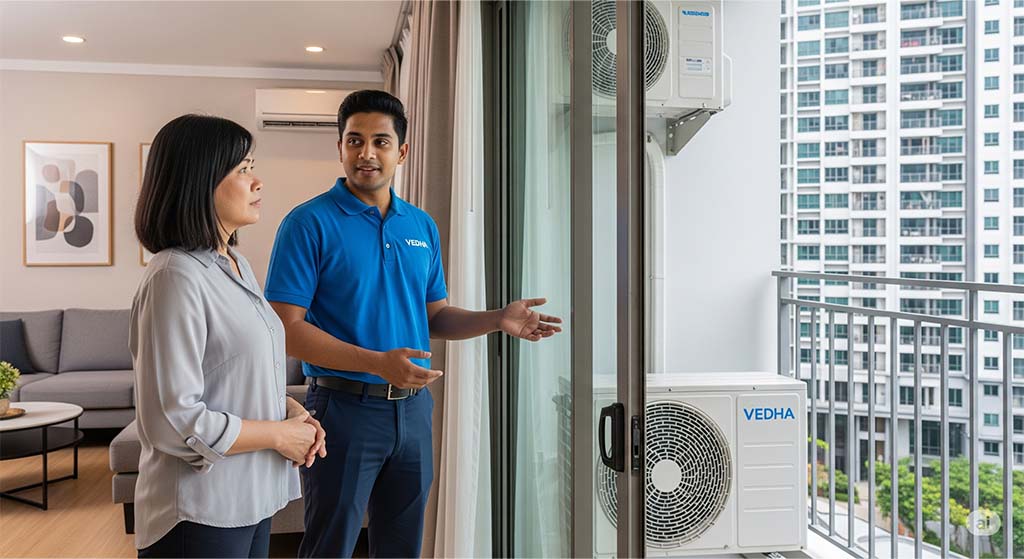
Vedha Aircon provides the two essential services that can make the difference between your home being a sanctuary and a health risk.
Immediate Relief: Chemical Wash
If your aircon is showing any of the warning signs — musty smell, weak airflow, water leaks, or a higher electricity bill — book a Vedha Chemical Wash today. Our technicians use specialised, safe cleaning solutions to thoroughly flush out all trapped haze pollutants, biofilm, mould, and bacteria from the internal coils, fan barrel, and drainage system. We restore your aircon to a hygienic, healthy state.
Long-Term Protection: Maintenance Contracts
Prepare for the haze season — and every season — with a Vedha Aircon Maintenance Contract. Regular professional servicing keeps your system running at peak efficiency and hygiene year-round, so it is fully ready to protect your family when conditions deteriorate.
Call Vedha Construction Today: 96540044
Don’t wait for the haze to get worse. The time to act is before your unit fails you. Call Vedha Construction at 96540044 today to schedule your Chemical Wash or set up a Maintenance Contract — and protect your family’s health before the next haze episode arrives.

We specialize in Aircon installation, repair, and service. We have all type & model of recon compressor, full set & fancoil. Our technicians are highly proficient in their respective field and repairs and fixes aircon of various brands.