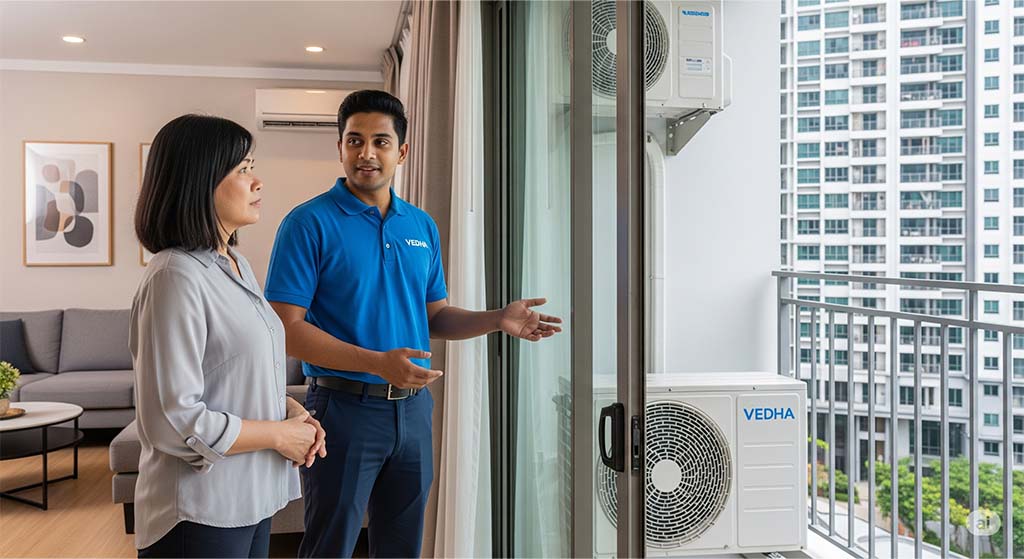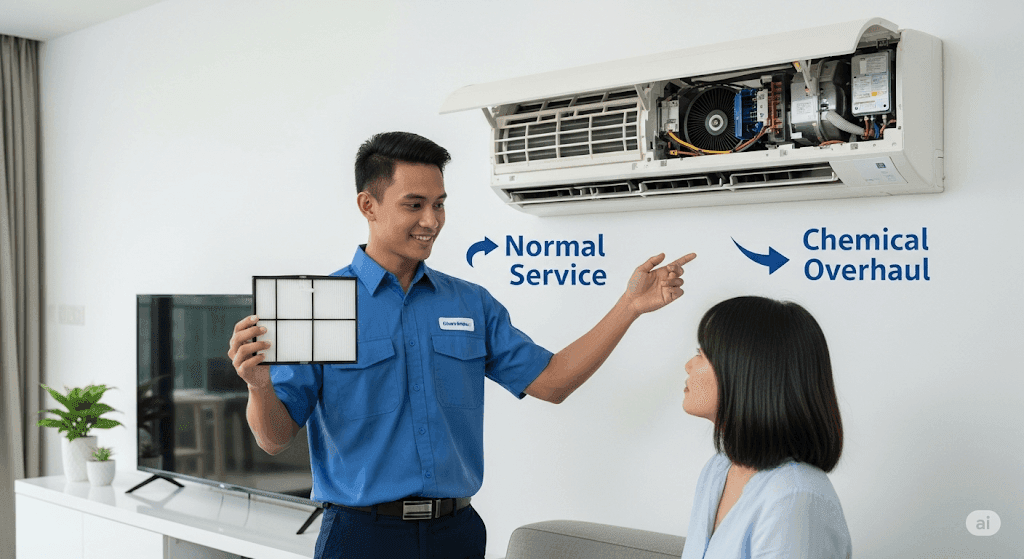
Your aircon technician just finished looking at your unit. “You need a chemical overhaul. $180 per unit.”
You called for routine servicing. Expected to pay $60 total. Now you’re facing a $540 bill for your System 3.
Is this legit? Or are you being scammed?
This scenario plays out in thousands of Singapore homes monthly. The aircon service industry uses terms like “chemical wash,” “chemical overhaul,” and “general servicing” interchangeably. Homeowners can’t tell the difference. Unscrupulous operators exploit this confusion.
Here’s the truth: There ARE real differences between these services. But you need to understand what each actually does before anyone touches your aircon.
The Three Service Tiers Explained (What You’re Actually Paying For)
Think of aircon maintenance like car maintenance. Oil changes aren’t the same as engine rebuilds. Both are legitimate services. But you only need the rebuild when something’s seriously wrong.
Same logic applies to aircons.
TIER 1 – NORMAL SERVICING (GENERAL MAINTENANCE)
What it is: Preventative maintenance. Keeps working units running smoothly.
What actually happens:
- Technician removes and washes your nylon mesh filters
- Wipes down front cover, louvers, and visible chassis
- Brushes or vacuums the FRONT FACE of evaporator coil (the part you can see)
- Vacuums the drainage pipe outlet to clear minor slime buildup
- Checks discharge air temperature (should be 8-12°C below room temperature)
- Listens for unusual motor sounds or airflow issues
What doesn’t happen:
- Unit stays on the wall (no dismantling)
- Blower wheel (fan inside) doesn’t get cleaned
- Back of evaporator coil untouched
- Drainage tray not accessed
- No deep cleaning of accumulated biofilm
Cost: $60-100 for System 3 (ad-hoc), $50-85 per visit (annual contract)
When you need it: Every 3-4 months for HDB homes running aircon 6-8 hours daily
TIER 2 – CHEMICAL WASH (IN-SITU CLEANING)
What it is: Intermediate cleaning where chemicals get sprayed on coils while unit stays mounted.
What actually happens:
- Technician straps catchment bag under aircon
- Sprays alkaline or acidic cleaning solution on evaporator fins
- Chemical foams up, pushing out dirt and grease
- Rinses with water spray
- Wastewater drains into catchment bag
The controversy: This method is problematic. Here’s why.
Unit isn’t dismantled. Impossible to guarantee 100% chemical rinse from back of coil. Residual alkaline solution corrodes aluminum fins over time. Creates white rust. Eventually causes refrigerant leaks.
Plus, you can’t use high-pressure water on a mounted unit without risking damage to electronics (PCB) or surrounding walls. Blower wheel barely gets cleaned.
Cost: $80-120 per unit
VD Aircon’s position: We don’t recommend this service. Too much risk, insufficient results. It’s a “middle ground” that often creates more problems than it solves.
TIER 3 – CHEMICAL OVERHAUL (FULL DISMANTLE)
What it is: Complete restoration. The “gold standard” for remediation.
What actually happens:
- Pump down: Refrigerant gas pumped back into outdoor condenser unit for safe disconnection
- Complete dismantling: Entire fan coil unit removed from wall (or coil separated from chassis depending on model)
- Component breakdown: Unit stripped to individual parts – Evaporator coil, drainage tray, blower wheel, front casing, PCB
- Chemical soak and flush: Waterproof components soaked in chemical solution, then flushed with high-pressure water jets
- Drainage remediation: Drainage pipe chemically flushed from source to ensure entire run is clear
- Component inspection: Bearings checked for wear and lubricated. Thermistors tested. Fan motor examined.
- Reassembly: Unit reconstructed with all components clean
- Vacuuming: If pipes disconnected, vacuum pump removes air and moisture from lines
- Gas release: Refrigerant released back into system
- Testing: Full operational test ensuring proper cooling and airflow
Why this matters in Singapore: The blower wheel accumulates heavy mold and dust layer in our humid climate. This drastically reduces air velocity. Only complete removal and scrubbing addresses this. Unit might sound loud but produce weak airflow – that’s dirty blower wheel.
Cost: $130-180 per wall-mounted unit, $180-250 per ceiling cassette
When you actually need it:
- Water leaking persistently (indicates biofilm blockage in tray/pipe)
- Weak airflow even after filter cleaning (blower wheel clogged)
- Persistent musty or sour smell (mold deep in coil/blower)
- Extremely high electricity bills (fouled coils forcing compressor to work harder)
- Unit blowing warm air despite functioning compressor
How often: Every 2-4 years for well-maintained units. More frequently if neglected.
The Singapore Climate Factor (Why Maintenance Matters More Here)
Singapore’s climate creates unique challenges. Understanding this explains why certain services are necessary.
HUMIDITY IS THE ENEMY
Singapore averages 70-90% relative humidity year-round. When your aircon operates, the evaporator coil drops to 5-10°C – way below dew point. Rapid, voluminous condensation occurs.
A standard System 3 in an HDB flat generates several liters of condensate water daily.
Unlike drier climates where coils dry between cycles, Singapore’s high ambient humidity keeps internal components damp constantly. This persistent moisture is the PRIMARY catalyst for “Aircon Jelly” formation.
WHAT IS AIRCON JELLY?
It’s not just dust. It’s biological biofilm.
Condensate water in drain tray mixes with organic dust (skin cells, textile fibers). Creates nutrient-rich environment. Bacteria colonies (Pseudomonas, Methylobacterium, Sphingomonas) thrive here. They secrete slime (extracellular polymeric substances) to adhere to surfaces.
This slime grows into the “Jelly” that plugs drainage pipes.
Unlike solid objects, jelly is viscous and elastic. Simple vacuum might remove core of plug, but bacterial film on pipe walls rapidly regenerates – often within weeks.
Chemical overhaul kills bacteria and dissolves the biofilm matrix. Resets growth cycle.
THE MOLD PROBLEM
Research in tropical built environments identifies aircons as primary reservoirs for mold species: Cladosporium, Penicillium, Aspergillus.
How it happens: Spores settle on wet coil and blower wheel. Cellulose in dust provides food. Condensate provides water. When fan activates, it aerosolizes these spores.
Health impact: Correlates with “Sick Building Syndrome” symptoms – chronic coughing, rhinitis, eye irritation, exacerbated asthma.
This is why chemical overhaul isn’t just about cooling performance. It’s about respiratory health.
THE EFFICIENCY DEGRADATION CURVE
Here’s data most companies won’t share: Coil fouling degrades efficiency rapidly.
A dust layer as thin as 0.042 inches reduces cooling efficiency by 21%. This effectively downgrades a 5-tick unit to 2-tick performance within 18-24 months of neglect.
In Singapore, where units run 8-12 hours daily, this curve accelerates.
What this means financially:
A fouled coil increases compressor energy consumption by 30-37%. Modern inverter units detect failure to reach target temperature. They force compressor to run at maximum speed (120% capacity) continuously. This negates ALL energy-saving benefits of inverter technology.
If your electricity bill suddenly jumped 25-35% with no usage change, dirty coils are likely culprit.
Cost Breakdown (What You Should Actually Pay in 2026)
Pricing varies widely across Singapore. Here’s realistic range based on current market rates.
NORMAL SERVICING:
Ad-hoc (one-time):
- 1 fan coil: $40-60
- 2 fan coils: $60-80
- 3 fan coils (System 3): $80-100
- 4 fan coils (System 4): $90-120
- 5+ fan coils: $110-150
Annual contract (per visit, 4 visits yearly):
- 2 fan coils: $50-65 per visit
- 3 fan coils: $70-85 per visit
- 4 fan coils: $80-100 per visit
- 5+ fan coils: $100-130 per visit
Annual contract savings: $40-80 yearly versus ad-hoc pricing
Contract benefits beyond price:
- Waived transportation fees ($20-30 value)
- Priority scheduling during peak hot months (May-August)
- Discounts on parts or chemical services
CHEMICAL OVERHAUL:
Wall-mounted units (9k-12k BTU): $130-180 per unit Larger wall units (18k-24k BTU): $180-250 per unit Ceiling cassettes: $250-350 per unit (harder to access, more labor)
Outdoor condenser chemical wash: $40-80 (9k-12k), $60-100 (18k-24k)
ADDITIONAL COSTS TO WATCH FOR:
Refrigerant top-up:
- R410A: $40-80
- R32: $60-100 (Warning: This is most common scam vehicle – see section below)
PCB replacement: $150-300 depending on brand
High ceiling surcharge: $30-50 (units above 3 meters, requires tall ladders)
Transportation fee: $20-40 (ad-hoc trips for single unit)
The Gas Top-Up Scam (How to Protect Yourself)
This is THE most pervasive fraud in Singapore’s aircon industry.
THE PITCH:
Technician performs low-cost service ($20/unit promotional rate). Claims “gas pressure is low” after checking. Shows you gauge reading 120 PSI instead of 150 PSI. Insists on top-up costing $50-100.
THE TECHNICAL REALITY:
Air conditioners are hermetically sealed systems. Refrigerant gas is NOT consumed like fuel in a car. It circulates in a closed loop indefinitely. Unless there’s a physical leak (hole in pipe), gas level remains constant for unit’s entire lifespan.
IMPLICATIONS:
If unit is truly low on gas, it will stop cooling effectively within days.
Adding gas to leaking system without fixing leak = waste of money. Refrigerant will escape again.
If there’s NO leak, adding gas (overcharging) actually DAMAGES the compressor and REDUCES cooling efficiency.
HOW TO VERIFY:
If technician claims low gas, ask for:
- Soap bubble test on all joints (identifies leak location)
- Electronic leak detector scan
- Specific location of the leak
If they cannot show you an actual leak, REFUSE the top-up.
RED FLAGS:
- “Low gas” diagnosis during promotional $15-20 service
- Refusing to show leak location
- Pressure reading shown on gauge but no leak test performed
- Claims “gas slowly evaporates over time” (FALSE – it doesn’t evaporate in sealed system)
When Normal Servicing Is Sufficient
Don’t let anyone upsell you to chemical overhaul if you don’t need it.
Normal servicing handles these situations perfectly:
SCENARIO 1: Routine preventative maintenance
- Unit cooling normally
- No unusual noises
- No water leaks
- No bad smells
- Just regular quarterly cleaning
SCENARIO 2: Minor efficiency drop
- Slightly less cold than usual
- Filter cleaning restores most performance
- No persistent issues
SCENARIO 3: Recently serviced unit (within 6 months)
- Previous service was thorough
- Unit operating normally
- Just needs filter refresh
Your maintenance schedule should be:
HDB 3-4 room flat (System 2-3):
- Normal servicing: Every 3-4 months
- Chemical overhaul: Every 3-4 years (or when problems develop)
HDB 5-room flat (System 4):
- Normal servicing: Every 3 months
- Chemical overhaul: Every 2-3 years
Condos with ducted/cassette systems:
- Normal servicing: Every 3 months
- Chemical overhaul: Every 2 years (concealed systems harder to access, accumulate dirt faster)
When Chemical Overhaul Is Actually Necessary
Don’t avoid chemical overhaul when you genuinely need it. Delaying creates bigger problems.
CLEAR INDICATORS YOU NEED CHEMICAL OVERHAUL:
PROBLEM 1: Water leaking from indoor unit
Normal servicing vacuums drainage outlet. Provides temporary relief. But if blockage is deep in pipe (common in concealed trunking), leak returns within weeks.
Chemical overhaul flushes entire drainage run from source. Clears biofilm from tray where water collects. Solves root cause.
PROBLEM 2: Weak airflow despite clean filters
You just washed filters. Airflow still pathetic. Unit sounds like it’s working hard but barely any air coming out.
This indicates blower wheel clog. The squirrel-cage fan accumulates felt-like layer of mold and dust. Only way to clean it: remove and scrub manually. Requires dismantling.
PROBLEM 3: Persistent foul smell
Unit smells musty, sour, or like mildew. Smell doesn’t go away after normal cleaning.
Mold colonies deep in coil fins and blower wheel. Normal service can’t reach these areas. Chemical soak and high-pressure flush necessary.
PROBLEM 4: Electricity bill spike
Your bill jumped 30-40% with no usage change. Unit runs constantly but room never reaches target temperature.
Fouled coils acting as thermal insulator. Compressor working overtime. Chemical overhaul restores heat exchange efficiency. Bill drops back to normal within one billing cycle.
PROBLEM 5: Unit age 4+ years with no previous chemical overhaul
If your unit is 4-6 years old and has NEVER had chemical overhaul, you’re overdue. Singapore’s climate guarantees biofilm accumulation by this point.
Better to do preventative overhaul now than wait for emergency breakdown.
The Bait-and-Switch Tactic (And How to Avoid It)
THE SCAM:
Company advertises impossibly low price. “$15 per unit servicing!” You book.
Technician arrives. Opens your aircon. Declares it “too dirty” for normal servicing. Refuses to proceed unless you upgrade to chemical wash/overhaul at 10x the price.
WHY THIS IS WRONG:
While unit might indeed be dirty, refusal to perform booked service is pressure sales tactic.
Legitimate companies assess condition BEFORE quoting. Or they perform the basic service and THEN recommend upgrade for next visit if needed.
HOW TO PROTECT YOURSELF:
- Ask upfront: “What’s included in your normal service? What are grounds for refusing service?”
- Get written quote: Email confirmation of service scope and price before booking
- Check reviews: Search company name + “scam” or “overcharge” on Reddit Singapore forums
- Use CaseTrust accredited companies: Consumers Association of Singapore (CASE) accredits businesses with fair trading practices
- BCA registration check: Companies handling installation/structural work should be registered with Building and Construction Authority for ME01 (Air-Conditioning, Refrigeration & Ventilation Works)
DIY Maintenance (What Homeowners Can Safely Do)
You can extend intervals between professional visits with simple DIY tasks.
SAFE DIY ACTIVITIES:
Task 1: Bi-weekly filter cleaning
Highest ROI activity you can do. Takes 5 minutes.
- Remove front cover
- Pull out mesh filters
- Rinse under tap water
- Let air dry completely
- Reinstall
Keeps airflow high. Reduces strain on fan motor. Prevents dust from reaching coil.
Task 2: Drainage outlet check
Once monthly, check drainage pipe outlet (usually at bathroom floor trap or external wall).
If you see slime or reduced flow, you can use wet/dry vacuum on drain outlet. Sucks out developing jelly plugs.
WARNING: Never use standard vacuum. Water will destroy motor. Must be wet/dry vacuum specifically.
Task 3: Visual coil inspection
Monthly, shine flashlight on evaporator coil fins (remove filter first).
If you see black spots (mold) or white fuzz (fungus), note it. Mention to technician during next service. This indicates need for chemical treatment soon.
DANGEROUS DIY ACTIVITIES (NEVER ATTEMPT):
- Chemical cleaning without dismantling – Risk of corrosion from residual chemicals
- Refrigerant top-up – Requires specialized equipment and certification. Incorrect charging damages compressor. Can be dangerous (R32 is mildly flammable).
- PCB repair – Involves high-voltage electronics. Risk of electrocution or permanent damage to unit.
- Dismantling for deep cleaning – Without proper training, you risk:
- Breaking refrigerant lines
- Damaging electrical connections
- Improper reassembly causing leaks
- Voiding manufacturer warranty
The Repair vs Replace Decision
Sometimes the question isn’t normal service vs chemical overhaul. It’s whether to service at all.
THE 50% RULE:
If repair/overhaul cost exceeds 50% of new system cost, replacement is usually better financial decision.
Example:
Your 9-year-old System 3 needs:
- Chemical overhaul all units: $450
- PCB replacement: $250
- Compressor repair: $400 Total: $1,100
New 5-tick R32 System 3 with installation: $3,200 (after $400 Climate Voucher)
Repair cost = 34% of replacement cost. Repair makes sense IF unit likely lasts another 3-4 years.
But if unit is 10+ years old, replacement delivers:
- New 5-tick efficiency (30-50% electricity savings)
- R32 refrigerant (better for environment, easier to service)
- Full warranty coverage
- Modern smart features
Electricity savings math:
Old 2-tick unit: ~4,500 kWh/year New 5-tick unit: ~2,800 kWh/year Savings: 1,700 kWh/year
At $0.2911/kWh: 1,700 × $0.2911 = $495/year saved
Over 10 years: $4,950 saved
The new unit literally pays for itself through electricity savings.
Warranty Considerations
CRITICAL: Unauthorized servicing voids manufacturer warranty.
Daikin, Mitsubishi, Panasonic have strict warranty terms.
“Unauthorized tampering” clause: Warranties void if unit serviced by unauthorized personnel or if non-genuine parts used.
What this means:
If your 2-year-old Daikin compressor fails (covered under warranty), but you used random uncle from Carousell for servicing, Daikin can refuse warranty claim.
How to protect warranty:
- Use authorized service centers for warranty period (first 1-3 years depending on brand)
- Keep service records: Every service receipt, dated and showing company details
- After warranty expires, you can use independent contractors like VD Aircon (often better value than authorized centers)
- For major repairs (compressor, PCB), consider authorized centers even after warranty if cost difference is small
Environmental and Safety Considerations
CHEMICAL WASTE DISPOSAL:
Chemicals used in overhauls (sodium hydroxide, potassium hydroxide) are classified as regulated Toxic Industrial Waste.
Under Environmental Public Health (Toxic Industrial Waste) Regulations, such waste must be disposed via licensed TIW collectors.
ILLEGAL: Pouring chemicals down HDB rubbish chutes, toilet bowls, or storm drains. Corrodes plumbing. Contaminates water catchment areas.
What to ask service providers: “How do you dispose of chemical waste?”
Reputable companies collect waste in drums for transport to treatment facilities. Unlicensed operators dump it illegally.
ECO-FRIENDLY OPTIONS:
2026 sees rise in biodegradable cleaning solutions. Use enzymes or colloidal surfactants instead of harsh caustics.
Benefits:
- Less corrosive to aluminum fins
- Biodegradable
- Safer for environment
Trade-off:
- Slightly less effective against extremely hardened deposits
- Best for regular maintenance rather than extreme restoration
What VD Aircon Does Differently
Since 2016, we’ve serviced thousands of Singapore homes. We’ve seen every scenario. Every scam tactic. Every legitimate need.
OUR PHILOSOPHY:
We don’t upsell. We educate.
If your unit needs normal servicing, that’s what we recommend. If it genuinely needs chemical overhaul, we explain exactly why and show you the evidence.
OUR NORMAL SERVICING INCLUDES:
- Thorough filter cleaning
- Front coil brushing and vacuuming
- Drainage pipe flushing
- Condensate tray inspection
- Operational temperature check
- Fan motor sound assessment
- Honest recommendation for next steps
OUR CHEMICAL OVERHAUL PROCESS:
- Full dismantling (we don’t do “in-situ” chemical wash)
- Individual component cleaning and inspection
- Drainage pipe chemical flush from source
- Bearing lubrication where needed
- Complete reassembly with vacuum pump usage if refrigerant lines disconnected
- Operational testing and verification
OUR PRICING:
Transparent. No hidden fees. No surprise charges.
Normal servicing: $70-85 per visit for System 3 (contract rate) Chemical overhaul: $130-180 per wall unit
We quote accurately after phone consultation. If additional work needed (PCB replacement, refrigerant top-up for proven leak), we call you BEFORE proceeding. Get explicit approval. No surprises on final bill.
OUR GUARANTEE:
If we recommend chemical overhaul and you don’t see measurable improvement (better cooling, resolved leak, eliminated smell), we refund the difference between overhaul and normal service cost.
We stand behind our assessments.
Quick Decision Matrix
YOUR SITUATION → RECOMMENDED ACTION
Routine quarterly maintenance, unit working fine: → Normal servicing
Weak airflow even after clean filters: → Chemical overhaul (blower wheel clog)
Water leaking persistently: → Chemical overhaul (biofilm in tray/pipe)
Musty smell that won’t go away: → Chemical overhaul (mold deep in system)
Technician claims “low gas” but shows no leak: → Refuse top-up, get second opinion
Unit age 10+ years, major repair needed: → Consider replacement vs repair using 50% rule
Unit 4-6 years old, never had chemical overhaul: → Schedule preventative overhaul
Electricity bill jumped 30%+ with no usage change: → Chemical overhaul (fouled coils)
The Bottom Line
Normal servicing and chemical overhaul serve different purposes. Both are legitimate. Neither is automatically a scam.
The scam happens when companies pressure you into services you don’t need or charge excessive prices for minimal work.
Your protection:
- Understand what each service actually involves
- Know when each is genuinely necessary
- Ask questions and demand explanations
- Refuse gas top-ups unless leak is proven
- Get multiple quotes for major work
- Check company credentials (CaseTrust, BCA registration)
- Read reviews on independent platforms (Reddit Singapore, HardwareZone)
For most Singapore households:
- Normal servicing every 3-4 months keeps units healthy
- Chemical overhaul every 2-4 years addresses accumulated biofilm
- Immediate chemical overhaul when water leaks, weak airflow, or persistent smells occur
This balanced approach maximizes unit lifespan, maintains efficiency, protects indoor air quality, and avoids unnecessary expenses.
Need Honest Aircon Service in Singapore?
VD Aircon Services provides transparent maintenance without upselling.
What we offer:
✓ Normal servicing: $70-85 per visit (System 3 contract rate)
✓ Chemical overhaul: $130-180 per wall unit (full dismantle)
✓ Honest assessments: We recommend only what you actually need
✓ No gas top-up scams: We test for leaks before any refrigerant work
✓ Experienced technicians: Serving Singapore since 2016
Why homeowners choose VD Aircon:
We’re the affordable aircon services provider that doesn’t compromise on quality. Our reliable aircon servicing Singapore is built on repeat customers who trust our honest recommendations.
As an aircon specialist Singapore technicians respect, we focus on long-term relationships over one-time profits. That means telling you when normal service is sufficient and when chemical overhaul is genuinely necessary.
We offer the best aircon servicing Singapore standards with transparent pricing. No surprise charges. No pressure sales.
Need urgent aircon servicing Singapore? We’re available 24/7 for emergencies.
Check our aircon servicing deals for annual maintenance contracts and multi-unit packages.
Contact VD Aircon Services:
📞 96540044 (Call/WhatsApp 24/7) 📧 vedha.airconservices@gmail.com 🌐 www.vdairconservices.com
Located: 11 Mandai Estate #02-04, ELDIX Singapore 729908
Let’s keep your aircon running efficiently without unnecessary costs. Call us for honest assessment and fair pricing.

We specialize in Aircon installation, repair, and service. We have all type & model of recon compressor, full set & fancoil. Our technicians are highly proficient in their respective field and repairs and fixes aircon of various brands.