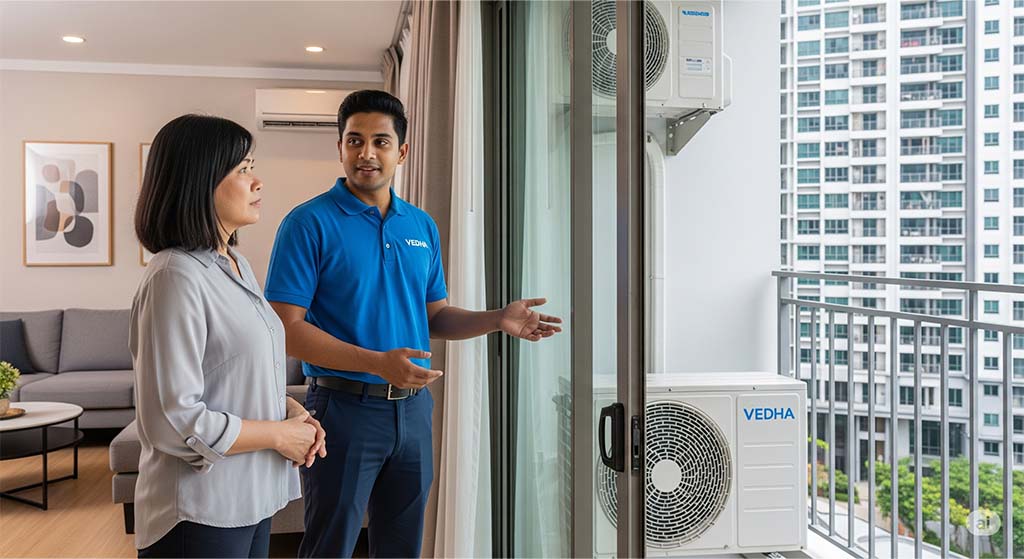
You’re renovating your 4-room HDB. The aircon salesperson rattles off options. “System 3 or System 4? Depends on your BTU requirements and connection ratio tolerance…”
You nod like you understand. You don’t.
Two weeks later, you’ve spent $4,800 on a System 4. All four units installed. But when you run the living room and all three bedrooms simultaneously, every room feels weaker than expected. The salesperson mentioned something about “block load” but you didn’t catch what that meant.
This happens constantly. Singapore homeowners spend thousands on aircon systems without understanding what the “system number” actually determines. Then they live with underperformance for 10 years because the configuration was wrong from day one.
Here’s what you actually need to know.
What System 2, 3, and 4 Actually Mean (The Simple Explanation)
The number tells you how many indoor units (fan coils on your walls) connect to one outdoor unit (compressor on your AC ledge).
System 2: 1 outdoor unit + 2 indoor units System 3: 1 outdoor unit + 3 indoor units
System 4: 1 outdoor unit + 4 indoor units System 5: 1 outdoor unit + 5 indoor units (increasingly rare in 2026)
Think of it like your home WiFi. One router (outdoor unit) broadcasts signal to multiple devices (indoor units). The router’s power determines how well all devices perform when running simultaneously.
Same concept with aircon. The outdoor compressor is the heart. It does the actual cooling work. Indoor units just blow the cooled air into rooms.
The critical part most salespeople skip: If your outdoor unit has 30,000 BTU capacity but you connect indoor units totaling 45,000 BTU, you’ve created a bottleneck. When all indoor units run together, the system can’t deliver full cooling to every room.
This is called exceeding the “connection ratio.” It’s the single biggest mistake homeowners make.
The April 2025 Regulatory Change
Before we dive into specific recommendations, understand what changed in Singapore’s aircon market.
Effective April 1, 2025: National Environment Agency (NEA) raised minimum energy performance standards.
New requirements:
- Multi-split systems (System 2/3/4/5): Minimum 5-tick rating MANDATORY
- Single-split systems: Minimum 4-tick rating
What this means: The “budget” 2-tick and 3-tick multi-split systems are now ILLEGAL to sell for new installations. The market shifted entirely to high-efficiency inverter technology.
Why it matters: 5-tick systems cost 15-25% more upfront than old 3-tick systems. But government introduced Climate Vouchers to offset this.
Climate Vouchers available:
- Total: $400 per eligible household
- Released in two tranches: $300 (April 2024), $100 (April 15, 2025)
- Valid until: December 31, 2027
- Eligible: All Singaporean/PR households in HDB flats AND private properties
- Restriction: Only works for 5-tick rated appliances
For a System 3 costing $3,800, the $400 voucher brings net cost to $3,400. This basically eliminates the 5-tick premium.
HDB Technical Constraints
HDB flats have strict limits that determine what system you can install. Ignore these and your contractor will need to rip everything out and start over.
ELECTRICAL LOADING LIMITS
Your flat’s electrical infrastructure determines maximum aircon capacity.
Pre-1994 HDB flats (30-Ampere main switch):
- Maximum running current for aircon: 8.5 Amps
- What this means: System 4 with high-capacity units often exceeds this limit
- Consequence: Circuit breaker trips when all units run simultaneously
Post-1994 HDB flats or upgraded flats (40-Ampere main switch):
- Higher capacity allowed (typically 20A isolator limit)
- Can support System 4 and even System 5 without issues
How to check: Look at your main switch in the distribution board. If it says “30A,” you’re limited. If “40A,” you have more flexibility.
STRUCTURAL WEIGHT LIMITS (AC LEDGE)
The aircon ledge is a cantilevered structure with weight restrictions.
Standard HDB flats: Maximum 110kg per wall panel Older HDB flats (pre-1994): Maximum 80kg per wall panel
Typical compressor weights:
- System 2 outdoor unit: 35-45kg
- System 3 outdoor unit: 40-55kg
- System 4 outdoor unit: 60-75kg
- System 5 outdoor unit: 70-85kg
What this means: A single large outdoor unit almost always fits within limits. But attempting to install TWO separate systems (like System 3 + System 2) on the same ledge panel in an old flat with 80kg limit can breach structural safety.
NOISE REGULATIONS
NEA sets boundary noise limits:
- Daytime (7am-7pm): 60-65 dBA
- Nighttime (7pm-7am): 50-55 dBA
Modern 5-tick inverter compressors operate at 46-52 dBA (well within limits). But multiple outdoor units close together create cumulative noise. If your neighbor’s unit is adjacent to yours, combined noise can trigger complaints.
Understanding BTU and Connection Ratios
BTU (British Thermal Unit): Cooling power measurement. Higher BTU means stronger cooling.
Standard indoor unit sizes:
- 9,000 BTU: Small/common bedrooms
- 12,000 BTU: Master bedrooms
- 18,000 BTU: Living rooms (standard)
- 24,000 BTU: Large living rooms or open-concept spaces
Connection Ratio: Total BTU of indoor units divided by outdoor unit BTU capacity.
Industry standard: 100-130% connection ratio
Example calculation:
System 4 setup:
- 3 bedrooms: 9,000 BTU each = 27,000 BTU
- 1 living room: 18,000 BTU
- Total indoor BTU: 45,000 BTU
If outdoor unit capacity is 33,000 BTU: Connection ratio = 45,000 / 33,000 = 136%
This EXCEEDS the safe 130% threshold. When all four units run simultaneously, cooling performance suffers across all rooms.
Why manufacturers allow this: Residential usage shows “diversity.” Living room runs during evening. Bedrooms run at night. Rarely do ALL rooms need maximum cooling simultaneously.
But if you host gatherings or have large families where all rooms run together regularly, exceeding 130% connection ratio creates noticeable weakness.
The fix: Either upgrade to higher-capacity outdoor unit, or reduce indoor unit BTU sizes, or split into two separate systems.
System 2 – When It Makes Sense
Configuration: 1 outdoor unit + 2 indoor units
Best for:
- 2-room Flexi HDB flats
- 2-bedroom condos
- Supplementing existing systems (cooling just living room + dining room)
Advantages:
1. Perfect connection ratio: With only 2 indoor units, you typically maintain 100% connection ratio. Both units get full cooling power.
2. Lower electrical draw: Smaller compressor means lower amperage. Works perfectly in older HDBs with 8.5A limit.
3. Simple and reliable: Fewer components mean fewer potential failure points.
4. Cost-effective for small spaces: For 2-bedroom properties, System 2 delivers exactly what’s needed without overpaying.
Disadvantages:
1. Higher per-unit cost: If you compare cost per indoor unit, System 2 is more expensive than System 4 (economies of scale).
2. Limited expandability: Can’t add more indoor units later without replacing entire outdoor unit.
3. Uses AC ledge inefficiently: If you have space for larger outdoor unit, you’re not maximizing the available capacity.
Typical configurations:
2-room Flexi HDB:
- Master bedroom: 9,000 BTU
- Living room: 12,000 BTU
- Total: 21,000 BTU
- Outdoor unit: 21,000-24,000 BTU
2-bedroom condo:
- Bedroom 1: 9,000 BTU
- Bedroom 2: 9,000 BTU
- Total: 18,000 BTU
- Outdoor unit: 18,000-21,000 BTU
Cost range (2026 market, 5-tick systems):
- Budget brands (Midea): $2,200-2,600
- Mid-range (Panasonic): $2,500-2,900
- Premium (Daikin, Mitsubishi): $2,700-3,200
Prices include standard installation (15m piping per unit, basic insulation).
System 3 – The Sweet Spot for Most HDB Flats
Configuration: 1 outdoor unit + 3 indoor units
Best for:
- 3-room HDB flats
- 3-bedroom condos (bedrooms only, separate living room unit)
- 4-room HDB if one room unused
Why System 3 is the “Goldilocks” choice:
1. Perfect for 3-room HDB layout: 2 bedrooms + living room = 3 units. Natural fit.
2. Optimizes 8.5A electrical limit: System 3 with moderate BTU indoor units typically stays within old HDB electrical restrictions.
3. Best value proposition: Cost per unit is reasonable. Not as cheap as System 4 but significantly better than System 2.
4. Manageable connection ratio: Easier to stay within 100-120% safe range.
Typical 3-room HDB configuration:
- Master bedroom: 9,000 BTU
- Common bedroom: 9,000 BTU
- Living room: 18,000 BTU
- Total: 36,000 BTU
- Recommended outdoor unit: 30,000-33,000 BTU
- Connection ratio: 109-120% (SAFE)
Typical 3-bedroom condo configuration (bedrooms only):
- Master bedroom: 12,000 BTU
- Bedroom 2: 9,000 BTU
- Bedroom 3: 9,000 BTU
- Total: 30,000 BTU
- Outdoor unit: 27,000-30,000 BTU
- Connection ratio: 100-111% (OPTIMAL)
Advantages:
1. Market standard: Most competitive segment in Singapore. Lots of promotions and packages.
2. Parts availability: Service providers stock System 3 components readily.
3. Proven reliability: Decades of usage data show System 3 is the most stable configuration.
4. Resale value: Buyers expect System 3 in 3-room flats. Having it installed adds value.
Disadvantages:
1. No room for expansion: If you convert study to bedroom later, you’re maxed out.
2. Living room might be underpowered: If you have open-concept kitchen, 18,000 BTU living room unit struggles.
Cost range (2026 market, 5-tick systems):
- Budget brands (Midea, Gree): $3,200-3,600
- Mid-range (Panasonic, LG): $3,500-4,200
- Premium (Daikin, Mitsubishi): $3,800-4,800
After $400 Climate Voucher: $2,800-4,400 net cost
System 4 – For Larger HDB Flats and Condos
Configuration: 1 outdoor unit + 4 indoor units
Best for:
- 4-room HDB flats (3 bedrooms + living room)
- 4-bedroom condos
- Large 3-bedroom condos with separate living/dining areas
The System 4 promise: Cover all rooms with one outdoor unit. Maximize cost-efficiency per unit.
The System 4 reality: This is where connection ratio problems appear most often.
Typical 4-room HDB configuration:
- Master bedroom: 12,000 BTU
- Common bedroom 1: 9,000 BTU
- Common bedroom 2: 9,000 BTU
- Living room: 18,000 BTU
- Total indoor BTU: 48,000 BTU
Problem: Standard System 4 outdoor unit capacity: 33,000-36,000 BTU
Connection ratio: 48,000 / 33,000 = 145% (TOO HIGH)
What happens: When all four units run simultaneously:
- Outdoor compressor hits maximum capacity
- Refrigerant flow gets limited
- Each indoor unit receives reduced cooling power
- Rooms feel “lukewarm” instead of cold
- Dehumidification stops (room feels cold but sticky/clammy)
Solutions:
Option 1 – Upgrade outdoor unit capacity: Use high-capacity outdoor unit (38,000-40,000 BTU)
- Connection ratio: 48,000 / 38,000 = 126% (ACCEPTABLE)
- Cost increase: $300-500
- Availability: Limited in residential series, more common in “semi-commercial” lines
Option 2 – Reduce indoor unit sizes:
- Master bedroom: 9,000 BTU (instead of 12,000)
- Common bedroom 1: 9,000 BTU
- Common bedroom 2: 9,000 BTU
- Living room: 18,000 BTU
- Total: 45,000 BTU
- Connection ratio with 36,000 BTU outdoor unit: 125% (ACCEPTABLE)
Option 3 – Split into two systems:
- System 3 for bedrooms: 9k + 9k + 12k = 30,000 BTU
- System 1 for living room: 18,000 BTU
- Total cost higher but performance guaranteed
Advantages of System 4:
1. Lowest cost per unit: Economies of scale. If connection ratio is managed properly, best value.
2. Single outdoor unit: Only one compressor to maintain.
3. Maximizes ledge space: Uses available AC ledge capacity efficiently.
Disadvantages:
1. Single point of failure: If outdoor compressor dies, entire home loses cooling. Major inconvenience during Singapore heat.
2. Connection ratio challenges: Hard to configure without exceeding safe limits.
3. Higher electrical load: May require 20A isolator in older HDBs.
Cost range (2026 market, 5-tick systems):
- Budget brands (Midea, Gree): $4,200-4,800
- Mid-range (Panasonic, LG): $4,800-5,500
- Premium (Daikin, Mitsubishi): $5,200-6,200
After $400 Climate Voucher: $3,800-5,800 net cost
System 5 – Rare and Problematic in 2026
Configuration: 1 outdoor unit + 5 indoor units
Designed for: 5-room HDB flats, Executive flats, Maisonettes
Current market reality: System 5 is declining in availability.
Why it’s disappearing:
1. Manufacturers limiting production: Many brands (including Mitsubishi) stopped offering System 5 in standard residential series. Requires “mini-VRV” commercial-grade chassis.
2. Connection ratio nightmare: Impossible to stay within 130% safe ratio with 5 units.
Example:
- 3 bedrooms: 9,000 BTU each = 27,000 BTU
- 1 master bedroom: 12,000 BTU
- 1 living room: 24,000 BTU
- Total: 63,000 BTU
Even largest residential outdoor units (40,000 BTU): 63,000 / 40,000 = 157% (WAY TOO HIGH)
3. Weight concerns: System 5 outdoor units (70-85kg) approach or exceed weight limits on older HDB ledges.
4. Electrical load: Often exceeds 8.5A limit in pre-1994 flats.
Better alternatives for 5-room flats:
Option A – Dual System approach:
- System 3 for bedrooms (9k + 9k + 12k)
- System 2 for living/dining (18k + 12k)
- Benefits: Redundancy (if one fails, half the house still cools), better connection ratios, distributed electrical load
Option B – System 4 + System 1:
- System 4 for main areas
- System 1 for study or additional bedroom
- Flexibility in configuration
Cost comparison:
System 5 (if available): $5,500-7,000
Dual system (System 3 + System 2): $5,800-7,500
Price difference: $300-500
Value proposition: Dual system’s redundancy and performance reliability justify slight premium.
The 5-Room HDB Special Case (Most Misunderstood)
5-room HDB flats present unique challenges.
Why standard System 4 fails:
5-room living rooms are HUGE. Often 35-40 square meters. Open-concept kitchen adds heat load.
Standard 18,000 BTU unit is insufficient. Needs 24,000 BTU minimum.
But 24,000 BTU living room unit plus three 9,000 BTU bedrooms = 51,000 BTU total.
No residential System 4 outdoor unit handles this without massive over-connection.
Recommended approach for 5-room flats:
Configuration A – Premium choice:
- System 3 for bedrooms (9k + 9k + 12k = 30k BTU)
- System 2 for living/dining (24k + 12k = 36k BTU)
- Total cost: $5,800-7,200
- Performance: Excellent, both systems run at optimal connection ratios
Configuration B – Budget choice:
- System 4 carefully configured:
- 3 bedrooms: 9k each = 27k BTU
- Living room: 18k BTU (accept it’s slightly underpowered)
- Total: 45k BTU
- High-capacity outdoor unit: 38k-40k BTU
- Connection ratio: 118%
- Total cost: $4,800-5,800
- Performance: Acceptable if living room usage is moderate
Configuration C – Maximum cooling:
- System 3 for bedrooms (9k + 9k + 12k)
- System 1 for living (24k BTU)
- System 1 for dining/study (12k BTU)
- Total cost: $6,200-7,800
- Performance: Every room gets dedicated, powerful cooling
Brand Comparison for 2026 (What You’re Actually Paying For)
All 5-tick systems meet minimum efficiency. But brands differentiate on features, build quality, and longevity.
DAIKIN (iSmileEco+ Series)
Strengths:
- Market leader in Singapore
- Compact outdoor units (fits through narrow BTO windows)
- Built-in WiFi (no dongles needed)
- Native smart home integration (Google Home, Alexa)
- Highest CSPF ratings (6.5-7.0 range)
Weaknesses:
- Premium pricing (15-20% above Midea)
- App can be complex for non-tech users
Best for: Smart home enthusiasts, BTO owners with tight installation spaces
System 3 price range: $3,800-4,800
MITSUBISHI ELECTRIC (Starmex Series)
Strengths:
- Quietest operation (19 dBA indoor noise)
- “Easy Clean” chassis (tool-free filter access)
- Dual Barrier anti-corrosion coating
- “I-See” thermal sensor (targeted cooling)
- Legendary reliability
Weaknesses:
- WiFi requires separate adapter
- Slightly larger outdoor units (installation can be tighter fit)
Best for: Light sleepers, families prioritizing quiet operation and easy maintenance
System 3 price range: $4,200-5,200
PANASONIC (X-Deluxe / NanoeX Series)
Strengths:
- Nanoe™ X air purification (kills bacteria, viruses, mold)
- Works in Fan Mode without cooling (standalone air purifier function)
- Good middle-ground pricing
- Robust build quality
Weaknesses:
- Comfort Cloud app setup more complex than Daikin
- NanoeX feature adds $200-300 to price
Best for: Families with young children, asthmatics, pet owners, health-conscious buyers
System 3 price range: $3,800-4,800
MIDEA (All Easy Pro Series)
Strengths:
- 20-30% cheaper than Japanese brands
- Fully meets 5-tick mandate
- Decent CSPF (5.5-5.8 range)
- Aggressive warranty offers
Weaknesses:
- Plastic quality noticeably lower grade
- Long-term electronics reliability concerns in humid climate
- Less established service network
Best for: Rental properties, budget-conscious buyers, secondary units
System 3 price range: $3,200-3,800
LG (DualCool Series)
Strengths:
- ThinQ smart platform integration
- PM1.0 particulate sensors (air quality monitoring)
- Competitive pricing
- Growing service network
Weaknesses:
- Brand perception below Japanese tier
- Features can be gimmicky (gold fin coating not always necessary)
Best for: Air quality focus, value-conscious buyers wanting smart features
System 3 price range: $3,500-4,200
Installation Quality Matters More Than Brand (The Truth Salespeople Hide)
A premium Mitsubishi Starmex installed poorly performs worse than budget Midea installed correctly.
Installation determines 50% of long-term performance and longevity.
CRITICAL INSTALLATION SPECIFICATIONS:
1. Copper Piping Grade
Standard: SWG 23 (0.61mm wall thickness) – Thin, prone to corrosion Upgrade: SWG 22 (0.71mm wall thickness) – Thicker, significantly stronger
R32 refrigerant operates at 1.6x higher pressure than old R22. Thin piping risks bursting under pressure.
Cost difference: $100-200 for entire system Value: Prevents catastrophic leaks in concealed piping (repair cost: $800-1,500)
Always specify SWG 22 piping.
2. Insulation Thickness and Grade
Standard: 3/8 inch (9mm) Class 1 insulation – Inadequate for Singapore humidity Upgrade: 1/2 inch (13mm) Class 0 Armaflex insulation – Proper vapor barrier
Thin insulation causes condensation on pipes. Water drips from ceiling trunking. Damages drywall and furniture.
Cost difference: $150-250 Value: Prevents water damage (repair cost: $500-2,000)
Always specify 1/2 inch Class 0 insulation.
3. Drainage Pipe Diameter
Standard: 13mm (1/2 inch) PVC pipe – Clogs easily with biofilm Upgrade: 16mm (5/8 inch) PVC pipe – Better flow, less clogging
Larger diameter allows faster drainage. Prevents “aircon jelly” accumulation that blocks pipes.
Cost difference: $50-80 Value: Reduces service calls for water leaks (service call + repair: $150-300)
Specify 16mm drainage minimum.
4. Electrical Safety
Standard: 13A power socket Upgrade: Dedicated 20A Double Pole (DP) isolator
DP isolator cuts both Live and Neutral wires. Safer during servicing. Required for high-capacity System 4/5.
Cost: $150-250 Value: Safety and compliance
5. Vacuum Pump Procedure
Critical but often skipped: After connecting refrigerant pipes, system must be vacuumed to remove air and moisture.
Proper vacuum: 30-45 minutes using calibrated vacuum pump, achieving -750mmHg Shortcut method: Quick 5-minute “suck” – Inadequate
Air and moisture in refrigerant lines cause:
- Ice formation in expansion valve
- Compressor damage from non-condensables
- Reduced cooling efficiency
- Premature system failure
Verify contractor uses proper vacuum pump and timing.
Total upgrade costs: $450-780 above standard installation
Is it worth it? Absolutely. These upgrades prevent 80% of post-installation problems and extend system life by 3-5 years.
Hidden Costs Nobody Mentions Upfront
“Free installation” packages typically include 15m piping per indoor unit, basic wire, standard insulation. This covers maybe 60% of actual requirements.
COMMON ADDITIONAL CHARGES:
Piping extension: $30-40 per meter beyond 15m allowance
- Scenario: Master bedroom at far end of 5-room flat needs 22m run
- Extra cost: 7m × $35 = $245
Stainless steel bracket: $150-250 if no AC ledge
- Common in corridor-access HDB flats
- Must be Grade 304 stainless (rust-resistant)
False ceiling cutting and patching: $100-200
- Concealed piping requires cutting drywall
- Contractor patches but rarely paints to match
Additional power points: $150-250 each
- Each indoor unit needs dedicated power point
- Often missing in new BTO flats
High ceiling surcharge: $50-80 per unit
- Units installed above 3 meters height
- Requires taller ladders, increased labor time
Weekend/evening installation: $100-200 premium
- If you can only supervise installation outside working hours
TOTAL “HIDDEN” COSTS: $600-1,500 typical for 4-room HDB System 3/4
How to avoid surprises: Request itemized quote BEFORE work starts. Ask specifically about piping length allowance, material grades, and surcharge policies.
Common Mistakes That Cost Thousands
MISTAKE 1: OVERSIZING INDOOR UNITS
Many homeowners buy 12,000 BTU units for small 10 sqm bedrooms thinking “bigger is better.”
Reality: Oversized units cause “short cycling.”
Unit cools air from 28°C to 24°C in 3 minutes. Compressor shuts off. But it hasn’t run long enough to remove moisture (latent heat).
Result: Room feels cold but sticky/clammy. Musty smell develops. Mold grows on walls.
Plus, constant on-off cycling wears out compressor relay. Unit dies prematurely.
Proper approach: Match BTU to room size.
- 10 sqm bedroom: 9,000 BTU
- 15 sqm master bedroom: 12,000 BTU
- 25 sqm living room: 18,000 BTU
- 35 sqm living room: 24,000 BTU
MISTAKE 2: IGNORING CONNECTION RATIO
Salesperson: “System 4 covers all four rooms!”
Reality: They installed four 12,000 BTU units (48k total) on 33,000 BTU outdoor unit. Connection ratio: 145%.
When all units run together, performance sucks.
Verification: Ask for outdoor unit BTU capacity. Calculate total indoor BTU. Ensure ratio stays under 130%.
MISTAKE 3: CHEAP INSTALLATION
Contractor quotes $2,800 for System 3. Market rate is $3,500-3,800. You save $700!
Six months later: Water dripping from ceiling trunking. Contractor used thin 3/8 inch insulation and SWG 24 piping. Condensation everywhere.
Repair: $1,200 to replace all trunking insulation.
Net result: Lost $500 plus major inconvenience.
Reality: Installation quality determines long-term performance. Budget contractors cut corners on invisible components.
MISTAKE 4: SKIPPING SITE SURVEY
You buy online based on standard 4-room HDB configuration.
Installation day: Contractor discovers your AC ledge has weight restriction (old flat). Can’t install specified System 4 outdoor unit. Needs smaller capacity unit.
Now connection ratio is 160%. Performance will be terrible.
Prevention: Always do physical site survey before purchasing. Verify electrical capacity, ledge weight limit, piping distances.
MISTAKE 5: NOT USING CLIMATE VOUCHERS
You’re eligible for $400 Climate Vouchers but don’t know about the program. Pay full price.
Check eligibility: climate-friendly-households.gov.sg Register before purchasing. Vouchers work at all major retailers (Courts, Gain City, Best Denki, Harvey Norman).
Total Cost of Ownership Over 10 Years
Most people only consider purchase price. Smart buyers calculate 10-year total cost.
SYSTEM 3 EXAMPLE (4-room HDB):
Upfront costs:
- Equipment + standard installation: $3,800
- Material upgrades (piping, insulation): $300
- Additional power point: $200
- Subtotal: $4,300
- Less Climate Voucher: -$400
- Net upfront: $3,900
Annual electricity costs:
- CSPF 6.5 system, usage 8 hours/night
- Estimated consumption: 2,600 kWh/year
- At $0.2911/kWh: $757/year
Maintenance costs:
- Quarterly general servicing: $70 × 4 = $280/year
- Chemical overhaul (every 2 years): $450 / 2 = $225/year
- Annual maintenance: $505
10-year totals:
- Upfront: $3,900
- Electricity: $7,570
- Maintenance: $5,050
- Total 10-year cost: $16,520
Cost per year: $1,652
COMPARISON: Budget 3-tick system (if it were still legal):
- Upfront: $2,800 (no Climate Voucher – doesn’t qualify)
- Electricity: $11,500 (lower CSPF, higher consumption)
- Maintenance: $5,050 (same)
- Total 10-year cost: $19,350
5-tick system saves $2,830 over 10 years despite higher upfront cost.
This is why 5-tick mandate makes economic sense for homeowners.
Dual System vs Single Large System
For 4-room and 5-room flats, you face a choice:
Option A – Single System 4: All eggs in one basket. If compressor fails, entire home loses cooling.
Option B – Dual systems (System 3 + System 1 or System 2 + System 2): Distributed risk. If one system fails, half the home still cools.
Cost comparison:
Single System 4: $4,800-5,500
Dual System 3 + System 1: $5,200-6,000 Cost difference: $400-500 premium
Redundancy value: During compressor failure waiting for repair (typically 3-7 days for parts), dual system means:
- Half your home still cools
- Can sleep in working bedrooms
- Can move to working living room during day
Single system failure: Entire home 30°C+ for a week during Singapore heat.
For 5-room flats with families (children, elderly): Dual system’s $400-500 premium is worthwhile insurance.
For 4-room flats with working couples (home only evenings): Single System 4 acceptable if budget tight.
Future-Proofing Considerations
ELECTRICAL VEHICLE (EV) CHARGING:
If you plan to install EV charger in future, it competes for electrical capacity.
EV charger: 7-15 Amps typical draw
Combined with 8.5A aircon limit in old HDBs, you might breach 30A main switch capacity.
Planning for EV? Consider dual smaller systems instead of one large system to distribute load.
SMART HOME INTEGRATION:
2026 aircons increasingly feature WiFi and smart controls. Future buyers expect this.
Brands with best smart integration:
- Daikin: Built-in WiFi, Google Home/Alexa native
- Samsung: SmartThings ecosystem
- LG: ThinQ platform
Budget brands often require separate WiFi dongles ($80-150) or lack smart features entirely.
Resale value consideration: Smart-enabled aircon adds perceived value.
REFRIGERANT TRANSITION:
R32 is current standard. But R290 (propane) and HFO refrigerants are coming.
By 2030, we might see another refrigerant transition.
Choosing established brands (Daikin, Mitsubishi) ensures better service support during transitions. Budget brands may orphan older models.
Special Situations
MAISONETTES AND EXECUTIVE FLATS:
Multi-level homes face piping distance challenges.
Maximum residential system piping: 50-70m total length, 20-25m single run, 15m elevation difference
Maisonette scenario: Compressor on 1st floor kitchen yard, bedroom on 3rd floor.
Vertical distance alone: 8-10 meters Horizontal run: 15-20 meters
Total: 25-30 meters (approaching limits)
Elevation head pressure reduces refrigerant flow. Compressor works harder.
Solution: Consider VRV-S (Variable Refrigerant Volume) semi-commercial system. Designed for longer piping runs and elevation changes.
Cost premium: 30-50% above standard multi-split Performance: Significantly better for multi-level homes
RENTAL PROPERTIES:
Landlord’s priority: Minimize upfront cost while meeting tenant expectations.
Recommendation: Midea or Gree 5-tick system
- Meets regulatory mandate
- Adequate cooling performance
- 20-30% cheaper than Japanese brands
- Sufficient for 2-year lease cycles
Don’t cheap out on: Installation quality. Use SWG 22 piping and proper insulation. Bad installation creates tenant complaints and water damage claims.
CONDOS WITH CONCEALED TRUNKING:
Pipes and drainage hidden in false ceilings or walls. Replacement requires major renovation.
Critical: Use absolute highest-grade materials.
- SWG 22 copper minimum
- 1/2 inch Class 0 insulation
- Quality fittings and joints
- Rigorous pressure testing before closing walls
Pipe failure in concealed trunking: $2,000-5,000 repair (wall demolition, pipe replacement, ceiling reconstruction, repainting).
Extra $300 on installation materials prevents this nightmare.
What VD Aircon Recommends
Based on 9+ years servicing Singapore homes, here’s our honest guidance.
FOR 3-ROOM HDB:
Standard choice: System 3
- 2 bedrooms (9k each) + living room (18k)
- Premium brand (Daikin/Mitsubishi) if budget allows
- Budget brand (Midea) if cost-conscious
- Ensure SWG 22 piping and 1/2 inch insulation
FOR 4-ROOM HDB:
Best performance: System 4 with high-capacity outdoor unit
- Verify outdoor unit is 38k-40k BTU minimum
- Keep total indoor BTU under 45k
- Alternatively: System 3 + System 1 for redundancy
Budget approach: System 3 for bedrooms, separate System 1 for living room later
FOR 5-ROOM HDB:
Recommended: Dual system (System 3 + System 2)
- System 3 for bedrooms (9k + 9k + 12k)
- System 2 for living/dining (24k + 12k)
- Best performance and redundancy
- Worth the $400-500 premium
Budget approach: Single System 4 but accept living room might be slightly underpowered
FOR CONDOS:
2-bedroom: System 2, premium brand, top-grade installation 3-bedroom: System 3 for bedrooms, separate System 1-2 for living areas Maisonette: VRV-S system to handle elevation and distance challenges
BRAND RECOMMENDATIONS:
Quiet operation priority: Mitsubishi Starmex Smart home integration: Daikin iSmileEco+ Air quality focus: Panasonic NanoeX Budget-conscious: Midea All Easy Pro Balanced choice: LG DualCool
Installation Quality Checklist
Before contractor closes walls/ceilings, verify:
1. Piping specifications:
- Ask: “What SWG rating?” (Accept only SWG 22)
- Check copper color: Should be clean reddish, not oxidized/green
2. Insulation:
- Measure thickness: Minimum 13mm (1/2 inch)
- Check coverage: No exposed copper anywhere
3. Drainage:
- Verify pipe diameter: 16mm minimum
- Test slope: Water should flow freely, not pool
4. Vacuum procedure:
- Confirm vacuum pump used (not just refrigerant flush)
- Timing: Minimum 30 minutes vacuum time
- Pressure reading: Should reach -750mmHg or below
5. Gas charging:
- Weigh refrigerant: Should match specification (check manual)
- Pressure readings: Record subcooling and superheat values
6. Leak testing:
- Soap bubble test on all joints
- 24-hour pressure hold test before covering pipes
7. Documentation:
- Photograph all work before closing walls
- Keep material receipts (piping grade, insulation specs)
- Warranty documentation
Final Decision Framework
STEP 1: Determine your property constraints
- HDB electrical limit (8.5A vs 20A)
- AC ledge weight limit (80kg vs 110kg)
- Number of rooms needing cooling
STEP 2: Calculate BTU requirements
- Small bedrooms: 9,000 BTU
- Master bedrooms: 12,000 BTU
- Standard living rooms: 18,000 BTU
- Large living rooms: 24,000 BTU
STEP 3: Verify connection ratio
- Total indoor BTU / Outdoor unit BTU
- Must stay under 130%
STEP 4: Choose between single vs dual system
- Single system: Lower cost, accept single-point-of-failure risk
- Dual system: $400-500 premium, redundancy protection
STEP 5: Select brand tier
- Premium (Daikin, Mitsubishi): Best features, quietest, most reliable
- Mid-tier (Panasonic, LG): Good balance of cost and performance
- Budget (Midea, Gree): Adequate performance, 20-30% savings
STEP 6: Prioritize installation quality
- Specify SWG 22 piping
- Specify 1/2 inch Class 0 insulation
- Verify vacuum procedure
- Budget $300-500 for material upgrades
STEP 7: Claim Climate Voucher
- Register at climate-friendly-households.gov.sg
- Reduces net cost by $400
- Only works with 5-tick systems
The Bottom Line
System choice matters less than most people think. Installation quality and proper sizing matter MORE.
A correctly-sized System 3 with quality installation outperforms poorly-configured System 4 every time.
Key priorities:
- Size correctly: Match BTU to room dimensions, stay under 130% connection ratio
- Install properly: SWG 22 piping, 1/2 inch insulation, rigorous vacuum procedure
- Choose reliable brand: Premium brands cost 15-25% more but last 30-40% longer
- Use Climate Vouchers: $400 subsidy essentially eliminates 5-tick premium
- Maintain regularly: Quarterly servicing, chemical overhaul every 2 years
Follow this framework and your aircon investment delivers 10-12 years of comfortable, efficient cooling.
Need Expert Guidance on System Selection?
VD Aircon Services provides free site surveys and honest recommendations for Singapore HDB and condo owners.
Our process:
✓ Physical site inspection (verify electrical capacity, weight limits, piping distances) ✓ BTU calculations based on actual room sizes and sun exposure ✓ Connection ratio verification to prevent underperformance ✓ Brand recommendations matching your budget and priorities ✓ Detailed quote including all material upgrades and potential additional costs
Why homeowners choose VD Aircon:
We’re the affordable aircon services provider that doesn’t compromise installation quality. Our reliable aircon servicing Singapore is built on proper sizing, premium materials, and transparent pricing.
As an aircon specialist Singapore contractors trust for training, we understand both technical requirements and real-world constraints.
We deliver the best aircon servicing Singapore standards with honest assessments. No overselling. No hidden costs.
Need urgent aircon servicing Singapore for failing systems? We’re available 24/7.
Check our aircon servicing deals for complete System 2/3/4 packages with installation and first-year maintenance included.
Contact VD Aircon Services:
📞 96540044 (Call/WhatsApp 24/7) 📧 vedha.airconservices@gmail.com 🌐 www.vdairconservices.com
Located: 11 Mandai Estate #02-04, ELDIX Singapore 729908
Schedule your free site survey today. We’ll help you choose the right system configuration, recommend quality brands within your budget, and ensure installation quality that lasts 10+ years.
Stop guessing. Get expert guidance.

We specialize in Aircon installation, repair, and service. We have all type & model of recon compressor, full set & fancoil. Our technicians are highly proficient in their respective field and repairs and fixes aircon of various brands.