Your phone buzzes. “Aircon refrigerant leak detected. Service scheduled for Thursday 2 PM. Estimated severity: Low. Unit continues operating safely.”
You didn’t call anyone. Your aircon diagnosed itself, booked the technician, and sent the alert. Three days before you would’ve noticed cooling performance drop.
This isn’t science fiction. It’s 2026 Singapore.
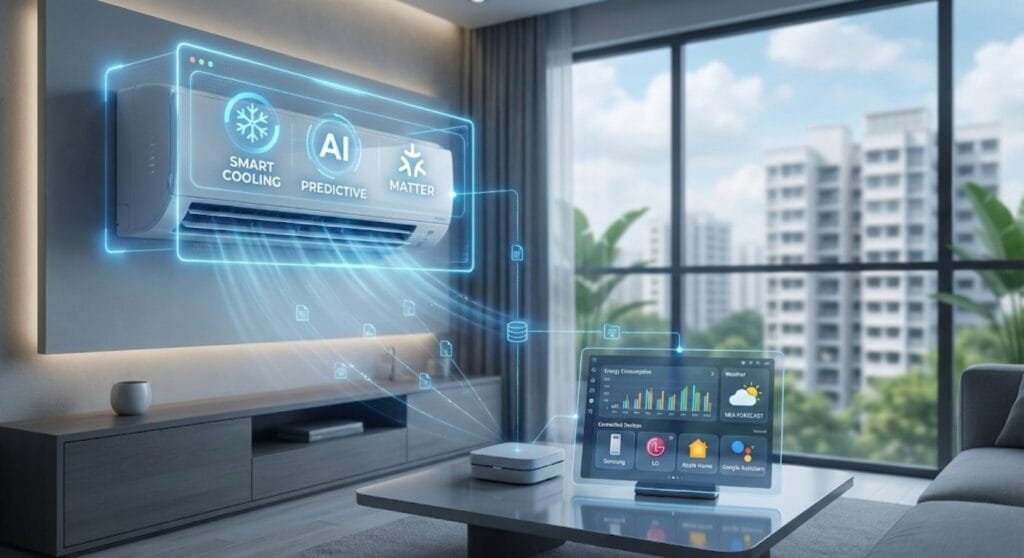
If you’re living in Tengah’s smart-enabled BTOs or Punggol Northshore’s smart homes, your aircon isn’t just cooling anymore. It’s monitoring electricity consumption in real-time, adjusting based on NEA weather forecasts, participating in grid demand response programs, and telling you when components will fail before they actually do.
Welcome to the Matter era. Where your Samsung aircon talks to your Apple HomePod, your LG unit responds to Google Assistant, and everything connects without the ecosystem wars that plagued smart homes five years ago.
For Singapore homeowners in 2026, especially those in HDB’s new smart estates, the question isn’t whether to make your cooling smart. It’s how to do it right.
The Matter Revolution (Why 2026 Is Different From 2020)
Remember 2020? If you bought a Samsung aircon, you needed SmartThings. Daikin required their proprietary app. Mitsubishi had their own system. Nothing talked to each other. Your phone had seven apps just to control home devices.
That fragmentation is dead.
Matter protocol unified everything. Developed by the Connectivity Standards Alliance (backed by Apple, Google, Amazon, Samsung), Matter is the universal language for smart homes.
By 2026, over 750 Matter-certified products exist. The average Singapore smart home contains 15-20 connected devices. That number was 8-10 in 2020.
Here’s what changed: Your aircon can now be controlled simultaneously by LifeSG (government app), Apple Home (family control), Google Assistant (voice), Samsung SmartThings (automation), and the manufacturer’s diagnostic cloud. All without conflicts or latency.
One device. Multiple control systems. Actually working.
How Matter Actually Works (Without the Tech Jargon)
Matter operates over Internet Protocol (IP). Same technology that runs the internet. This means devices connect to your home WiFi network and speak a standardized language.
For aircons, Matter 1.2 (released 2023) was the breakthrough. It added the “Room Air Conditioner” device type with controls for:
- Temperature setpoints
- Mode selection (Cool, Dry, Fan, Auto)
- Fan speed granularity
- Real-time power monitoring
Matter 1.4 (2025) brought energy management clusters. Your aircon can now report voltage, current draw, and accumulated kWh consumption directly to your smart home hub.
Matter 2.0 (2026) refined multi-admin control and added stability for complex automations.
Translation? Your aircon became a grid-aware computing device that optimizes for comfort, health, and cost simultaneously.
The Transport Layer Nobody Talks About
Matter uses two physical connection methods:
Matter over WiFi: This is what your actual aircon unit uses. Requires bandwidth for firmware updates and diagnostic telemetry. Since the unit plugs into power constantly, WiFi makes sense.
Matter over Thread: This is the secret weapon for sensors. Thread is a low-power mesh network perfect for battery-operated temperature and humidity sensors.
Why this matters in Singapore: Reinforced concrete HDB walls block 5GHz WiFi signals. A temperature sensor in the back bedroom can’t reliably connect to your router three rooms away.
Thread solves this. Smart plugs, light bulbs, and premium aircons act as Thread Border Routers, creating a mesh network. Battery sensors communicate through this mesh reliably even through thick walls.
Your Samsung WindFree or LG DualCool premium unit? It’s likely also your room’s Thread Border Router, anchoring the entire sensor network.
The Big Five Brands and Their Matter Strategy (2026 Edition)
Not all brands adopted Matter equally. Here’s how Singapore’s top aircon manufacturers handled integration.
Samsung (The Integration Leader)
Samsung went all-in. Their Bespoke AI WindFree series are Matter-native devices. They don’t just receive commands. They actively participate in the smart home ecosystem.
Native capabilities:
- Built-in Matter Controller (can control other Matter devices)
- Thread Border Router functionality
- AI Energy Mode exposed to Matter network (other devices can trigger based on aircon state)
The automation advantage: When your Samsung enters ultra-efficient WindFree mode, it can signal smart blinds to close automatically via Matter. This reduces solar heat gain, helping the compressor work less. Multi-device coordination that was impossible with proprietary systems.
Cost: Premium pricing ($2,200-3,500 for System 3). Worth it if you’re building a comprehensive smart home.
LG (The Sensor-First Approach)
LG’s ThinQ platform evolved into a robust Matter bridge. Newer DualCool models support Matter over WiFi natively. Older units integrate through ThinQ hub.
Standout feature: PM1.0 particulate sensors. These high-precision sensors are exposed to Matter as Air Quality Monitors.
Practical application: Your LG aircon detects construction dust spike from nearby Tengah development. It automatically triggers your standalone air purifier via Matter automation. Whole-home air quality management without manual intervention.
Cost: Competitive ($1,600-2,800 for System 3). Strong value for air quality-conscious families.
Daikin (The Hybrid Strategy)
Market leader in Singapore known for reliability. Their Matter approach is pragmatic.
Integration method: Updated WiFi adaptors function as Matter Bridges. The popular iSmileEco series connects to Apple Home and Google Home as standard thermostat devices.
Reiri for Home platform: For larger homes or landed properties, this local gateway aggregates multiple fan coil units and presents them to Matter network. Key advantage: works even when internet connection fails. Local control through LAN.
Cost: Mid-range ($1,800-3,200 for System 3). Established reliability with modern connectivity.
Mitsubishi Electric (The Engineering Bridge)
Starmex series maintains reputation for robust construction. Connectivity treated as modular add-on.
Official path: WiFi interface connects via cloud-to-cloud integration through manufacturer app. Latency can be noticeable.
The enthusiast path: Mitsubishi’s CN105 data port spawned a thriving ecosystem of third-party integrations. Tech-savvy homeowners use ESP32-based modules running ESPHome firmware.
These modules connect directly to CN105 port and expose the aircon as native Matter device on local network. Zero cloud dependency. Access to granular data like compressor frequency and vane position that official API hides.
Cost: Standard units ($1,700-3,000 for System 3). Third-party Matter integration adds $80-150 for hardware plus technical knowledge.
Panasonic (The Air Quality Specialist)
Comfort Cloud app and HEMS gateways serve as Matter bridges.
Notable implementation: Nanoe-X air purification technology maps to Matter Air Quality clusters. This allows automating purification independently from cooling.
Example automation: Kitchen air quality sensor detects cooking fumes. Triggers Nanoe-X in living room aircon without changing temperature settings. Targeted air treatment.
Cost: Competitive range ($1,600-2,900 for System 3).
Bridging Legacy Units: Smart IR Blasters in 2026
Got a “dumb” aircon from 2018-2020? Don’t replace it yet.
Smart IR Blasters evolved from simple remote cloners into sophisticated Matter bridges with edge computing.
Sensibo (Sky/Air Pro/Elements)
Dominant in Singapore’s retrofit market. Fully Matter-compliant by 2026.
Solved problem: State de-synchronization. Traditional IR control had no feedback. If someone used physical remote to turn aircon off, the app still thought it was on. Commands went nowhere.
Sensibo 2026 models use current-sensing smart plugs and audio analysis. They listen for the aircon’s confirmation beep, confirming digital state matches physical reality.
Climate React technology: Processes temperature and humidity rules locally on device. Instant response without cloud latency.
Cost: $180-280 per unit. Pays for itself through geofencing energy savings in 6-8 months.
SwitchBot Hub 2 & Hub 3
Aggressive Matter adoption. Hub 2 functions as Matter bridge exposing IR-controlled aircon as generic Matter Thermostat.
Built-in sensors: Temperature and humidity visible to entire smart home network.
Smart Learning: Refined IR waveform replication. Supports distinct codes for On/Off and specific mode changes. Handles complex Singapore brands (Daikin, Mitsubishi) with high fidelity.
Cost: $90-120 per hub. Budget-friendly Matter entry.
Aqara Hub M3
High-end bridging solution supporting Matter over Thread.
Edge computing: Processes automations locally. Internet fails? Hub still controls aircon based on local Thread sensor data.
360-degree IR: High-power emitters provide omnidirectional coverage. No direct line-of-sight needed in smaller HDB bedrooms. More flexible installation.
Cost: $180-220. Premium option for serious automation.
AI-Driven Cooling (The Physics of Prediction)
Traditional aircon logic: Current Temperature > Setpoint → Compressor On. React to heat.
AI cooling in 2026: Predicted Temperature > Setpoint → Pre-cool. Anticipate heat.
The difference costs 20-30% less electricity.
NEA Weather API Integration
Smart home hubs (Home Assistant, Samsung SmartThings, Google Home) now pull real-time data from National Environment Agency.
Data points ingested:
- Dry bulb temperature
- Relative humidity
- Rain radar (precipitation forecasts)
- UV index
Operational example: NEA API predicts heatwave hitting 34°C at 2 PM. AI system commands aircon to start pre-cooling at 1:30 PM.
Why this works: You cool the building envelope (walls, floors) early, potentially using cheaper off-peak electricity or solar generation. Avoids inefficient “turbo” ramp-up required to fight peak heat load later.
Your room stays comfortable. You never notice the optimization. Electricity bill drops 18-25%.
Rain adaptation: Heavy rain alert for Punggol received. AI anticipates rapid external temperature drop and humidity spike. Automatically shifts aircon from Cool mode to specialized Dry mode or WindFree.
Prevents uncomfortable cold room while external heat load on walls decreases. Addresses incoming humidity simultaneously.
Thermal Modeling (Your Home’s Digital Twin)
Advanced AI controllers (Ambi Climate, high-end native systems) build thermal profiles of specific rooms.
Learning pattern: Your master bedroom heats rapidly between 7-9 AM due to east-facing windows. AI proactively increases fan speed and cooling during this window before you feel temperature rise.
U-value estimation: By correlating outdoor temperature (NEA data) with indoor temperature rise rate (internal sensors) while aircon is off, AI estimates room insulation quality.
Poor insulation? Steeper cooling curve applied. Well-insulated room? Gentler approach saves electricity.
This happens automatically. Zero manual configuration.
Adaptive Humidity Control (Singapore’s Mold Challenge)
Singapore averages over 80% relative humidity. Traditional aircons cool air to dew point to remove moisture. Result: rooms either “cold and clammy” or freezing cold just to achieve dryness.
2026 solution: Software-simulated reheat. Set “Thermal Comfort Index” instead of fixed temperature. System balances temperature and humidity to achieve comfort.
Humidity high (>70%) but temperature acceptable? Aircon runs specialized dry mode that pulses compressor to remove moisture without significantly dropping temperature. No more “freezing but damp” sensation.
Automated anti-mold cycles: After cooling function turns off, smart controllers run Fan-Only cycle for 30-60 minutes. This dries evaporator coil and drainage pan, preventing moisture accumulation that feeds mold.
AI automates duration based on cooling session length and ambient humidity from sensors.
Predictive Maintenance (The End of Surprise Breakdowns)
This is where AI truly changes the game.
Refrigerant Leak Detection (Soft Faults)
Legacy systems detect leaks only when unit completely stops cooling. Smart systems detect “soft faults” weeks or months early.
Thermodynamic signature analysis: System continuously monitors temperature delta (intake air vs blowout air) and correlates with compressor power draw.
Detection logic: Refrigerant leak causes compressor to work harder (higher current) while achieving diminishing temperature delta.
AI detects 5% efficiency degradation over one week. Flags “Potential Low Refrigerant” alert to homeowner and service provider.
Intervention happens before system runs dry and damages compressor. Repair cost: $150-250. Avoided compressor replacement: $800-1,200.
Motor Signature Analysis
IoT sensors integrated into smart isolators or plugs sample electrical current at high frequency.
Pattern recognition: Dying fan motor or seizing compressor bearing exhibits specific irregularities in current waveform.
AI models trained on millions of operation hours identify these spectral signatures. System predicts motor failure or bearing seizure before physical breakdown.
“Preventative Repair” notification sent. You schedule service at convenience. No emergency midnight breakdown. No water damage from unexpected leaks.
Government Integration (Tengah and Punggol’s Smart Infrastructure)
Singapore’s HDB estates aren’t just residences. They’re connected ecosystems.
Tengah Forest Town (The Smart Cooling Testbed)
Tengah operates differently. Centralized Cooling System (CCS) managed by SP Group eliminates individual outdoor condensers.
How it works: Chilled water produced at highly efficient central rooftop plants, piped directly to Fan Coil Units (FCUs) in flats.
MyTengah app control: Residents monitor chilled water usage (measured in kWrh) in real-time. Transparency previously impossible.
System-level AI optimization: Backend OneTengah platform manages central chillers. System chills water during peak solar production, using water network as thermal battery to store renewable energy.
Challenge addressed: Early CCS rollouts faced condensation issues on trunking. 2026 mitigations include improved insulation and AI-controlled variable flow rates governed by estate’s central AI, adjusting flow based on dew point to minimize condensation risk.
For residents: You control your FCU. Backend efficiency delivers estate-wide carbon reduction.
Punggol Northshore Smart-Enabled Homes
Completed 2020. First HDB flats with built-in smart infrastructure.
Smart Distribution Boards: Break down electricity usage by circuit. Distinguish aircon circuit from lighting or kitchen circuits.
Gateway agnostic data: Commercial vendors build apps on this infrastructure. Link Smart DB data to third-party energy management apps.
Track aircon operational costs separate from rest of household. Powerful psychological tool for behavioral change.
Real example: Resident notices aircon circuit consuming 180 kWh monthly. Compares against neighbors (anonymized data). Realizes consumption 40% higher. Investigation reveals dirty coils reducing efficiency. One chemical wash brings consumption to 120 kWh. $18/month savings identified through data visibility.
LifeSG Integration
LifeSG evolved into “super app” for citizen services. By 2026, integrates utility and estate data.
Unified dashboard: View U-Save utility credits alongside consumption data. Secure portal (verified via Singpass) links to SP Utilities or retailer apps for granular control.
Climate Vouchers integration: Seamlessly use vouchers for purchasing energy-efficient appliances. Policy incentives connect directly with consumer action.
OneService reporting: Report estate-level cooling issues (noise from CCS pump, common area ventilation defects) directly through app. Tickets routed to town council smart management system for rapid resolution.
Energy Optimization (Dollars and Sense for 2026)
Economic argument for smart cooling is powerful when you run the numbers.
Geofencing (The Automation of Absence)
Your phone’s location services automate aircon based on presence.
Operational scenario: Leave HDB flat at 8 AM for work. Without geofencing, you might leave aircon on 25°C Eco Mode for pet, or simply forget to turn off.
With geofencing (radius 500m), system detects departure. Automatically triggers Away scene: either turns unit off completely or raises setpoint to 28°C (acceptable for pets with humidity control).
Data: Sensibo and Tado case studies show 15-25% energy savings in Singapore households from geofencing.
Math: Typical System 3 consuming 450 kWh monthly. 20% saving equals 90 kWh. At 2026 tariff ($0.2911/kWh with GST), that’s $26/month saved.
Sensibo costs $200. Payback period: 7-8 months. Pure savings after that.
Dynamic Pricing & Demand Response
Open Electricity Market (OEM) matured in 2026. Time-of-Use and Wholesale pricing plans available.
How it works: Retailers (Wholesale Electricity via SP, Geneco, Keppel Electric) offer fluctuating rates based on real-time grid demand. Lower during off-peak (afternoon solar peaks, late night). Higher during evening peaks.
Smart aircon response: Matter-connected aircon linked to Home Energy Management System monitors real-time price API.
Automation logic:
- Price < $0.20/kWh: AC runs at Comfort Setting (23°C)
- Price > $0.45/kWh (Peak): AC shifts to Eco Mode (26°C, Low Fan) or WindFree
User utilizes thermal inertia of home (cooled during cheaper period) to ride out price spike with minimal comfort impact.
Savings: Users on wholesale plans who automate high-load appliances reduce bills 15-30% versus regulated tariff.
Demand Response pilots: Energy Market Authority and SP Group incentivize households to reduce consumption during grid stress.
During designated DR Event (generator failure, extreme demand spike), grid sends signal to smart home hub. Hub automatically adjusts aircon setpoint up 2°C for 30 minutes.
You barely notice slight temperature shift. Aggregate load reduction across thousands of homes provides massive grid stability. You earn bill credits for participation.
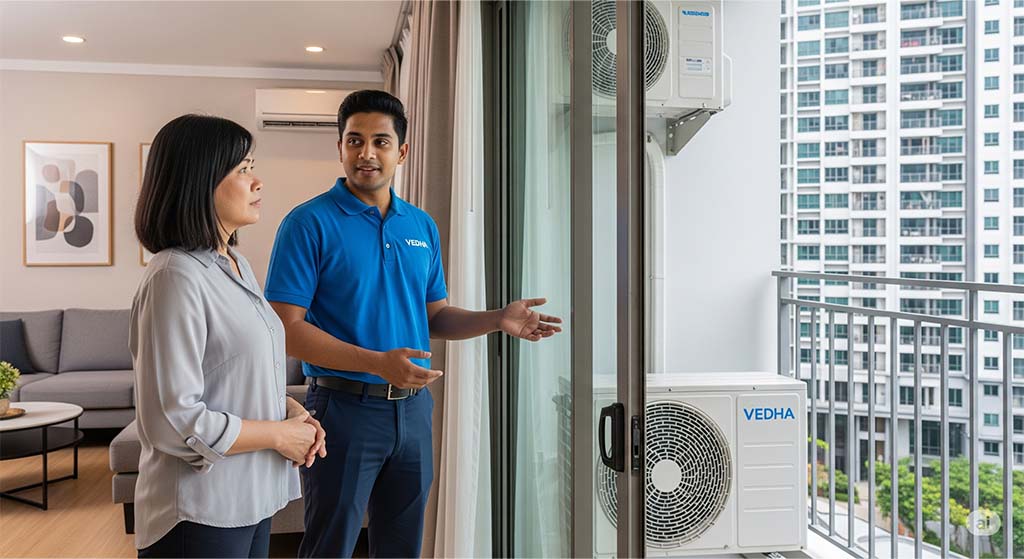
The Technician’s Evolving Role (Why Professional Service Matters More Now)
AI and self-healing networks didn’t eliminate the need for technicians. They changed what technicians do.
The Dirty Sensor Problem
Smart aircons rely entirely on data. Typical 2026 unit contains:
- Multiple thermistors (air intake, coil temperature)
- Humidity sensors
- Often optical PM2.5/PM1.0 sensors
Singapore’s challenge: Urban dust plus high moisture creates sticky sludge coating sensor surfaces.
Thermistors: Dust coat insulates the thermistor, causing thermal lag. Sensor reads dust insulation temperature, not air temperature. AI thinks room is warmer than reality. Drives compressor harder. Over-cools room. Negates AI energy savings.
PM2.5 sensors: Use light scattering to detect particles. Dust on lens causes light to scatter internally. False positives. Aircon believes air quality is poor. Ramps fan speed to “purify” air that’s actually clean. Wastes electricity.
Sensor drift: Electrochemical sensors drift over time. Uncalibrated humidity sensor reads 60% when reality is 75%. Adaptive Humidity Control algorithms fail. Mold growth risk increases as system fails to trigger drying cycles.
The Technician as Calibrator (2026 Service Protocol)
Smart aircon service in 2026 includes critical digital maintenance alongside physical cleaning:
1. Sensor cleaning: Specialized non-corrosive solvents and compressed air clean optical sensor lenses and thermistors. Restoring the “eyes” of AI.
2. Digital calibration: Technician uses reference psychrometer (highly accurate temperature/humidity meter) to verify aircon readings. Discrepancy found? Access Service Menu or Installer Settings to input offset, recalibrating system.
Example: AC reads 60% humidity. Reference reads 70%. Technician enters +10% offset. System now accurate. Adaptive algorithms work properly.
3. Firmware updates: Checking and updating Matter firmware ensures compatibility with latest mesh network security standards and feature sets.
4. Network diagnostics: Verify Thread mesh stability. Check WiFi signal strength. Ensure border router functioning correctly.
This is why “cheap” $15 general service fails smart homes. Physical cleaning without digital calibration leaves AI systems operating on bad data.
VD Aircon’s Smart Cooling Service (What We Actually Do Differently)
We’ve been servicing Singapore homes since 2016. The transition to smart systems required evolving our entire service protocol.
Smart System Assessment
When you contact us from Tengah, Punggol Northshore, or any smart-enabled home, our assessment includes:
Infrastructure audit:
- What smart home platform (Apple Home, Google Home, SmartThings, Home Assistant)?
- Native Matter devices or using bridges?
- Thread network present?
- Smart Distribution Board integration?
Current state evaluation:
- Are sensors calibrated?
- Is firmware current?
- Are automations working as intended?
- Energy consumption matching expectations?
Performance baseline: We establish digital baseline using Smart DB data and sensor readings. This creates comparison point for future optimization.
Smart Chemical Overhaul Service
Our chemical overhaul for smart-enabled systems includes standard physical cleaning PLUS:
Digital maintenance:
- Sensor cleaning and calibration
- Firmware updates
- Matter/Thread connectivity verification
- Smart plug current monitoring setup (if applicable)
- Automation testing and optimization
Documentation: Every service generates:
- Timestamped photos
- Before/after sensor readings
- Power consumption measurements
- Calibration offsets applied
- Firmware versions
All stored in cloud-accessible digital logbook. Export to PDF for insurance claims or Smart DB analysis.
Smart Upgrade Consultation
For homeowners with legacy units wanting to transition to smart cooling, we provide:
Option A – IR Blaster Retrofit:
- Hardware selection (Sensibo, SwitchBot, Aqara based on needs)
- Professional installation with optimal placement
- Matter integration and automation setup
- Geofencing configuration
- NEA weather API automation
Cost: $180-280 per unit plus installation ($80-120 for multiple units same visit)
Option B – Native Smart Unit Replacement:
- Brand consultation based on ecosystem (Samsung for SmartThings users, LG for air quality focus, Daikin for reliability)
- Proper sizing accounting for thermal modeling needs
- Installation with Thread Border Router configuration
- Multi-admin Matter setup (LifeSG + personal platform)
- First-year maintenance included
Cost: Equipment $1,600-3,500 depending on brand/size. Installation $300-500.
Predictive Maintenance Monitoring
For clients who opt-in, we integrate remote monitoring:
What we track:
- Compressor power draw trends
- Temperature delta degradation
- Refrigerant soft fault signatures
- Motor current waveform analysis
When alerts trigger: We contact you before breakdown. “We detected early refrigerant leak indicator. Schedule service next week to top up before efficiency drops further.”
Cost: $15/month per unit. Includes priority scheduling and parts discount.
Roadmap for Different Homeowner Scenarios
Scenario A: New BTO Owner (Tengah/Punggol Northshore)
Infrastructure: CCS or System 4/5 pre-installed. Smart DB present.
Your action plan:
- Download apps: MyTengah or SP Utilities for baseline control and consumption monitoring.
- Platform selection: Choose primary smart home platform (Apple Home if iPhone family, Google Home if Android, SmartThings if Samsung ecosystem).
- Bridge deployment: If using legacy IR fans alongside CCS, add Matter Bridge (Aqara M3) to unify controls.
- LifeSG setup: Link LifeSG and OneService for estate-level reporting and voucher usage.
- Automation creation:
- Geofencing (away mode when leaving 500m radius)
- NEA weather integration (pre-cooling before predicted heat)
- Time-of-Use optimization (if on dynamic pricing plan)
- VD Aircon service: Schedule initial system calibration and sensor baseline (3 months after move-in, after dust settles from renovation).
Scenario B: Retrofit Owner (Existing Split Units 2018-2022)
Infrastructure: Standard Daikin/Mitsubishi System 3. Non-smart. IR remote controlled.
Your action plan:
- Hardware acquisition: Install Sensibo Air Pro or SwitchBot Hub 2 in each room. These serve as Matter bridges.
- Platform unification: Connect bridges to chosen platform via Matter protocol. Centralize control.
- Sensor addition: Add standalone Thread sensors (Eve Room or Aqara) near bed/sofa for more accurate temperature monitoring than ceiling-mounted aircon sensor.
- Automation setup:
- Pre-cool automation linked to phone location
- Adaptive humidity triggers (fan-only dry cycles after cooling)
- Smart plug current monitoring for predictive maintenance
- VD Aircon service: “Smart Chemical Overhaul” including sensor cleaning, IR signal strength testing, automation optimization.
Cost: $180-280 per unit for smart controllers. $150-180 per unit for chemical overhaul with digital calibration.
Scenario C: Replacement Buyer (Upgrading Old Units)
Your action plan:
- Matter-native purchase: Prioritize Samsung Bespoke AI or LG DualCool for bridge-free connectivity. Alternative: Daikin iSmileEco with latest WiFi adaptor.
- Sensor suite: Complement aircon with standalone Matter sensors at user location rather than relying solely on ceiling sensor.
- Logic configuration: Configure “Follow Me” mode. Aircon automation follows remote sensor temperature for superior comfort accuracy.
- Thread network: If choosing Samsung or premium model, utilize built-in Thread Border Router. Deploy Thread sensors throughout home.
- VD Aircon service: Full installation including Matter integration, multi-admin setup, automation programming, first-year maintenance contract.
Cost: Equipment $1,600-3,500. Installation $300-500. First-year maintenance $120-150.
The 2026 Reality Check (What Works vs What’s Hype)
Not everything about smart cooling lives up to marketing claims. Here’s the honest assessment.
What actually works:
✓ Geofencing saves 15-25% electricity. Real, measurable, consistent.
✓ NEA weather integration prevents inefficient peak cooling. 18-20% savings when implemented correctly.
✓ Predictive maintenance catches 70-80% of component failures 1-3 weeks early.
✓ Matter eliminated ecosystem fragmentation. Devices actually work together now.
✓ Smart DB data visibility changes behavior. People reduce consumption when they see real numbers.
✓ Adaptive humidity control prevents mold better than manual operation.
What’s overhyped:
✗ “AI learns your preferences automatically” – Requires 2-3 months of training data. Not instant magic.
✗ “Never think about cooling again” – Automations need occasional adjustment. Seasons change. Room usage changes.
✗ “Smart aircon pays for itself in one year” – True for geofencing and dynamic pricing. Not true for every feature.
✗ “Perfect compatibility across all brands” – Matter improved things dramatically. Some platform-specific features still don’t translate fully.
The balanced truth: Smart cooling reduces electricity costs 20-35% when properly implemented. Provides genuine predictive maintenance value. Improves comfort through adaptive algorithms. But requires upfront investment ($200-400 for retrofit, $2,000-3,500 for new units) and occasional maintenance of digital systems alongside physical equipment.
Why This Matters for Singapore Specifically
Singapore’s unique combination of factors makes smart cooling more impactful here than most places:
1. Tropical climate means aircon runs year-round. Energy optimization compounds over 12 months, not just summer.
2. High electricity costs ($0.29/kWh). Every percentage point of efficiency saves real money.
3. Dense urban living (HDB flats). Thread mesh networks overcome concrete wall WiFi challenges. Smart DB infrastructure already installed in new estates.
4. Government infrastructure support. LifeSG integration, MyTengah platform, smart estate initiatives. Public and private systems work together.
5. High technology adoption rates. 57% of Singapore households have smart home devices. Average connected device count: 15-20.
6. Open Electricity Market allows arbitrage. Dynamic pricing and demand response programs reward automation.
These factors converge to make Singapore the ideal testbed for smart cooling technology.
The Bottom Line for Singapore Homeowners
Your aircon in 2026 is fundamentally different from 2020. It’s not just an appliance. It’s an edge computing node in Singapore’s Smart Nation grid.
The benefits are measurable:
- 20-35% lower electricity bills through automation
- Predictive maintenance preventing 70-80% of emergency breakdowns
- Improved air quality through integrated sensor networks
- Grid participation earning demand response credits
The requirements are real:
- Initial investment ($200-400 retrofit, $2,000+ for new units)
- Professional digital calibration every 6-12 months
- Firmware maintenance and automation tuning
- Understanding basic smart home concepts
For Tengah and Punggol Northshore residents, the infrastructure is already built in. Smart DB, MyTengah app, estate-level integration. Your home was designed for this.
For everyone else, the transition path exists. IR blasters provide affordable entry ($180-280 per unit). Native Matter units offer premium experience ($2,000-3,500).
The question isn’t whether smart cooling makes sense. The math is clear. The question is how to implement it right.
That’s where professional guidance matters. DIY smart home forums are useful. YouTube tutorials help. But integrating cooling systems with predictive AI, government platforms, and energy markets requires expertise.
VD Aircon evolved from aircon technicians to smart system integrators. We calibrate sensors. Update firmware. Configure Matter bridges. Program NEA weather automations. Test Thread mesh stability.
Because in Singapore’s 2026 reality, the best aircon servicing Singapore offers includes understanding both thermodynamics and network protocols.
Ready to Make Your Cooling Smart?
VD Aircon Services provides complete smart cooling integration for Singapore homes.
Services:
- Matter bridge installation and configuration
- Sensor calibration and digital maintenance
- NEA weather API automation setup
- Predictive maintenance monitoring
- Smart chemical overhaul with firmware updates
- New smart unit installation with full integration
📍 Serving Tengah, Punggol Northshore, and all Singapore locations
⏰ 24/7 Emergency Service (even for smart system failures)
🔧 Digital + Physical Maintenance Expertise
Contact VD Aircon Services:
📞 96540044 (24/7)
📧 vedha.airconservices@gmail.com
🌐 www.vdairconservices.com
Smart Cooling Packages Available
Whether you need affordable aircon services that include basic smart integration, urgent aircon servicing Singapore for failed automations, or the best aircon servicing Singapore offers with complete Matter ecosystem setup, we bring both HVAC expertise and smart home knowledge to every job.
As the aircon specialist Singapore tech-forward homeowners choose, we understand that reliable aircon servicing Singapore in 2026 means more than cleaning coils. It means calibrating digital systems that prevent failures before they happen.
Check our aircon servicing deals for Tengah and Punggol residents. Special packages for smart-enabled homes with Smart DB integration and LifeSG automation setup included.

We specialize in Aircon installation, repair, and service. We have all type & model of recon compressor, full set & fancoil. Our technicians are highly proficient in their respective field and repairs and fixes aircon of various brands.