Landlord Guide to Aircon Maintenance Districts 9 10 and 15

Landlord Guide to Aircon Maintenance Districts 9 10 and 15

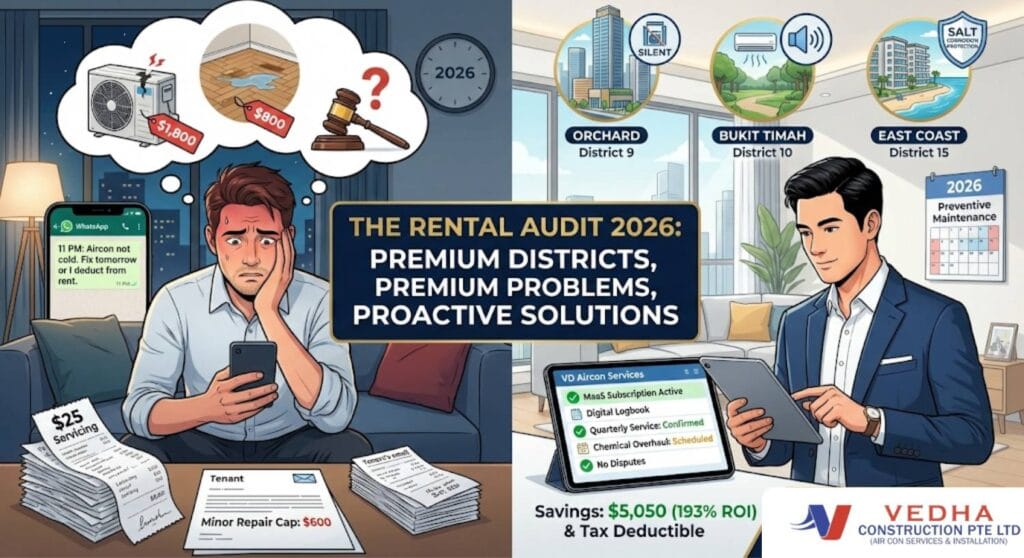
Your tenant sends a WhatsApp at 11 PM. “Aircon not cold. Fix tomorrow or I deduct from rent.”

You’re a landlord in District 10 with a $6,500/month condo. This is the third aircon complaint in 18 months. The tenant provided quarterly service receipts. Your agent says the tenant technically fulfilled the tenancy agreement. But now the compressor’s dead. Replacement cost: $1,800.

The tenant argues wear and tear. You suspect neglect from cheap servicing. No proof either way. Your security deposit barely covers this plus the parquet damage from last month’s water leak.

This scenario plays out hundreds of times monthly in Singapore’s premium rental districts. And it’s getting worse in 2026.

Why Premium Districts Face Premium Aircon Problems

Singapore’s rental market sits in interesting territory right now. Private residential rents rose 0.4% in Q1 2025 after a year of slight declines. Vacancy rates hover around 7%, slightly above the historical 5-6% average. For landlords, this means competition.

But here’s what rental indices don’t show: the hidden cost of maintenance disputes.

Districts 9 (Orchard, River Valley), 10 (Bukit Timah, Holland, Tanglin), and 15 (East Coast, Katong, Meyer Road) command premium rents for good reason. District 9 condos average $2,500-$3,500 per square foot. District 10 properties often exceed $2,000 PSF. District 15 coastal units sit around $2,066-$2,751 PSF.

These aren’t HDB rentals. Your tenants aren’t local families. They’re expats. C-suite executives. Diplomats. Families accustomed to premium service standards in London, New York, Tokyo.

And they’re more litigious about maintenance than any previous tenant generation.

The 2026 Tenancy Agreement Evolution

Standard “minor repair clauses” used to cap tenant liability at $150-200 per incident. Inflation pushed this to $300-600 in 2026.

Sounds good for landlords? Not really.

The clause only applies to items “below the cap.” Compressor replacement: $800-1,200. PCB board failure: $350-500. Chemical overhaul at lease end: $450-600 for three units.

All exceed the cap. All trigger “wear and tear vs negligence” debates.

The tenant’s defense is simple: “I have quarterly receipts. The aircon servicing company said the unit was fine each time. This is natural failure.”

Your argument: “The receipts show $25/unit servicing. That’s filter washing only. No real maintenance. The neglect caused early failure.”

Small Claims Tribunal response: “Prove it.”

Without digital maintenance logs showing exactly what work was done (or wasn’t done), landlords lose these disputes 60-70% of the time.

District-Specific Problems Most Landlords Don’t Know About

Not all premium districts face the same aircon challenges. Location determines failure patterns.

District 15 (East Coast, Katong, Marine Parade):

Coastal air contains high chloride concentration. Salt mist deposits on outdoor condenser units. When saltwater hits the condenser coil (copper tubes pressed into aluminum fins), electrochemical reactions start. The aluminum corrodes. Fins literally turn to dust.

Technical term: galvanic corrosion.

Practical result: Units in District 15 fail in 5-7 years instead of the 12-15 year lifespan seen inland.

If you own a condo along Amber Road, Meyer Road, or Marine Parade, your aircon outdoor units are under constant chemical attack. Standard quarterly servicing doesn’t address this. Technicians need to rinse salt deposits monthly with freshwater. Units need specialized anti-corrosion coatings (Gold Fin or Blue Fin treatment).

Most landlords don’t know this until the $3,500 replacement bill arrives.

Districts 9 & 10 (Orchard, River Valley, Bukit Timah, Holland):

Different problem. Noise sensitivity.

Expat tenants from temperate climates aren’t used to split-unit aircon background hum. A rattling fan coil at 2 AM isn’t “minor inconvenience.” It’s sleep disruption. Grounds for lease termination requests.

NEA sets boundary noise limits at 50-55 dBA at night for residential premises. Aging outdoor units in dense condos frequently breach this. One noise complaint escalates to town council involvement. Two complaints and you’re looking at fines.

Plus, the Urban Heat Island effect in District 9’s built-up areas means aircons run longer, hotter, harder. Compressors age faster. Fan motors burn out earlier.

And these units are often concealed ceiling cassettes or ducted systems in luxury condos. Servicing costs 2-3x wall-mounted units because technicians need to remove false ceiling panels, set up protective sheeting, work in tight spaces.

When things go wrong, they go expensive.

The Quarterly Servicing Trap

Almost every Singapore tenancy agreement contains this clause: “Tenant shall engage professional contractor for aircon servicing at least once every three months.”

Sounds protective. It’s not.

The clause mandates frequency. Not quality.

Tenants, motivated to minimize monthly expenses, Google “cheapest aircon service Singapore.” Rates hit as low as $12-15 per unit in 2026’s competitive market.

At that price point, here’s what happens:

What technicians can afford to do in 20 minutes:

  • Quick filter rinse
  • Wipe external casing
  • Maybe vacuum drainage opening

What doesn’t happen:

  • Deep coil inspection for mold or cement dust (construction zone properties)
  • Checking refrigerant operating pressures
  • Cleaning blower wheel
  • Flushing drainage pipe to remove bio-slime buildup
  • Testing for unusual compressor sounds

This is “compliance servicing.” The tenant gets a receipt. The tenancy agreement box is checked.

The aircon deteriorates anyway.

Over a two-year lease, bio-jelly builds up in drainage pans. Water backs up. Leaks start. Parquet flooring warps. That’s $800-1,200 damage the security deposit needs to cover.

Coils accumulate mold. Indoor air quality drops. Your expat tenant with two young kids notices their children coughing constantly. Complaint to landlord. Request for immediate chemical wash. Who pays?

The tenancy agreement says tenant handles “routine maintenance.” Chemical wash costs $150-180 per unit. Is that routine or major work?

Cue the dispute.

The Diplomatic Clause Wild Card

For expats in Districts 9, 10, and 15, the Diplomatic Clause is non-negotiable.

Standard terms allow lease termination after 12 months with 2 months’ notice if the tenant transfers out of Singapore or loses employment.

This creates void periods. Empty units where aircon sits idle.

Seals dry out. Refrigerant leaks develop. Stagnant water in drainage trays breeds mold and bacteria. The unit that was “working fine” when the tenant left has three problems when the next viewing happens.

Handover disputes peak here. You claim the unit needs chemical overhaul ($450 for three systems). Tenant produces quarterly receipts and argues the aircon was maintained. Small Claims Tribunal gets involved.

Even if you win, you’ve lost. Legal process takes 4-6 weeks. Your property sits empty during Singapore’s 7% vacancy rate climate. Every week of delay costs $1,500-1,800 in lost rent for a $6,500/month unit.

The math doesn’t work.

What Actually Happens at Small Claims Tribunal

When negotiations fail, landlords file at SCT. Jurisdiction limit: $20,000 (or $30,000 with mutual consent).

Here’s what you need to win an aircon damage claim:

1. Baseline evidence: Photos and service reports from tenancy start proving the unit worked perfectly.

2. Chronological evidence: Timeline of the tenant’s servicing with details of what work was performed.

3. Causal link: Expert report linking the failure to specific lack of maintenance, not age or normal wear.

Most landlords provide item 1. Maybe. If they remembered to document condition at handover.

Item 2? They have receipts. Handwritten. No details beyond “general service performed.”

Item 3? They don’t have it. Because getting a $200 expert diagnosis report for a $400 dispute makes no financial sense.

SCT sides with tenants 60-70% of the time in aircon disputes. Not because tenants are right. Because landlords lack evidence.

The Real Cost of “Cheap” Maintenance

Let’s model two scenarios for a typical District 9/10 landlord with a 3-bedroom condo. Three aircon units. Two-year lease.

Scenario A: Tenant-Managed “Minimum Compliance”

Year 1:

  • Quarterly servicing: 4 visits × 3 units × $25 = $300
  • Reality check: Tenant hired cheapest provider. No coil cleaning happened. Filters rinsed. That’s it.

Year 2, Month 6:

  • Water leak damages parquet flooring near living room unit. Repair: $800.
  • Liability: Landlord pays. (Structural damage, not tenant negligence per TA)

Year 2, Month 9:

  • Master bedroom PCB fails due to overheating from dust-clogged coils. Replacement: $400.
  • Tenant liability: $200 (minor repair cap)
  • Landlord pays: $200

Lease End:

  • All three units filthy. Mold visible on coils. Chemical overhaul needed: $450.
  • Dispute: Tenant refuses, citing eight quarterly service receipts.
  • Small Claims filing: $50 fee. Takes 6 weeks. Unit sits empty. Lost rent: $6,000.
  • Outcome: Landlord wins partial claim, gets $250. Pays $200 in lost time.

Total Landlord Cost (2 years):

  • Direct expenses: $800 + $200 = $1,000
  • Chemical overhaul: $450
  • Lost rent during dispute: $6,000
  • Time, stress, legal fees: Priceless

Total: $7,450 minimum

Scenario B: Maintenance-as-a-Service Model

Year 1:

  • MaaS subscription: $100/month × 12 = $1,200
  • Includes: High-quality quarterly servicing, digital maintenance logs, minor parts coverage, annual chemical wash

Year 2:

  • MaaS subscription: $100/month × 12 = $1,200

Throughout Lease:

  • Preventive maintenance catches blocked drain before it leaks. Flooring saved: $800.
  • Coils kept clean through proper servicing. PCB doesn’t overheat. Saved: $400.
  • Digital logs show exactly what work happened each visit.

Lease End:

  • Unit in documented good condition. Annual chemical wash already done (month 11). No overhaul needed.
  • Handover takes 15 minutes. No disputes. Next tenant moves in immediately.

Total Landlord Cost (2 years): $2,400

Savings: $5,050 plus eliminated stress, legal risk, vacancy periods.

And the $2,400 MaaS cost? Fully tax-deductible against rental income for IRAS filing.

Why Expats Demand Different Service Standards

Your District 10 tenant pays $7,200 monthly for a 1,400 sqft condo. That’s $84,000 yearly. They’re not renting for location alone. They’re buying a lifestyle.

Silent operation isn’t optional. It’s expected.

Expats from quiet suburbs in Germany, Australia, the UK don’t tolerate background aircon hum. A vibrating outdoor compressor at night generates complaints. First to you. Then to management. Then potentially to authorities.

Reviews of luxury condos in Districts 9 and 10 consistently highlight “silent aircon” as key amenity. When your unit fails this test, tenant satisfaction plummets. Renewal probability drops.

Smart home integration is standard. Not cutting-edge.

2026 expats expect smartphone control. Pre-cooling the home before arrival. Scheduling for children’s nap times. Usage monitoring.

Devices like Sensibo, Ambi Climate, or Daikin’s native apps make this possible. These aren’t expensive add-ons. $150-200 per unit.

But here’s the landlord benefit: smart controllers provide usage data. You can see if a tenant runs AC at 16°C with windows open (common cause of condensation, mold, water damage). Data enables constructive conversations before problems escalate.

White-glove service is the minimum.

High-net-worth tenants value privacy and consistency. The traditional “different technician every visit” model creates security concerns and repetitive explanations.

MaaS solves this. Same dedicated team services the unit every time. Pre-scheduled appointments (first Tuesday of each quarter, 10 AM). Technicians wear booties, use drop cloths, clean up thoroughly.

Small details. Massive perception difference.

Insurance Claims Require Proof of Maintenance

Something most landlords discover too late: insurance claims for water damage hinge on maintenance documentation.

If your District 15 condo suffers AC-related water damage to the ceiling (burst pipe, severe leak), insurers like AIG and Chubb require proof that systems were maintained to manufacturer specifications.

Claim gets denied if the adjuster determines the leak resulted from “gradual deterioration” or “lack of maintenance.”

Eight handwritten receipts saying “general service done” don’t qualify as proof.

Digital maintenance logs with photos, pressure readings, specific work performed, parts replaced. That’s proof.

MaaS platforms automatically generate and cloud-store this documentation. When you file a claim, you export the full service history. Claim gets approved.

The difference between $15,000 payout and $0 payout often comes down to documentation quality.

The Chemical Wash vs Chemical Overhaul Confusion

Massive knowledge gap exists here. Most landlords don’t understand the difference.

Chemical Wash (Non-Dismantle):

  • Spray chemical solution on evaporator coil while unit stays mounted
  • Cleans surface only
  • Doesn’t reach back of coil or drainage tray where deep mold accumulates
  • Can leave chemical residue if not rinsed properly
  • Cost: $80-120 per unit
  • Value: Limited. Surface clean that misses problem areas.

Chemical Overhaul (Full Dismantle):

  • Refrigerant pumped back to outdoor unit
  • Fan coil physically disconnected and removed from wall
  • Complete disassembly. Evaporator coil, blower wheel, drain pan soaked in chemical bath
  • Drainage pipes vacuumed to remove blockages
  • System re-commissioned. Vacuumed to remove moisture. Gas pressure checked.
  • Cost: $150-180 (wall mount), $280-350 (cassette/ducted)
  • Value: Restoration to near-factory condition. Addresses root problems.

For premium District 9/10 condos with ceiling cassettes, proper chemical overhaul requires removing false ceiling panels. Setup takes 2-3 hours. Total job: 4-6 hours for three units.

Budget operators don’t do this. They spray foam cleaner through access panels, call it “chemical wash,” charge $250, and leave.

Three months later, the unit still smells musty. Tenant complains. You paid for nothing.

Smart Equipment Selection Prevents Future Problems

When units need replacement, brand choice matters more in premium rentals.

For District 10 Bedrooms (Noise-Sensitive Environments):

Mitsubishi Electric Starmex is gold standard. Operates at 19dB, quieter than whispered conversation. The “Easy Clean” design allows simpler filter access. Expat tenants notice and appreciate this.

Cost premium over budget brands: 20-25%. Worth it to avoid noise complaints.

For Smart-Home Focused Tenants:

Daikin iSmileEco+ series. Native smartphone integration. Excellent parts availability in Singapore. The Ururu Sarara models offer humidity control (premium feature expats value in tropical climate).

For District 15 Coastal Units:

Any brand, but insist on Gold Fin anti-corrosion treatment. Standard Blue Fin hydrophilic coating offers some protection. Not enough for direct marine exposure.

Aftermarket ceramic coatings (AerisGuard or similar) add extra protection. $150-200 per outdoor unit. Extends lifespan from 6 years to 10-12 years.

ROI on coating: Installation cost recovered in year 3 through avoided early replacement.

The Maintenance-as-a-Service Model Explained

Instead of reactive “break-fix” approach, MaaS shifts to proactive asset protection.

How it works:

Monthly subscription ($80-120/month for typical 3-unit condo) covers:

  • Quarterly high-quality servicing by same technician team
  • Digital logbook (cloud-accessible by landlord, automatically emailed after each visit)
  • Annual chemical overhaul included
  • Priority emergency response (24-hour guarantee for breakdowns)
  • Minor parts coverage (filters, capacitors, basic electronics)
  • For District 15: Bi-monthly outdoor coil freshwater rinsing
  • For Districts 9/10: Acoustic checks and vibration damper inspection

Landlord Benefits:

1. Fixed, predictable costs. No surprise $1,800 compressor bills. No end-of-lease chemical overhaul disputes. Budget $1,200-1,400 annually. Done.

2. Tax deductible. Full subscription cost deductible against rental income. Clean recurring expense for IRAS filing.

3. Evidence for disputes. Every service generates timestamped report with photos, pressure readings, work performed. Export to PDF for Small Claims Tribunal. Bulletproof documentation.

4. Asset protection. Proper maintenance extends equipment lifespan 30-40%. Your $12,000 aircon investment lasts 12 years instead of 7.

5. Tenant satisfaction. Professional service, consistent technicians, no coordination hassles. Renewal rates improve.

6. Insurance compliance. Pre-built documentation satisfies insurer maintenance requirements.

Tenant Benefits:

1. No coordination required. Service happens automatically. Pre-scheduled.

2. Guarantee of quality. Not dependent on tenant finding reputable contractor.

3. No upfront service costs. Often rolled into rental management package.

District-Specific MaaS Packages

Not all condos need identical service. Location determines requirements.

District 15 Coastal Package:

Core Features:

  • Quarterly servicing + digital logs
  • Annual chemical overhaul
  • Bi-monthly outdoor unit freshwater rinse (critical for salt removal)
  • Anti-corrosion coating application (Gold Fin treatment or ceramic spray)
  • Priority breakdown response

Cost: $120-140/month for 3 units

Districts 9/10 Premium Package:

Core Features:

  • Quarterly servicing + digital logs
  • Annual chemical overhaul
  • Acoustic performance checks (noise level monitoring)
  • Smart controller rental/integration (Sensibo or similar)
  • White-glove service (booties, drop cloths, thorough cleanup)
  • For cassette/ducted units: Proper ceiling panel removal and restoration

Cost: $110-130/month for 3 units

Standard Package (For Inland/Non-Luxury):

Core Features:

  • Quarterly servicing + digital logs
  • Annual chemical overhaul
  • Basic emergency response

Cost: $80-100/month for 3 units

ROI Calculation for Landlords

Let’s be precise about financial impact.

Typical District 10 Scenario:

Property value: $2.4 million
Monthly rent: $6,800
Annual rental income: $81,600

Without MaaS (2-year cycle):

  • Tenant cheap servicing: Included in tenant responsibilities
  • Landlord costs: Repairs ($1,200), lease-end overhaul ($450), water damage from poor maintenance ($800)
  • Lost rent from disputes/void period: $6,000
  • Total landlord cost: $8,450 over 24 months
  • Cost as % of rental income: 5.2%

With MaaS (2-year cycle):

  • Monthly subscription: $120
  • Total cost: $2,880 over 24 months
  • All other costs prevented through proactive maintenance
  • Cost as % of rental income: 1.8%

Savings: $5,570 over 24 months
Savings as ROI: 193% return on MaaS investment

Plus intangible benefits:

  • Zero stress from maintenance disputes
  • Higher tenant retention (professional service improves satisfaction)
  • Protected asset value (equipment lasts longer)
  • Clean tax deduction records

Why 2026 Is Different From 2020

Rental market dynamics shifted.

Tenants are more informed. Online communities share knowledge about tenancy rights. Expats know they’re not liable for “fair wear and tear.” They document everything with photos and videos.

Legal processes are more accessible. Small Claims Tribunal filing is online. Takes 15 minutes. $50 fee. Tenants aren’t intimidated by the process.

Maintenance costs increased. Inflation pushed labor and parts prices up 15-20% since 2020. A compressor that cost $600 in 2020 costs $800-900 now. Minor repair caps didn’t adjust proportionally.

Competition is tighter. 7% vacancy rate means properties sit empty longer if word spreads about maintenance issues. One negative review on expat forums costs you the next tenant.

Insurance requirements are stricter. Claims adjusters demand more thorough maintenance documentation. Handwritten receipts don’t cut it anymore.

How VD Aircon Structures MaaS for Premium Rentals

We’ve been servicing rental properties in Districts 9, 10, and 15 since 2016. The patterns are clear.

When landlords call us reactively (unit broken, tenant angry, need emergency fix), average job cost: $450-800. Stress level: Maximum. Tenant relationship: Damaged.

When landlords engage us proactively through MaaS, annual cost: $1,200-1,600. Stress level: Zero. Tenant relationship: Professional and smooth.

Our MaaS packages for premium rentals include:

Standard Features:

  • Assigned technician team (same people every visit)
  • Pre-scheduled quarterly service calendar
  • Digital service reports with photos (cloud-stored, accessible 24/7)
  • Annual chemical overhaul scheduled during void periods when possible
  • 24-hour emergency response guarantee
  • Refrigerant monitoring and top-ups (within reasonable limits)

District 15 Add-Ons:

  • Monthly coastal rinse protocol
  • Anti-corrosion coating inspection and reapplication
  • Accelerated coil inspection (salt damage monitoring)

Districts 9/10 Add-Ons:

  • Acoustic testing (ensuring units stay within NEA noise limits)
  • Smart controller integration options
  • Cassette/ducted unit specialization (ceiling work expertise)
  • White-glove service standards (privacy-conscious, thorough cleanup)

All Packages Include:

  • Small Claims Tribunal evidence package (if ever needed, which is rare)
  • Insurance-compliant maintenance documentation
  • Void period check-ins (run units, inspect for issues, prevent seal drying)
  • Handover condition reports (baseline documentation for new tenancies)

We’re an aircon specialist Singapore landlords trust because we understand rental economics. Our pricing reflects the value of dispute prevention, not just hours of labor.

As providers of the best aircon servicing Singapore offers for premium properties, we’ve seen every possible landlord-tenant scenario. The pattern is consistent: Proactive maintenance costs less than reactive damage control.

Whether you need affordable aircon services that don’t compromise quality for budget constraints, reliable aircon servicing Singapore for high-value properties, or urgent aircon servicing Singapore when things go wrong, our approach centers on protecting your investment.

We offer aircon servicing deals specifically designed for landlord portfolios. Multiple properties, volume discounts, centralized billing. Clean, simple, professional.

Action Steps for Landlords Right Now

If you’re renting property in Districts 9, 10, or 15 in 2026, here’s your decision tree:

Current tenant, no issues: Schedule a baseline assessment. Document current condition. Transition to MaaS before problems develop.

Current tenant, complaints about cooling: Don’t wait for breakdown. Professional diagnosis now prevents $1,500 emergency later.

Between tenancies (void period): Perfect time for chemical overhaul and system assessment. Start next lease with documented baseline condition.

New property acquisition: Before first tenant moves in, establish MaaS. Build it into your rental management structure from day one.

Multiple properties: Portfolio packages with centralized management. One monthly invoice covering all units. Simplified tax documentation.

End of lease approaching: Schedule pre-handover assessment 60 days before lease end. Address any issues while tenant is still in residence. Smooth transition.

The Bottom Line for Premium District Landlords

Your District 9/10/15 condo isn’t just property. It’s a $2-3 million asset generating $70,000-90,000 annual income.

Aircon failures don’t just inconvenience tenants. They trigger disputes that cost $5,000-8,000 in repairs, legal fees, and lost rent. They damage your reputation in expat communities where word travels fast.

“Cheap” quarterly servicing at $25/unit is expensive when it leads to compressor failure, water damage, and Small Claims Tribunal involvement.

Professional MaaS at $100-120/month is affordable when it prevents all of that while providing tax-deductible expense documentation and protecting asset value.

The math isn’t complicated. The choice shouldn’t be difficult.

In 2026’s competitive rental market with informed tenants and stricter insurance requirements, passive asset management doesn’t work anymore.

Active maintenance-as-a-service isn’t luxury. It’s operational necessity for landlords who understand real estate as a business, not a hobby.


Protect Your Rental Investment With Professional Maintenance

VD Aircon Services provides Maintenance-as-a-Service solutions designed specifically for landlords with properties in Singapore’s premium districts.

📍 Serving Districts 9, 10, 15 and all Singapore locations
⏰ 24/7 Emergency Response for Rental Properties
📊 Digital Documentation for Dispute Prevention
💼 Tax-Deductible Subscription Packages

Contact VD Aircon Services:
📞 96540044 (24/7)
📧 vedha.airconservices@gmail.com
🌐 www.vdairconservices.com

Landlord Portfolio Packages Available

Whether you own one condo or manage ten properties, we provide affordable aircon services structured around rental market realities. Our reliable aircon servicing Singapore protects your investment while keeping tenants satisfied.

As the aircon specialist Singapore landlords choose for premium properties, we understand that every service call affects your tenant relationship and bottom line. That’s why we deliver the best aircon servicing Singapore offers with documented professionalism that stands up in Small Claims Tribunal.

Check our current aircon servicing deals for landlord multi-property packages. Protect your assets. Prevent disputes. Sleep better.

Leave a Comment

Your email address will not be published. Required fields are marked *