
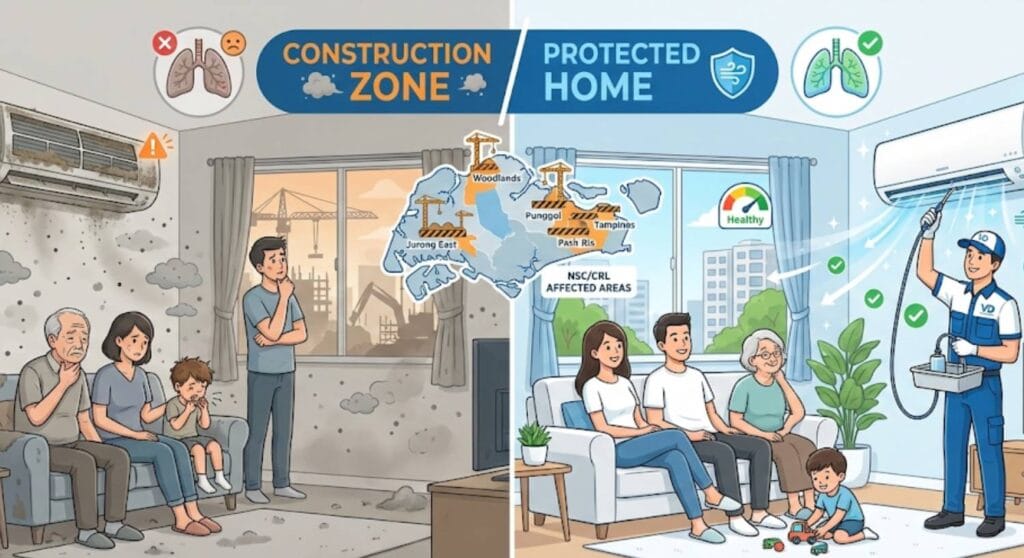
Your kid’s been coughing for three weeks. Not sick. Just this persistent dry cough that won’t quit.
Your elderly mom complains her throat feels scratchy every morning. The doctor can’t find anything wrong.
You wipe down surfaces daily. Two hours later, there’s a fine grey film on everything again.
If you live in Marymount, Ang Mo Kio, Novena, Serangoon North, or Hougang in 2026, this isn’t random. It’s construction dust. And your aircon is making it worse.
Singapore’s biggest infrastructure projects in decades are happening right outside your window. The North-South Corridor’s 12.3km tunnel section through the Central zone. The Cross Island Line’s excavation at Ang Mo Kio, Serangoon North, and Tavistock. Brickland MRT station construction starting in the first half of 2026. Tengah BTOs still rising while earlier phases settle in.
All that building comes with dust. Not normal household dust. Something harder. More chemical. More dangerous for lungs.
And here’s what nobody tells you: your aircon is either protecting your family or poisoning them. There’s no middle ground.
The 2026 Construction Map (Where the Dust Actually Comes From)
Let’s map this out. If you live in certain zones, you’re sitting in what researchers call “high-impact construction hotzones.”
North-South Corridor (The Big One)
The NSC stretches 21.5km from Woodlands to East Coast Parkway. Cost: $7.47 billion. Completion: viaduct section targeting 2027, tunnel section pushing to 2029.
In 2026, here’s where the heavy work happens:
Marymount and Thomson: Peak construction intensity. The NSC dives underground here, connecting with existing MRT lines and diverting major roads. Condominiums like Jadescape, Tresalveo, Seasons View, and Thomson 800 sit directly in the dust dispersion path. The excavation removes marine clay and granite-heavy earth. When trucks load this spoil, fine silt becomes airborne. That dust travels.
Ang Mo Kio Avenue 6: Complete street transformation underway. The Transit Priority Corridor vision means breaking existing pavement, realigning lanes, constant barrier movement. This generates sticky, oily dust. Bitumen-coated silica that clings to everything, especially aircon coils.
Novena and Newton: Underground integration of NSC with Pan Island Expressway creates complex works near Novena Medical Centre. The high-rise buildings create a “street canyon effect.” Dust gets trapped between buildings instead of dispersing. Ground-level and mid-floor units get hit hardest.
Toa Payoh and Bishan: Surface repurposing works continue through 2026-2027 as the viaduct approaches completion. Less intense than tunnel zones but still generating construction particulates.
Cross Island Line Phase 1 (The Underground Giant)
CRL Phase 1 targets 2030 completion. In 2026, excavation hits peak intensity. This 29km line with 12 stations cuts through densely populated areas.
Serangoon North and Tavistock: Station box excavation ongoing. The soil here contains distinct clay markers. When airborne, this forms fine, sticky particulate that clogs filters within weeks.
Hougang and Defu: Industrial-residential mix creates composite dust. Factory emissions blend with construction dust. The result is chemically complex, often acidic, highly corrosive to aluminum fins.
Ang Mo Kio Interchange: Massive construction footprint where CRL links with the North-South Line. Existing structures get hacked apart to create connections. This generates fine concrete dust that pervades surrounding blocks.
The work involves deep tunneling 45 meters below ground, cut-and-cover excavation for station boxes, and complex interfaces with existing infrastructure. All while MRT lines keep operating above and around construction zones.
Western Construction (Brickland and Tengah)
Brickland MRT Station: Construction kicks off first half 2026. This “infill” station between Choa Chu Kang and Bukit Gombak involves removing noise barriers, modifying live tracks, building platforms over operational viaduct. The work generates metallic dust (rail grinding and cutting) plus concrete dust (platform construction). Metallic particles can short inverter boards and accelerate corrosion.
Tengah Town: Singapore’s first “forest town” is a patchwork. Early precincts like Plantation Acres and Plantation Grange are occupied with over 12,000 completed flats. But surrounding plots are still under construction. This “checkerboard” development pattern means finished homes sit adjacent to active dust sources. Parc Point neighbourhood centre opens mid-2026, meaning construction continues in occupied areas.
Table: High-Risk Construction Zones in 2026
| Region | Primary Project | Affected Areas | Dominant Dust Type | Family Risk Level |
|---|---|---|---|---|
| North-Central | NSC Tunnel Sector | Marymount, Thomson Ridge, Ang Mo Kio Ave 6, Bishan | Silica fines, clay silt, asphalt dust | CRITICAL |
| North-East | CRL Phase 1 | Serangoon North, Tavistock, Hougang, Defu | Excavation silt, concrete dust, industrial mix | HIGH |
| West | Brickland MRT, Tengah BTOs | Keat Hong, Brickland District, Tengah Plantation | Soil/sand, cement, metallic dust | HIGH |
| Central | NSC Surface Works | Novena, Newton, Toa Payoh | Fine concrete dust, urban grime | MEDIUM-HIGH |
Why Construction Dust Isn’t “Just Dust” (The Science Your Kids’ Doctor Needs to Know)
Your family doctor sees the cough. Prescribes cough syrup. It doesn’t work because the problem isn’t infection. It’s particulate exposure.
Construction dust differs fundamentally from household dust. This isn’t about more dirt. It’s different material entirely.
What’s in Household Dust
Normal home dust is biological. Skin cells (you shed 30-40,000 dead cells every minute). Fabric fibers from clothes and furniture. Pet dander if you have animals. Some tracked-in soil.
This stuff is large (over 10 microns), light, fluffy. It forms a soft mat when it accumulates. Your aircon filter catches most of it. What gets through rinses away easily with water.
What’s in Construction Dust
Lithogenic and chemical. Completely different beast.
Crystalline silica (SiO2): From soil, sand, concrete cutting. Mohs hardness of 7. That’s harder than steel. Harder than aluminum (your aircon fins are aluminum, hardness 2.75). When silica particles get sucked into your AC unit, they act like micro-sandblasting agents. They physically erode the protective coating on coils and damage fan motor bearings.
Calcium silicates and carbonates: From cement and concrete. When wet, these don’t just get muddy. They undergo chemical reactions. Hydration. Essentially, your aircon coil becomes a site for micro-concreting.
Particle size (PM2.5 and PM10): Construction activities generate enormous volumes of particles under 2.5 microns. That’s invisible to the human eye. Your standard aircon filter has mesh designed for particles over 50-100 microns. PM2.5 blows straight through. It settles deep inside cooling coils and the blower wheel where you can’t see it.
Morphology: Under microscope, construction dust particles are jagged, angular, crystalline. They interlock with aluminum fin texture. Regular airflow or light brushing doesn’t dislodge them.
The “Micro-Concreting” Problem
Here’s where Singapore’s humidity makes everything worse.
Singapore averages over 80% relative humidity. Your aircon’s evaporator coil is the coldest point in the system, constantly condensing moisture to dehumidify rooms.
When cementitious dust (containing unhydrated calcium compounds) settles on that wet coil, it absorbs the condensate water and begins to cure. Harden. Just like concrete dries.
The dust isn’t just sitting on the coil. It’s bonding to it.
Once hardened, this crust is insoluble in water. Spraying water on it during standard servicing just wets the stone. It doesn’t remove it. The crust acts as thermal insulation, blocking heat exchange. Airflow drops as the hardened material bridges gaps between fins. Cooling capacity plummets. Electricity consumption spikes.
For families with young children or elderly members, this is where health risk escalates.
Health Impact: Why This Matters for Vulnerable Family Members
PM2.5 and mold exposure aren’t theoretical concerns. They’re measurable health threats, particularly dangerous for:
Children under 12: Developing respiratory systems are more susceptible to particulate inflammation. Exposure to elevated PM2.5 from construction sources has been linked to exacerbated asthma, allergic rhinitis, and chronic respiratory symptoms. A child breathing contaminated air from a dirty aircon gets continuous exposure, not just when outside near construction.
Elderly family members: Reduced lung capacity and compromised immune systems make older adults vulnerable to respiratory infections and complications from mold exposure. “Sick Building Syndrome” symptoms (headaches, dry throat, eye irritation) appear faster and more severely in seniors.
Anyone with existing respiratory conditions: Asthma, COPD, allergies all worsen with prolonged PM2.5 and bioaerosol exposure.
The cemented dust layer on coils provides perfect breeding grounds for mold. The porous matrix holds water. While clean aluminum fins drain quickly, dust-encrusted coils retain moisture like sponges. Add some organic matter (spores, pollen, skin cells passing through), and you’ve created ideal conditions for biofilm formation.
Aspergillus and Penicillium species thrive in tropical climates. These fungi release spores into your circulated air. Every time the AC runs, it shoots mold spores back into rooms where children sleep and elderly family members spend time.
What Happens When You Keep Using “Normal” Servicing in Construction Zones
Standard general servicing for aircons involves:
- Washing the filter mesh
- Vacuuming the drainage pipe
- Wiping the cover
- Maybe lightly brushing the front of coils
This was fine for normal household dust in finished neighborhoods. It’s completely inadequate for construction zone conditions.
Why General Servicing Fails
No penetration: Brushing only cleans the surface of fins. It often packs dust deeper into the coil assembly, compacting it further.
No chemical action: Water alone cannot dissolve calcium silicate bonds. The hydrated cement crust just gets wet, then hardens more when it dries.
No biofilm removal: Without chemical agents, the slimy protective layer surrounding bacterial colonies and mold remains intact.
A Marymount family spent $120 on general servicing every quarter in 2025. Their electricity bill stayed high. Cooling performance stayed poor. Why? Because the cemented layer deep inside coils never got addressed. They were essentially watering a stone.
The Premature Failure Cycle
Units in construction zones are failing 40-50% earlier than expected lifespan.
Normal aircon lifespan in clean zones: 10-12 years
Observed lifespan in NSC/CRL construction zones without proper maintenance: 6-7 years
The killer is compressor burnout. High compression ratios from blocked coils cause oil breakdown. Metal-on-metal friction increases. Seizure follows.
Blower fan motors die early too. Silica dust infiltrates past seals. Gets inside bearing races. Acts as grinding paste. Bearings fail, motor seizes. Units only 2-3 years old coming in with whining, rattling noises that signal imminent motor death.
Replacement cost for System 3 in 2026: $3,000-3,600
If your unit dies at year 7 instead of year 10 because construction dust wasn’t properly addressed, you’re paying $428/year in ownership costs versus $300/year. That’s $128/year penalty, plus the higher electricity bills from degraded efficiency before failure.
Over a 7-year cycle, that’s $896 hardware penalty plus roughly $2,500 in excess electricity ($360/year for 7 years). Total: $3,400 wasted by not adapting maintenance to environmental reality.
The Chemical Wash Solution (What Actually Works)
For families in NSC, CRL, Brickland, and Tengah zones, chemical washing isn’t luxury service. It’s health protection.
How Chemical Wash (Hydro-Clean) Actually Works
The process involves full dismantling to access buried components.
Step 1: Complete disassembly. Fan coil unit gets taken apart. This exposes the back of cooling coils and drainage tray. That’s where construction dust bypasses filters and accumulates.
Step 2: Alkaline foaming agent application. High-quality coil cleaners containing sodium hydroxide or potassium hydroxide with surfactants get applied. The foam is critical. It expands between tight fins (spacing often under 1.5mm), pushing debris outward from deep within the coil. Surfactants lower surface tension, allowing solution to penetrate the cement crust and lift it from metal.
Step 3: Dwell time. The chemical sits for 5-10 minutes. This dwell period lets the solution react with silicate binders in the cemented dust. Without sufficient dwell, you’re just wetting the surface.
Step 4: High-pressure rinse. Specialized pressure washer (set safely under 500 PSI to avoid fin damage) flushes dissolved sludge out. The water volume matters as much as pressure. You need enough flow to carry heavy silica sediment completely out of the drainage pan.
Step 5: Drainage pipe flush. The tray and pipe get chemical treatment too. Silica settles in pipes and hardens. Unlike biological slime that vacuums out, silica plugs can cement pipes shut. Chemical dissolution is necessary.
Why This Matters for Indoor Air Quality
Clean coils mean:
- No trapped moisture (no mold breeding grounds)
- Proper airflow (no PM2.5 recirculation from caked dust breaking off)
- Efficient cooling (system doesn’t run excessively trying to compensate for blocked heat exchange)
- Proper drainage (no stagnant water in trays breeding bacteria)
For a family with an asthmatic child in Serangoon North or an elderly parent in Marymount, this translates directly to breathable air.
Practical Protection Plan for Construction Zone Families
If you’re in the impact zones, passive maintenance guarantees problems. Here’s what actually protects your family’s health.
Phase 1: Prevention (Reduce What Gets In)
Seal windows facing construction during work hours (8am-7pm). Keep them closed. Use heavy curtains to dampen sound and trap some infiltrating dust before it reaches AC intake.
Don’t rely on standard filters. The mesh that came with your AC won’t stop PM2.5. Consider electrostatic filter upgrades (like 3M Filtrete series). These use static electricity to attract particles, offering better PM2.5 capture with lower pressure drop than HEPA.
Critical warning: Do NOT tape HEPA filters over split unit intakes. Split ACs have low-pressure fans that can’t overcome HEPA resistance. You’ll freeze the coil, collapse airflow, and burn out the motor. Electrostatic filters are the safe middle ground, but they clog fast in construction zones.
Inspection schedule: Check filters weekly. If they’re grey/brown, replace immediately. In high-dust areas like Marymount during NSC tunnel works, electrostatic filters might need changing every 2-3 weeks instead of the usual 3 months.
Run standalone air purifiers. A HEPA purifier in living rooms and bedrooms captures suspended dust before it cycles through the AC. This reduces load on the AC unit while improving air quality. Particularly important in rooms where children or elderly family members spend most time.
Phase 2: Maintenance (The Construction Zone Schedule)
Forget quarterly servicing. Construction zones demand more.
Monthly (DIY): Wash mesh filters. Visually inspect cooling fins for grey crust buildup. If you see cement-like deposits forming, don’t wait for scheduled service.
Every 3 months (Professional): General servicing to clear drainage, check refrigerant levels, verify operation.
Every 6 months (Critical): Full chemical wash. Non-negotiable in high-dust zones. This dissolves the cementitious buildup before it hardens permanently.
Outdoor units matter: The condenser gets packed with mud from rain mixing with dust. Ensure technicians use high-pressure jets (with appropriate fin care) on outdoor units every service.
This schedule isn’t cheap. Budget roughly:
- Monthly DIY: Your time
- Quarterly general service: $80-120 per unit
- Bi-annual chemical wash: $120-180 per unit
For a 4-room HDB with 3 units in Ang Mo Kio near CRL construction, annual maintenance cost jumps from $400-500 (standard schedule) to $900-1,200 (construction schedule).
But compare that to:
- Premature unit replacement: $3,000-3,600 per system
- Medical costs for recurring respiratory issues in children: $200-500 yearly
- Lost work days caring for sick family members: Hundreds in lost income
The maintenance cost pays for itself.
Phase 3: Post-Construction Recovery
Once major construction near your block finishes (for NSC viaduct areas, that’s 2027; for tunnel areas, 2029; for CRL, 2030), don’t just resume normal maintenance.
Commission a “Full Chemical Overhaul.” This involves complete dismantling to remove all construction silica traces from chassis, blower wheel internals, and drainage system. Consider this resetting your unit’s lifespan for the post-construction era.
This deep clean typically costs $250-350 per unit but extends equipment life by 2-3 years compared to units that never get this recovery treatment.
Special Considerations for New Tengah BTO Residents
If you’re moving into Tengah in 2026-2027, your situation differs slightly.
You’re getting brand new aircon units. But you’re moving into an active construction environment. Early Tengah precincts are occupied while later phases remain under construction. Parc Point neighbourhood centre opens mid-2026 with ongoing building work.
Pre-Move-In Aircon Preparation
Your new BTO keys come with pristine AC units. Keep them that way.
First month: Run units minimally. Open windows for natural ventilation when possible. Let initial construction dust settle in the unit (from your own renovation work) before heavy AC use begins.
Month 2: Schedule first servicing. This early clean removes renovation dust before it cements under prolonged operation.
Month 3 onwards: Adopt construction zone schedule. Tengah’s checkerboard development pattern means nearby blocks under construction will dust your completed unit for 1-2 more years.
Filter obsession: New units come with basic filters. Upgrade to electrostatic immediately. Check and replace frequently. Construction dust clogs fresh filters within weeks.
Why This Matters for Families Choosing Tengah
Tengah attracted many young families. Affordable pricing ($300,000-450,000 for 4-room flats). Green town concept. Good future connectivity with Jurong Region Line opening mid-2028.
But those green spaces are still being built. Schools are going up. Commercial centres are under construction. If you have young children or live with elderly parents, the construction dust exposure is real and prolonged.
Protecting indoor air quality isn’t optional. It’s health maintenance.
According to Singapore’s Building and Construction Authority, 73% of homeowners rank “indoor air quality” as a critical concern, especially for families with vulnerable members. But only 30% actually take proactive maintenance steps beyond standard servicing.
That gap between concern and action leaves families exposed.
What VD Aircon Does Differently for Construction Zone Residents
We’ve serviced aircons in every construction hotzone since 2016. Woodlands during early NSC works. Punggol during mass BTO development. Now Marymount, Ang Mo Kio, Serangoon, Tengah during the 2026 peak.
The pattern is clear. Location determines maintenance needs more than brand or model.
Our Construction Zone Protocol
Initial assessment includes location-specific factors. When you call from Marymount, we know you’re in NSC tunnel zone. We factor in silica dust and clay silt exposure before we arrive.
Site visits include environmental evaluation. We use laser thermometers to check outdoor unit operating temperatures. We measure actual dust type (silica-heavy vs cement-heavy vs composite) by visual inspection and feel. This determines cleaning chemical selection.
Chemical wash as baseline, not upsell. For families in critical zones (Marymount, Serangoon North, Ang Mo Kio central), we recommend bi-annual chemical wash upfront. Not because it’s more profitable. Because general service alone doesn’t solve the problem.
Education matters. We show parents with young children the actual dust buildup. We explain why their kid’s persistent cough might be linked to contaminated AC output. We demonstrate proper filter maintenance.
Outdoor unit care is standard. Many companies ignore condensers. In construction zones, outdoor coils get packed with mud. We clean both units thoroughly every visit.
Real Results from Construction Zone Families
A Novena family with two kids under 8 called us in Q4 2025. Their previous contractor did quarterly general service. Bills stayed high. Kids kept coughing. Doctor found nothing.
We opened their units. The evaporator coils had 3-4mm cement-like crust. Drainage tray had solidified silt. Blower wheel caked with sticky grey sludge.
Chemical wash removed kilograms of material. Within two weeks, the father reported: electricity bill dropped 18%, kids’ coughs cleared, no more morning throat irritation.
Cost of chemical wash for their 3 units: $450
Electricity savings over next 6 months: $180
Health improvement: Priceless
That’s what proper maintenance in construction zones delivers.
As reliable aircon servicing Singapore providers, we understand that families need more than generic service packages. You need location-specific expertise. We offer affordable aircon services adapted to NSC and CRL environmental challenges because we’ve seen what happens when families don’t get proper protection.
Whether you need urgent aircon servicing Singapore for failing units in Tengah or the best aircon servicing Singapore offers for Marymount families near NSC tunnel works, our approach stays the same. Assess your actual environment. Address your specific dust profile. Protect your family’s air quality.
That’s why residents in construction zones trust us as their aircon specialist Singapore for health-focused maintenance. We don’t just clean coils. We protect lungs.
The Bottom Line for Parents and Caregivers
If you’re reading this from Marymount, Thomson, Ang Mo Kio, Serangoon North, Hougang, Novena, Tengah, or Brickland area, you’re living through Singapore’s biggest infrastructure transformation in decades.
The NSC will be amazing when finished. CRL will revolutionize east-west connectivity. Tengah’s green town vision is genuinely inspiring.
But getting there means dust. Years of it. And that dust doesn’t care about your baby’s developing lungs or your father’s COPD.
Your aircon is either filtering it out and staying clean, or trapping it and breeding mold. There’s no neutral position.
Standard servicing schedules designed for finished neighborhoods won’t protect your family. Chemical washing every 6 months isn’t expensive preventive care. It’s necessary health protection.
The numbers are clear:
- Bi-annual chemical wash: $240-360 yearly
- Medical visits for recurring respiratory issues: $200-500 yearly
- Premature AC replacement from dust damage: $3,000-3,600
- Health issues from prolonged PM2.5 and mold exposure: Ongoing complications
Investing in proper maintenance now prevents all of it.
Singapore’s construction will peak in 2026-2027, then gradually reduce as projects complete. NSC viaduct targets 2027. Tunnel section pushes to 2029. CRL Phase 1 aims for 2030.
But your family breathes every day between now and then.
Make sure what they’re breathing is clean.
Protect Your Family’s Air Quality During NSC Construction
VD Aircon Services provides specialized construction-zone maintenance for Singapore families living near active infrastructure projects. Our chemical wash protocols are designed specifically for NSC, CRL, and Tengah dust profiles.
- Serving all construction impact zones: Marymount, Ang Mo Kio, Novena, Serangoon North, Hougang, Bishan, Toa Payoh, Tengah, Brickland
- 24/7 Emergency Service: Because dust-damaged units don’t fail on schedule
- Family Health Focus: We prioritize homes with children and elderly members
Contact VD Aircon Services:
📞 96540044 (24/7)
📧 vedha.airconservices@gmail.com
🌐 www.vdairconservices.com
Check our aircon servicing deals for construction-zone maintenance packages designed to protect your family through Singapore’s biggest building phase. We offer affordable aircon services without compromising the chemical wash quality families in dust-heavy areas need.
As the aircon specialist Singapore families trust for health-focused maintenance, we bring construction-zone expertise to every job. Don’t wait for respiratory problems to develop. Schedule your construction-dust assessment today.

We specialize in Aircon installation, repair, and service. We have all type & model of recon compressor, full set & fancoil. Our technicians are highly proficient in their respective field and repairs and fixes aircon of various brands.

