Your neighbor in Bukit Timah runs their aircon maybe 4 hours a day. You’re in Punggol, and yours barely shuts off. Same city. Same weather forecast. But your electricity bill is 20% higher.
What’s happening?
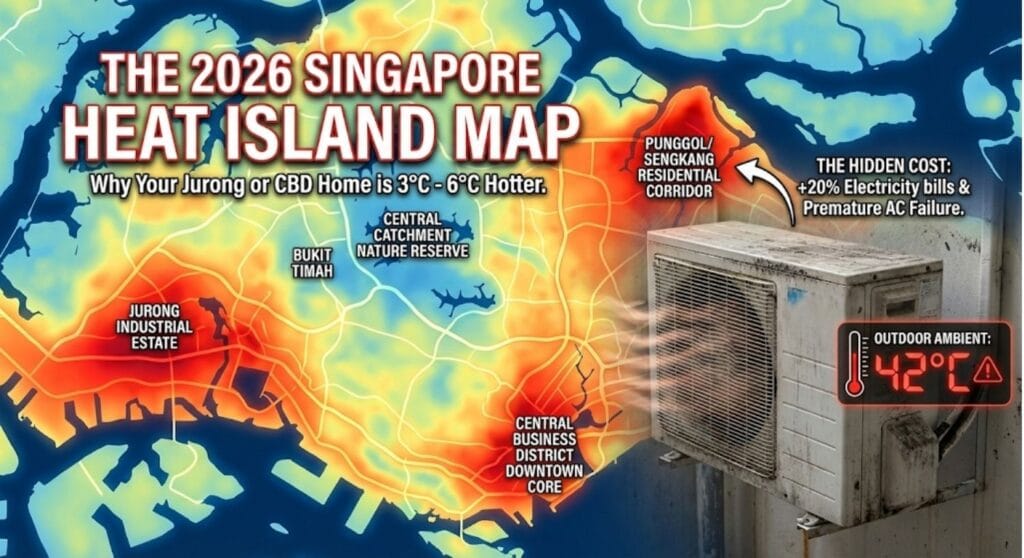
It’s not bad luck. It’s physics. Singapore isn’t uniformly hot anymore. Research from the Cooling Singapore 2.0 project and the Digital Urban Climate Twin shows something startling: some neighborhoods are sitting 3-6°C hotter than others. That temperature gap isn’t just uncomfortable. It’s expensive. And it’s slowly killing your aircon unit.
The Singapore Heat Island Map Doesn’t Talk About Enough
Walk through Telok Ayer at 11 PM. Then drive to Upper Peirce Reservoir. Same night. The temperature difference can hit 6°C during peak conditions.
That’s not a typo. Six degrees.
The Urban Heat Island effect turned Singapore into a thermal patchwork. Dense concrete estates, industrial zones, and glass-heavy CBD areas trap and reflect heat differently than green, low-density neighborhoods. Your postal code now determines how hard your aircon works, how long it lasts, and how much you pay monthly.
Singapore’s Hottest Zones (Ranked by Temperature Variance)
Based on 2024-2026 data from Cooling Singapore 2.0 and Arup’s Urban Heat Snapshot, here’s where Singapore really heats up:
1. Telok Ayer / Raffles Place (CBD)
Temperature variance vs green zones: +5.5°C to +6.5°C
Why it’s hot: Urban canyon effect. Glass towers reflect heat like mirrors. Concrete everywhere. Almost zero vegetation. The buildings create wind tunnels during day, heat traps at night.
2. Jurong East / Industrial West
Temperature variance: +4.0°C to +5.0°C
Why it’s hot: Industrial waste heat from Jurong Island’s petrochemical plants drifts over residential areas. Add heavy vehicular traffic and dark surface absorption, you get a neighborhood that never really cools down.
3. Punggol / Sengkang
Temperature variance: +3.5°C to +4.5°C
Why it’s hot: Here’s the irony. These were designed as eco-towns. But high-density BTO layouts created something unexpected. The concrete blocks wind paths. Service yards trap hot air. Massive concrete volume absorbs heat all day, releases it at night. Your aircon fights this 24/7.
4. Geylang / Marine Parade
Temperature variance: +3.0°C
Why it’s hot: Compact low-rise geometry. Narrow streets. Dense building coverage. Limited green space. Heat just sits there.
5. Choa Chu Kang
Temperature variance: +2.5°C to +3.5°C
Why it’s hot: Distance from coastal breezes. Concrete infrastructure from LRT/MRT systems. West-facing sun exposure all afternoon. The heat accumulates.
Compare this to Upper Peirce Reservoir (88% water and vegetation coverage) or Bukit Timah Nature Reserve. These areas stay 5-6°C cooler consistently. That’s where your aircon can actually rest between cycles.
Why Construction Zones Make Everything Worse Right Now
If you’re in Tengah or near the North-South Corridor construction, you’re dealing with double heat stress.
Tengah New Town is Singapore’s latest housing development. Over 42,000 homes being built progressively through 2030. Right now? It’s a massive construction site. Tower cranes. Excavation work. Concrete pouring. Dust everywhere.
Construction adds localized heat in three ways:
- Heavy machinery generates heat (diesel engines, generators, compressors)
- Exposed earth and cleared vegetation removes natural cooling
- Dust particles coat aircon outdoor units faster, choking efficiency
Residents who moved into the first Tengah BTO batches in 2023-2024 noticed something quickly: their outdoor units get filthy fast. That industrial dust layer acts like insulation, preventing proper heat exchange. What takes 9 months to build up in Bedok happens in 4 months in Tengah.
North-South Corridor construction runs 21.5 kilometers through central Singapore. Completion targets shifted to 2027 for the viaduct portion, 2029 for tunnels. Areas along Novena, Ang Mo Kio, Bishan, Toa Payoh are dealing with construction dust, diverted traffic (more vehicle emissions and heat), and temporary road barriers that block natural wind flow.
If you’re living within 500 meters of either project, expect your aircon servicing needs to double. Not because something’s wrong with your unit. Because the environment changed.
What This Heat Actually Does to Your Aircon (The Technical Reality)
Most aircons are designed for 35°C outdoor temperature. That’s the standard T1 Climate Class rating. When outdoor units sit in service yards hitting 38-40°C (common in Jurong and Punggol), three things break down:
1. Efficiency Drops Fast
For every 1°C above 35°C, your unit loses roughly 1-2% cooling capacity while power consumption increases 1.5-2%.
At 38°C (typical in Punggol service yards):
- Your 12,000 BTU unit performs like 11,280 BTU
- Power draw increases 6-8%
- You’re running harder, delivering less cooling, paying more electricity
The math isn’t kind. A household in Jurong running three System 2 units faces an estimated 15-25% higher electricity bill compared to identical usage in Bukit Timah. That’s $30-50 extra monthly just from location.
2. Short-Cycling Kills Compressors
Short-cycling means your compressor turns on and off rapidly (every 3-5 minutes) instead of running smooth, long cycles.
In dense estates like Punggol and Sengkang, service yards are tiny. Often boxed in by louvers. When your condenser blows hot exhaust air (50°C+) against an angled louver, a chunk of that heat bounces right back into the intake.
The feedback loop starts. Your unit senses 45-50°C intake temperature. The high-pressure switch trips. Compressor shuts down. Cools slightly. Restarts. Repeats.
This creates brutal mechanical stress. Start capacitors wear out. Compressor scroll components grind. What should last 10-12 years dies in 6-7 years.
We’ve seen this pattern consistently in Punggol homes. Units only 5-6 years old coming in with dead compressors. The diagnosis isn’t defective equipment. It’s environmental stress nobody planned for.
3. Oil Breakdown Accelerates Failure
Compressor oil keeps metal parts lubricated. At continuous high temperatures (38°C+ outdoor ambient), refrigerant discharge temperatures spike. If the compressor shell exceeds 105-110°C, the oil thins out or starts breaking down chemically.
Result? Metal-on-metal friction. Then seizure. That’s the “compressor dead” call we get too often from Jurong and CBD condos.
The Hidden Cost: Lifespan Truncation
Here’s what most people don’t realize until it’s too late.
Standard aircon lifespan in “green zones” (Bukit Timah, Novena near parks): 10-12 years
Actual lifespan in “heat islands” without adapted maintenance (Jurong, Punggol): 6-7 years
The numbers work out like this:
Green Zone Economics:
- System 3 unit cost: $3,000
- Lifespan: 10 years
- Annual cost: $300/year
Heat Island Economics:
- System 3 unit cost: $3,000
- Lifespan: 7 years
- Annual cost: $428/year
That’s $128/year lost just to premature replacement. Add the 20% electricity penalty ($360/year), and residents in heat island zones waste nearly $490 annually compared to cooler neighborhoods.
Over a 7-year cycle, that’s $3,400 gone. Enough to buy a high-end T3-rated system designed for extreme heat.
Solutions That Actually Work (Not Generic Advice)
If you’re in Jurong, Punggol, CBD, Geylang, or near Tengah/NSC construction, generic aircon maintenance doesn’t cut it. You need location-specific strategies.
For Jurong & Industrial West Residents
Problem: Industrial dust and persistent high ambient temperatures.
Solution:
- Quarterly chemical flushing of outdoor units (not yearly). Industrial particulates coat coils 3x faster here. A dirty coil increases energy consumption by 30%. This isn’t optional maintenance. It’s survival.
- Check refrigerant levels every 6 months. High-temperature operation leaks refrigerant faster through micro-cracks in joints.
- Install air deflectors if your condenser faces west. Afternoon sun adds 5-7°C to surface temperatures.
For Punggol / Sengkang Residents
Problem: Service yard heat recirculation and wind blockage.
Solution:
- Airflow audit during servicing. Technician should check if exhaust air can escape properly. If louvers angle wrong or obstructions exist, install air deflectors that force exhaust upward.
- Coastal corrosion protection. Punggol Point residents deal with salt spray. Opt for units with blue fin or gold fin anti-corrosion coatings. These prevent oxide buildup that insulates coils.
- Never block your service yard. Moving washing machines or storage racks directly in front of AC units creates static pressure. Your fan can’t push hot air out. Heat staggers.
For CBD / Telok Ayer Condo Residents
Problem: Reflected heat (albedo effect) from glass towers frying electronics.
Solution:
- Heat-reflective coatings on outdoor unit casings. Products like Nippon SolarCool contain ceramic microspheres that reflect infrared radiation. This can drop surface temperature by 5°C, protecting inverter PCBs from heat damage.
- Prioritize units with refrigerant-cooled PCBs. High-end models from Daikin (iSmileEco) and Mitsubishi (Starmex) use refrigerant loops to cool electronics instead of relying on ambient air.
- Check error codes frequently. U4, E7, or communication errors often signal PCB overheating before total failure. Early detection prevents expensive board replacement.
For Tengah / NSC Construction Zone Residents
Problem: Dust accumulation at accelerated rates.
Solution:
- Monthly filter cleaning minimum. Construction dust clogs filters within weeks, not months.
- Bi-annual outdoor coil inspection and cleaning. Dust layer builds fast. Chemical cleaning might be needed every 6 months instead of yearly.
- Temporary outdoor unit covers during heavy construction phases (but ensure proper ventilation holes). Some residents near Tengah use mesh covers that block large particles while allowing airflow.
When It’s Time to Replace: Choose T3-Ready Units
If your current aircon died in a heat island zone, don’t just replace it with another T1 standard unit. You’re setting up for the same 6-year failure cycle.
Look for T3 Climate Class specifications. These units are designed for maximum outdoor ambient temperatures of 52°C (versus 43°C for T1). Previously only used in Middle East, they’re now entering Singapore market.
Models to consider:
- Midea Xtreme Cool (T3): Inverter Quattro technology, larger heat exchangers
- Daikin iSmileEco+: Advanced inverter logic operates up to 46°C without tripping
- Mitsubishi Starmex (latest generation): J-Multi technology modulates frequency during high heat instead of hard shutdowns
These cost 15-20% more upfront. But in Jurong or Punggol, they’ll outlast standard models by 3-4 years. The ROI makes sense.
The Maintenance Schedule Your Location Actually Needs
Stop following generic “once yearly” servicing advice. Your maintenance frequency should match your neighborhood’s thermal stress.
Green Zones (Bukit Timah, Upper Peirce, Thomson area):
- General servicing: Once yearly
- Chemical wash: Every 2-3 years
- Filter cleaning: Every 2-3 months
Moderate Heat Zones (Bedok, Tampines, Hougang):
- General servicing: Every 8-9 months
- Chemical wash: Every 18 months
- Filter cleaning: Monthly
Heat Island Zones (Jurong, Punggol, Sengkang, Geylang, CBD):
- General servicing: Every 6 months
- Chemical wash: Annually
- Filter cleaning: Bi-weekly
- Outdoor coil inspection: Every 6 months
Active Construction Zones (Tengah, NSC corridor):
- General servicing: Every 4-6 months
- Chemical wash: Every 8-9 months
- Filter cleaning: Weekly during heavy construction
- Dust cover check: Monthly
This isn’t upselling. It’s matching maintenance intensity to environmental stress. VD Aircon technicians see the difference daily. Units on proper location-based schedules last years longer and cost less to operate.
Why This Matters More in 2026 Than Ever Before
Singapore’s Meteorological Service predicts that by the end of this century, average daily temperatures during the eight warmest months will hit 34.1°C “almost every day.”
But heat islands won’t warm uniformly. The gap between Telok Ayer and Bukit Timah could widen to 7-8°C during peak conditions. What we’re seeing in 2026 is just the start.
For homeowners and businesses, this means:
- Location-based HVAC planning becomes critical, not optional
- Standard maintenance schedules don’t match reality anymore
- Equipment selection needs to account for microclimate, not just overall Singapore climate
- The “postcode penalty” for cooling costs will grow
Ignoring your neighborhood’s thermal profile is expensive. Really expensive.
How VD Aircon Approaches Heat Island Service
We’ve adapted our service protocols based on this research. When you contact us, location is part of the diagnostic process now.
Jurong client? We know to check for industrial residue on coils.
Punggol client? We measure service yard airflow before leaving.
CBD condo? We inspect PCB condition and check for heat stress indicators.
Near Tengah or NSC? We factor in accelerated dust accumulation.
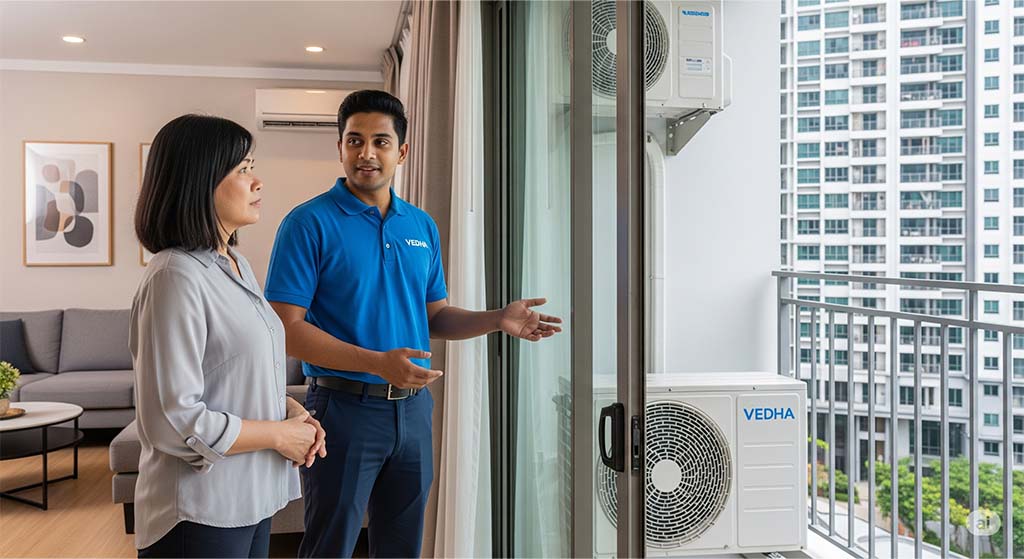
Our technicians carry laser thermometers. During servicing, we’ll show you the actual temperature your outdoor unit is sitting in. When you see 42°C on the display, suddenly that higher electricity bill makes sense.
We also recommend based on your location. If you’re in a heat island zone, we won’t sell you an entry-level T1 unit that’ll die early. We’ll explain why spending a bit more on T3-ready or high-ambient models saves money long-term.
According to 2024 consumer surveys by Singapore’s Building and Construction Authority, 73% of homeowners ranked “transparent pricing” and “technician reliability” as their top factors when choosing an aircon service provider. We built our entire approach around those two things, with location-specific technical knowledge layered on top.
That combination positions us as an aircon specialist Singapore residents trust when standard solutions fail.
The Bottom Line for Singapore Homeowners
Your neighborhood determines your aircon’s lifespan more than brand or model.
If you’re in Jurong, Punggol, Sengkang, the CBD, or near active construction, you’re fighting a 3-6°C temperature disadvantage. That’s not something better insulation or closed curtains fixes. It’s ambient heat your outdoor unit breathes constantly.
Standard yearly maintenance schedules designed for “average Singapore conditions” don’t apply to you. You need more frequent servicing, location-specific interventions, and sometimes equipment upgrades to avoid the cycle of premature failures and bloated electricity bills.
The research from Cooling Singapore 2.0 makes this clear. We’re not one island anymore thermally. We’re a mosaic of microclimates. Treat your aircon maintenance like it.
Want a service approach that factors in where you actually live? That’s what we do. No generic packages. No one-size-fits-all schedules. Just honest assessment based on your postal code’s thermal reality.
Need urgent aircon servicing Singapore residents in heat island zones can count on?
VD Aircon Services operates 24/7 across all districts.
Call 96540044 or email vedha.airconservices@gmail.com
We bring location-specific expertise to every job.
Whether you need affordable aircon services adapted to Jurong’s industrial environment, reliable aircon servicing Singapore for Punggol’s unique challenges, or expert consultation on the best aircon servicing Singapore offers for CBD condos facing heat reflection, we approach every job with your microclimate in mind.
Check our aircon servicing deals designed for high-stress neighborhoods at www.vdairconservices.com

We specialize in Aircon installation, repair, and service. We have all type & model of recon compressor, full set & fancoil. Our technicians are highly proficient in their respective field and repairs and fixes aircon of various brands.