
You’re standing in Gain City staring at a wall of identical white boxes. Every aircon looks the same. Every salesperson is pushing different brands. The labels are covered in codes you don’t understand.
BTU. CSPF. 5-tick. R32. Inverter. dB.
You need to make a $3,000-5,000 decision right now. Get it wrong and you’re stuck with high electricity bills or uncomfortable rooms for the next decade.
Here’s the truth nobody tells you upfront: Buying an aircon in 2026 is completely different from buying one in 2020. The rules changed. The government banned certain models. New regulations kicked in April 2025 that eliminated half the options on the market.
This guide breaks down everything that matters. No engineering degree required. Just the facts you need to choose the right unit, save money on electricity, and qualify for the $400 Climate Vouchers the government’s offering.
What Changed in 2025 (And Why It Matters to You)
April 1, 2025 was a watershed moment for Singapore aircon buyers. The National Environment Agency (NEA) raised the minimum energy performance standards dramatically.
The old rules: You could buy a 2-tick multi-split system. Cheaper upfront. Terrible for electricity bills.
The new rules (current): Multi-split systems (System 3, System 4, System 5) must be minimum 5-tick. No exceptions. Single-split units must be minimum 4-tick.
If you’re looking at HDB packages online and seeing 3-tick System 3 sets at “clearance prices,” understand what you’re getting. Those units became illegal to sell new after April 2025. Any remaining stock is old inventory. No warranty protection if something goes wrong.
Why the government did this: Aircon accounts for 40-50% of Singapore household electricity consumption. By forcing everyone to buy high-efficiency units, the national grid load drops significantly. It’s part of the Singapore Green Plan 2030 carbon reduction strategy.
What it means for you: The “budget” aircon option no longer exists for multi-split systems. But the government cushioned the blow with enhanced Climate Vouchers.
Climate Vouchers Explained (The $400 You’re Entitled To)
If you’re a Singaporean or PR living in HDB or private property, you qualify for $400 in Climate Vouchers.
How it was distributed:
- $300 released April 2024
- Additional $100 released April 15, 2025
- Valid until December 31, 2027
What you can use it for:
- Purchasing 5-tick aircons (4-tick doesn’t qualify, even though legal for single splits)
- Energy-efficient refrigerators
- LED lights
- Water-efficient shower fittings
How to claim: Register at climate-friendly-households.gov.sg with your Singpass. Vouchers are digital. When you buy at participating retailers (Courts, Gain City, Best Denki, Harvey Norman), the voucher amount gets deducted at checkout.
Important: Vouchers only work for 5-tick models. This is intentional. Government wants to push you toward the most efficient option.
Understanding BTU (The Number That Actually Determines Cooling)
BTU stands for British Thermal Unit. Think of it as horsepower for cooling. Higher BTU means more cooling power.
The old simple formula: Room area (square feet) × 50 = Required BTU
Why that formula fails in 2026 Singapore: It doesn’t account for:
- Urban Heat Island effect (Singapore got hotter)
- West-facing sun exposure (afternoon heat)
- Ceiling height variations (condos with 3m+ ceilings)
- Humidity load (removing moisture requires 30% of aircon capacity)
The Updated Singapore BTU Calculation
For 2026, industry standards shifted. The multiplier increased from 50 to 55-65 for standard rooms, and 70-85 for challenging conditions.
Standard bedrooms: 55-60 BTU per square foot
West-facing bedrooms: 70-75 BTU per square foot
Living rooms: 60-70 BTU per square foot
Open-concept living/dining: 70-80 BTU per square foot
Top-floor units: Add 15% to all calculations
Real-World Examples (Typical HDB Sizes)
3-Room HDB Master Bedroom:
- Size: 140 square feet (13 sqm)
- Standard calculation: 140 × 55 = 7,700 BTU
- Recommended unit: 9,000 BTU (System 2 configuration)
If west-facing: 140 × 70 = 9,800 BTU. The 9,000 BTU unit will struggle. You need 12,000 BTU.
4-Room HDB Living/Dining:
- Size: 280 square feet (26 sqm)
- Standard calculation: 280 × 65 = 18,200 BTU
- Recommended unit: 18,000 BTU minimum
If open-concept kitchen: 280 × 75 = 21,000 BTU. Go for 24,000 BTU to handle cooking heat.
5-Room HDB Master Bedroom:
- Size: 170 square feet (16 sqm)
- Standard calculation: 170 × 60 = 10,200 BTU
- Recommended unit: 12,000 BTU
Why “Bigger Is Better” Is Wrong
Two mistakes people make:
Undersizing (too small): Unit runs 24/7 trying to reach target temperature. Never succeeds. Compressor works at 100% capacity constantly. Electricity bills skyrocket. Unit dies in 5-6 years instead of 10-12.
Oversizing (too large): Unit cools room from 30°C to 24°C in 3 minutes. Shuts off. Walls and furniture still warm. Humidity barely removed. Room feels cold but clammy. Musty smell develops. Mold grows on walls.
Proper sizing is about matching capacity to actual heat load. Not guessing bigger for “safety margin.”
Tick Ratings vs CSPF (The Numbers That Determine Your Electricity Bill)
NEA energy labels show tick ratings (1 to 5 ticks). More ticks means better efficiency. But there’s nuance most people miss.
What Tick Ratings Actually Measure
Tick ratings are based on CSPF (Cooling Seasonal Performance Factor). This replaced the old EER (Energy Efficiency Ratio) standard.
Why CSPF is better: EER tested efficiency at one fixed condition (35°C outdoor, full load). CSPF tests performance across varying conditions that simulate real Singapore usage.
Singapore aircons rarely run at full blast. They mostly operate at 30-60% capacity maintaining temperature after initial cooldown. CSPF captures this reality.
CSPF ranges for tick ratings:
- 5-tick: CSPF ≥ 5.50
- 4-tick: CSPF 4.90 – 5.49
- 3-tick: CSPF 4.30 – 4.89
- 2-tick: CSPF 3.80 – 4.29
- 1-tick: CSPF < 3.80
The Hidden Detail Nobody Explains
Two aircons can both have 5-tick ratings but perform very differently.
Example:
- Aircon A: 5-tick with CSPF 5.52 (barely qualifies)
- Aircon B: 5-tick with CSPF 7.0 (high-performance)
Aircon B uses roughly 25% less electricity than Aircon A despite identical tick ratings.
Where to find CSPF: Look at the NEA label on the display unit. The exact CSPF number is printed below the tick rating. Compare this number between brands when shopping.
Premium brands (Daikin, Mitsubishi) often hit CSPF 6.5-7.0. Budget brands (Midea, Gree) typically sit at 5.5-5.8. Both qualify as 5-tick. But the electricity savings difference is real.
Inverter vs Non-Inverter (The Technology That Changed Everything)
This is the single biggest factor affecting comfort and electricity costs.
Non-Inverter (Fixed Speed): Works like a light switch. 100% ON or 100% OFF.
When room hits 26°C (target temperature), compressor shuts off completely. Room gradually warms to 27°C. Compressor kicks back on at 100% power. Cools to 25°C. Shuts off again.
Result: Temperature swings between 25°C and 27°C all night. Noisy start-stop cycling. High electricity consumption from repeated full-power startups.
Inverter (Variable Speed): Works like a car’s cruise control or dimmer switch. Adjusts power smoothly from 20% to 100%.
Room reaches 26°C target. Instead of shutting off, compressor slows to 30% capacity. Just enough to maintain temperature against heat gain. No cycling. Steady temperature. Quiet operation.
Result: Rock-steady temperature (±0.5°C). Whisper-quiet operation. 30-50% lower electricity consumption.
The Real-World Savings Math
Scenario: System 3 in 4-room HDB. Used 8 hours nightly.
Non-inverter consumption: ~4,500 kWh/year
Inverter consumption: ~2,800 kWh/year
Savings: 1,700 kWh/year
At Q1 2026 tariff (29.11 cents/kWh with GST): 1,700 × $0.2911 = $495/year saved
Over 10-year lifespan: $4,950 saved
Inverter premium at purchase: ~$800-1,000
Payback period: Less than 2 years. Pure savings after that.
Why Non-Inverter Still Exists
You’ll still see non-inverter units at budget retailers. Usually for industrial or commercial applications where they run continuously anyway (server rooms, restaurant kitchens). For residential use, they make no financial sense.
Understanding R32 vs R410A (The Refrigerant Change)
If your current aircon was installed before 2023, it probably uses R410A refrigerant. All new units in 2026 use R32.
What changed:
NEA banned import and sale of new R410A residential split units starting Q4 2022. By 2026, the market is 99% R32.
Why R32 is better:
Environmental: GWP (Global Warming Potential) of 675 vs R410A’s 2,088. That’s 68% lower environmental impact.
Efficiency: Better heat transfer properties. R32 systems achieve 10-12% higher CSPF than equivalent R410A designs.
Maintenance: Single-component refrigerant. If there’s a leak and you need a top-up, you just add R32. R410A is a blend that can’t be topped up after partial leak (requires complete recovery and recharge).
Can you convert existing R410A units to R32?
No. Absolutely not. Different operating pressures. Different oils. Different compressor designs. Anyone suggesting conversion is either ignorant or dishonest.
When your R410A unit dies, replacement means upgrading to R32. Which, given efficiency gains, is financially beneficial anyway.
Noise Levels (The dB Rating You Should Care About)
NEA sets strict boundary noise limits. For residential premises:
- Daytime (7am-7pm): 60-65 dBA
- Evening (7pm-11pm): 55-60 dBA
- Nighttime (11pm-7am): 50-55 dBA
What this means practically:
Your outdoor condenser can’t disturb neighbors. In HDB blocks where condensers sit meters from neighbors’ bedroom windows, noise complaints trigger town council involvement and potential fines.
Indoor unit noise:
Modern inverter aircons in “Quiet Mode” operate at 19-21 dBA. For reference:
- 20 dBA: Whisper in library
- 30 dBA: Quiet rural area at night
- 40 dBA: Quiet residential area
- 50 dBA: Normal conversation
Premium brands emphasize this. Mitsubishi Starmex advertises 19 dB indoor operation. That’s genuinely whisper-quiet.
Why noise increases:
Dirty fan motor bearings. Loose chassis vibrations. Refrigerant undercharge causing compressor strain. Regular maintenance keeps units quiet. Neglect leads to progressively louder operation until neighbors complain.
Brand Comparison (What You’re Actually Paying For)
Singapore’s aircon market splits between Japanese premium brands and Chinese value brands.
Japanese Tier (Premium)
Daikin
- Market leader in Singapore
- iSmileEco+ series dominates
- Highest CSPF ratings (6.5-7.0 range)
- “Streamer” air purification technology
- 10-year compressor warranty standard
- Cost: $4,500-5,500 for System 3 (5-tick)
- Starmex series famous for quiet operation
- “Easy Clean” chassis design (tool-free filter access)
- 19 dB indoor noise (industry-leading)
- “I-See” thermal sensor for targeted cooling
- Dual Barrier anti-corrosion coating (critical for Singapore humidity)
- Cost: $4,200-5,200 for System 3 (5-tick)
- “nanoe™ X” air purification (post-pandemic positioning)
- Focus on air quality beyond cooling
- Good middle-ground pricing vs Daikin/Mitsubishi
- Cost: $3,800-4,800 for System 3 (5-tick)
Chinese Tier (Value)
Midea
- Aggressive pricing (20-30% below Japanese brands)
- Fully meets 5-tick mandate
- CSPF typically 5.5-5.8 (lower end of 5-tick range)
- Growing market share in budget-conscious renovations
- Cost: $2,800-3,500 for System 3 (5-tick)
Gree
- Similar positioning to Midea
- Common in rental units
- Acceptable performance, lower longevity expectations
- Cost: $2,800-3,400 for System 3 (5-tick)
The Honest Assessment
Japanese brands cost 30-40% more. You get:
- Higher CSPF (more electricity savings)
- Better build quality (longer lifespan)
- Quieter operation
- Better after-sales support in Singapore
- Premium features (air purification, smart controls)
Chinese brands offer:
- Regulatory compliance (5-tick mandatory standard)
- Adequate cooling performance
- Significantly lower upfront cost
- Acceptable for rental properties or budget constraints
VD Aircon recommendation: If you’re staying in the property 5+ years, Japanese brands deliver better ROI through electricity savings. If you’re renovating a rental unit or have tight budget, Chinese 5-tick brands meet minimum requirements.
The Real Cost Analysis (With Climate Vouchers Factored In)
Let’s model total cost for typical 4-room HDB System 3 installation.
Scenario A: Premium Japanese Brand (Daikin iSmileEco+)
Purchase & Installation:
- Equipment: $4,800
- Installation (standard): $400
- Total: $5,200
Climate Vouchers: -$400
Net upfront cost: $4,800
Annual electricity cost:
- CSPF: 6.8
- Estimated consumption: 2,600 kWh/year
- Cost: 2,600 × $0.2911 = $757/year
10-year total cost:
- Upfront: $4,800
- Electricity: $7,570
- Maintenance (quarterly): $1,800
- Total: $14,170
Scenario B: Budget Chinese Brand (Midea)
Purchase & Installation:
- Equipment: $3,200
- Installation (standard): $400
- Total: $3,600
Climate Vouchers: -$400
Net upfront cost: $3,200
Annual electricity cost:
- CSPF: 5.6
- Estimated consumption: 3,150 kWh/year
- Cost: 3,150 × $0.2911 = $917/year
10-year total cost:
- Upfront: $3,200
- Electricity: $9,170
- Maintenance (quarterly): $1,800
- Total: $14,170
The surprising result: Total 10-year cost is nearly identical. The Midea saves $1,600 upfront but costs $1,600 more in electricity over the decade.
Factor in comfort and longevity: Premium brand likely lasts 12+ years. Budget brand might need replacement at year 9-10. If you factor lifespan, premium brand delivers better value.
Proper Sizing Table (Updated for 2026 Singapore Conditions)
Based on typical HDB and condo dimensions with heat island effect factored in:
HDB 3-Room Flat
Master Bedroom
- Size: 13 sqm (140 sq ft)
- Standard BTU: 9,000
- West-Facing BTU: 12,000
- System Config: System 2/3
Common Room
- Size: 10 sqm (107 sq ft)
- Standard BTU: 9,000
- West-Facing BTU: 9,000
- System Config: System 2/3
Living/Dining
- Size: 23 sqm (247 sq ft)
- Standard BTU: 18,000
- West-Facing BTU: 18,000
- System Config: System 2/3
Recommended System 3: 9k + 9k + 18k BTU
HDB 4-Room Flat
Master Bedroom
- Size: 14 sqm (150 sq ft)
- Standard BTU: 9,000
- West-Facing BTU: 12,000
- System Config: System 3/4
Common Room 1
- Size: 10 sqm (107 sq ft)
- Standard BTU: 9,000
- West-Facing BTU: 9,000
- System Config: System 3/4
Common Room 2
- Size: 10 sqm (107 sq ft)
- Standard BTU: 9,000
- West-Facing BTU: 9,000
- System Config: System 3/4
Living/Dining
- Size: 28 sqm (301 sq ft)
- Standard BTU: 18,000
- West-Facing BTU: 24,000
- System Config: System 3/4
Recommended System 4: 9k + 9k + 9k + 18k BTU (standard orientation)
West-facing: 12k + 9k + 9k + 24k BTU
HDB 5-Room Flat
Master Bedroom
- Size: 16 sqm (172 sq ft)
- Standard BTU: 12,000
- West-Facing BTU: 12,000
- System Config: System 4/5
Common Room 1
- Size: 12 sqm (129 sq ft)
- Standard BTU: 9,000
- West-Facing BTU: 9,000
- System Config: System 4/5
Common Room 2
- Size: 11 sqm (118 sq ft)
- Standard BTU: 9,000
- West-Facing BTU: 9,000
- System Config: System 4/5
Living/Dining
- Size: 38 sqm (409 sq ft)
- Standard BTU: 24,000
- West-Facing BTU: 24,000
- System Config: System 4/5
Recommended System 4: 12k + 9k + 9k + 24k BTU
Special Conditions Requiring BTU Adjustment
Top floor units: Add 15% to all calculations (roof absorbs solar heat all day)
Ceiling height >3.0m: Add 10% for every 30cm above standard 2.6m height
Glass curtain walls: Add 20% (poor insulation compared to concrete)
Open-concept kitchens: Treat living/dining as single space, calculate total area, add 15% for cooking heat
Common Mistakes That Cost Money
Mistake 1: Trusting the “Free Site Survey” Sales Pitch
Retailers send “surveyors” who are actually salespeople. They consistently over-size units because:
- Larger units cost more (higher commission)
- Eliminates any risk of customer complaints about insufficient cooling
- Creates margin to offer “discounts” while maintaining profit
Reality check: If surveyor recommends System 5 for your 4-room HDB, get a second opinion. That’s oversizing in 90% of cases.
Mistake 2: Choosing Based Solely on Upfront Price
$2,800 System 3 vs $4,500 System 3. The cheap one seems smart until you calculate 10-year electricity costs. The $1,700 savings upfront becomes $2,000+ loss over the decade from inefficiency.
Mistake 3: Ignoring Installation Quality
Cheapest installer cuts corners:
- Insufficient pipe insulation (condensation and mold)
- Poor drainage slope (water backflow)
- No vacuum pump usage (moisture in system degrades efficiency)
- Wrong pipe sizing (refrigerant flow restriction)
Bad installation ruins good equipment. Pay for proper workmanship.
Mistake 4: Skipping Chemical Wash
General servicing ($15-20/unit) just rinses filters. Chemical wash ($120-150/unit) dismantles and deep-cleans evaporator coils where mold accumulates.
Singapore’s humidity creates perfect mold conditions. General service only delays the inevitable clog. Chemical wash every 12-18 months extends equipment life 3-4 years and maintains efficiency.
Mistake 5: Setting Temperature Too Low
Running aircon at 18°C doesn’t cool faster. It just forces the system to work harder removing more moisture. Creates condensation on pipes. Wastes electricity. Optimal setting: 24-25°C.
What Smart Home Integration Means in 2026
Almost all 5-tick units come with native WiFi. No dongles. This enables:
Real-time energy monitoring: See exact kWh consumption via smartphone app. Track daily and monthly costs.
Geofencing automation: Aircon turns off when you leave home (phone GPS detection). Turns on 30 minutes before you arrive home. Eliminates “forgot to turn off” waste.
NEA weather integration: System pre-cools before predicted heatwave. Shifts to dry mode before expected rain (humidity spike). Optimizes operation based on actual weather data.
Preventative diagnostics: Unit detects refrigerant leak, motor bearing wear, or coil blockage. Sends alert before breakdown. Schedule service at convenience instead of emergency.
Matter protocol support: 2026 models support Matter standard. Works seamlessly with Apple Home, Google Home, SmartThings, regardless of brand. No ecosystem lock-in.
For tech-savvy homeowners in Tengah or Punggol Northshore smart-enabled homes, this integrates naturally with Smart Distribution Boards and LifeSG app.
The Bottom Line for Singapore Homeowners
In 2026, buying an aircon is more complex than it was five years ago. But the regulations improved things. The mandatory 5-tick standard eliminated bad options. Climate Vouchers offset higher upfront costs. R32 refrigerant is both greener and more efficient.
Decision framework:
1. Calculate BTU correctly. Use the updated multipliers (55-75 BTU/sq ft). Account for west-facing sun. Don’t under or oversize.
2. Verify 5-tick minimum. For multi-split (System 3/4/5), this is mandatory. Check the actual CSPF number, not just tick rating.
3. Choose inverter technology. The 30-50% electricity savings pay back the premium in under 2 years.
4. Compare brands based on 10-year TCO. Factor in electricity costs using your actual usage (8 hours/night = ~3,000 kWh/year for System 3).
5. Claim your $400 Climate Vouchers. Register at climate-friendly-households.gov.sg before buying.
6. Don’t cheap out on installation. Proper pipe insulation, drainage slope, and system vacuuming matter as much as the equipment itself.
7. Budget for maintenance. Quarterly general service ($60-80 per visit) and annual chemical wash ($400-500 for System 3) keep units running efficiently.
Typical all-in cost for 4-room HDB System 3:
- Equipment: $3,500-5,000 (depending on brand)
- Installation: $400-600
- Less Climate Vouchers: -$400
- Net: $3,500-5,200
That investment, properly sized and maintained, delivers 10-12 years of comfortable, efficient cooling.
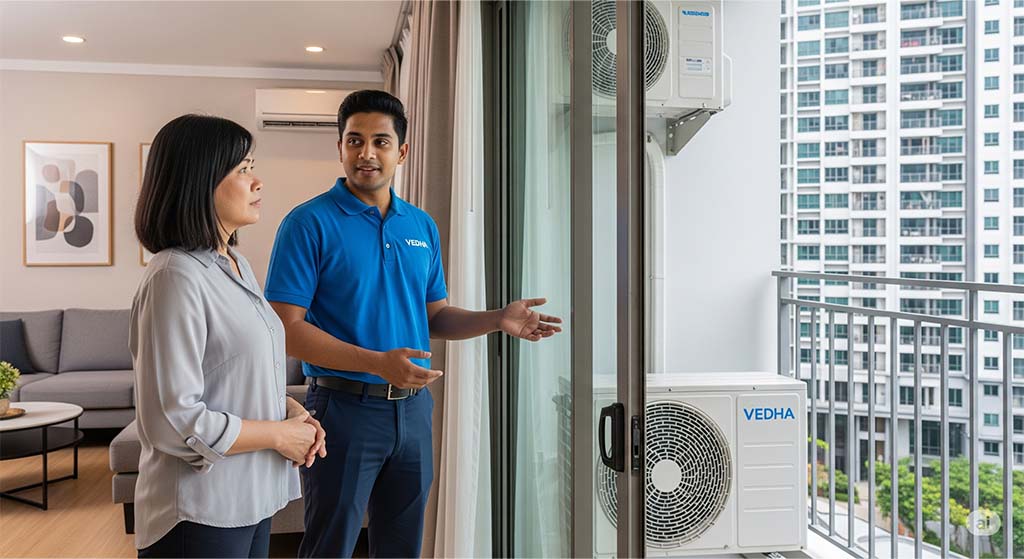
VD Aircon Can Help You Choose Right
Feeling overwhelmed by all the technical specifications? You’re not alone. Most Singapore homeowners aren’t HVAC engineers. That’s normal.
At VD Aircon Services, we’ve been guiding homeowners through aircon decisions since 2016. We understand the 2026 regulatory landscape. We know which brands offer real value versus marketing hype. We calculate BTU requirements based on your actual room conditions, not generic formulas.
Our process:
Free consultation: We assess your home’s unique cooling requirements. Room sizes, sun exposure, ceiling heights, usage patterns. No sales pressure.
Transparent recommendations: We explain exactly why we recommend specific BTU configurations and brands. Show you the CSPF numbers and 10-year cost projections.
Climate Voucher assistance: We handle the voucher registration and application process. Maximize your $400 benefit.
Professional installation: Our technicians follow NEA standards for pipe insulation, drainage, and system commissioning. Work is warrantied.
Ongoing maintenance: We don’t disappear after installation. Quarterly servicing and annual chemical wash packages keep your investment running efficiently.
Whether you need affordable aircon services that meet 2026 standards, urgent aircon servicing Singapore for failed systems, or expert guidance on the best aircon servicing Singapore offers for your specific home, we bring decade of experience to every consultation.
As the aircon specialist Singapore homeowners trust for honest advice, we focus on long-term value. Not just selling equipment, but ensuring you’re comfortable and saving money for years.
Our reliable aircon servicing Singapore covers proper specification, quality installation, and maintenance that actually extends equipment life.
Ready to make the right choice?
Contact VD Aircon Services for free consultation:
📞 96540044 (Call/WhatsApp)
📧 vedha.airconservices@gmail.com
🌐 www.vdairconservices.com
Check our aircon servicing deals for complete System 3/4/5 packages with installation and first-year maintenance included. We make the 2026 regulations work in your favor.

We specialize in Aircon installation, repair, and service. We have all type & model of recon compressor, full set & fancoil. Our technicians are highly proficient in their respective field and repairs and fixes aircon of various brands.
