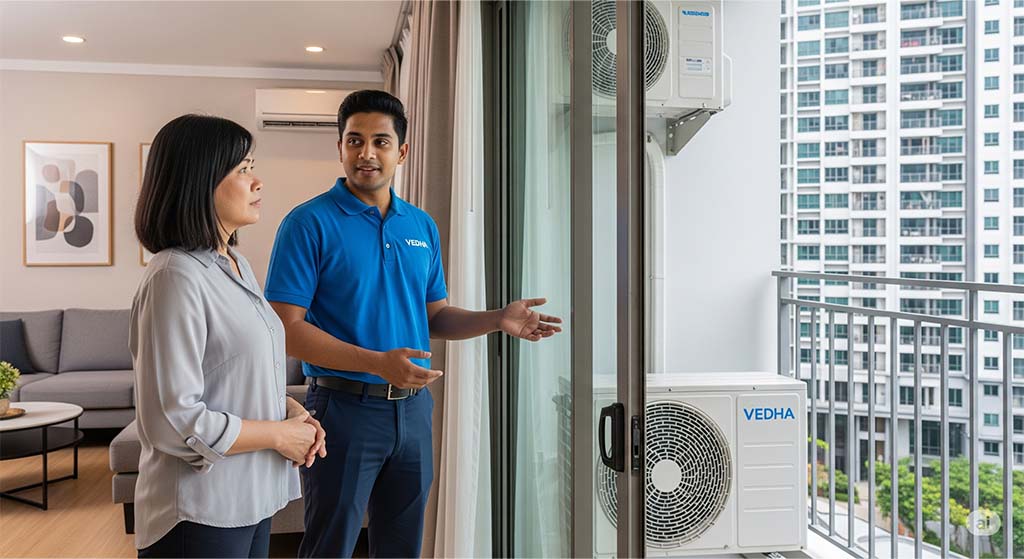
You’ve done your research. You know you want a Mitsubishi Starmex System 3 for your new BTO.
Then you see the prices:
Shopee listing: S$2,850 with “free installation” Aircon company quote: S$3,950 with installation
The math seems obvious. Save S$1,100. Click “Add to Cart.”
Six months later, you’re staring at a puddle of water under your bedroom aircon, calling a technician who tells you the installation used thin copper pipes that are now leaking refrigerant. The repair quote: S$800—and your “warranty” apparently doesn’t cover installation defects.
This is the story we hear every month from homeowners who learned the expensive way that buying an aircon isn’t like buying a phone case. The unit is only half the equation. The installation determines whether you get 10 years of trouble-free cooling or a recurring nightmare of leaks, breakdowns, and warranty disputes.
This guide breaks down the true cost difference between buying from e-commerce platforms versus aircon companies—including the hidden costs that don’t appear until it’s too late.
Part 1: What You’re Actually Buying
Let’s start with what most buyers don’t understand: an aircon purchase is two separate products bundled together.
Product 1: The Hardware
This is the actual aircon unit—the indoor fan coil units (FCU) and outdoor condenser. This hardware is identical regardless of where you buy it. A Mitsubishi Starmex from Shopee is the same physical unit as one from an aircon company.
The manufacturer warranty on the hardware is also the same:
- 1 year comprehensive warranty on fan coil units
- 5 years warranty on compressor
- Warranty is registered with the manufacturer, not the seller
So if you’re comparing hardware prices between a Shopee seller and an aircon company, you’re comparing apples to apples—sort of. The unit specifications are identical.
Product 2: The Installation
This is where everything diverges. Installation includes:
- Labour: Physical work of mounting units, drilling holes, connecting pipes
- Materials: Copper pipes, insulation, drainage pipes, electrical wiring, brackets, trunking
- Workmanship: Quality of flaring connections, vacuum testing, proper drainage slope, secure mounting
- Workmanship warranty: Protection if installation causes problems
When e-commerce listings advertise “free installation,” they’re bundling a complex service worth S$800-1,500 into a single price—and that service quality varies dramatically.
The Critical Difference
An aircon company controls both products. They select the hardware, perform the installation with their own trained technicians, and stand behind both with a unified warranty.
An e-commerce purchase separates these products. The platform seller provides the hardware. Installation is often handled by subcontractors or third-party installers the seller coordinates with but doesn’t employ or directly supervise.
This separation creates every hidden cost we’re about to discuss.
Part 2: The Real Price Comparison
Let’s compare what you actually pay, not just the sticker price.
Scenario: System 3 for 4-Room BTO
E-Commerce Purchase (Shopee/Lazada)
| Item | Typical Price |
|---|---|
| Mitsubishi Starmex System 3 unit | S$2,400-2,800 |
| “Free” installation (standard materials) | Included |
| Advertised Total | S$2,400-2,800 |
Aircon Company Purchase
| Item | Typical Price |
|---|---|
| Mitsubishi Starmex System 3 unit + installation | S$3,500-4,500 |
| Upgraded materials (usually included) | Included |
| Quoted Total | S$3,500-4,500 |
Apparent savings from e-commerce: S$700-1,700
This is where most buyers stop their comparison. But the real costs haven’t even started.
The Hidden Costs of E-Commerce Installation
Hidden Cost 1: Standard vs. Upgraded Materials
“Free installation” typically uses the cheapest acceptable materials:
| Component | Standard (E-Commerce) | Upgraded (Aircon Company) | Why It Matters |
|---|---|---|---|
| Copper pipes | SWG23 (0.61mm) | SWG22 (0.71mm) or SWG21 (0.81mm) | Thinner pipes can’t handle R32 refrigerant pressure as well, leading to leaks |
| Insulation | 3/8″ Armaflex | 1/2″ Armaflex | Thinner insulation causes condensation and dripping in Singapore’s humidity |
| Drainage pipes | 13mm without insulation | 16mm with insulation | Smaller pipes clog easily, causing water leaks |
| Electrical wiring | Basic grade | PSB-tested Singapore brands | Safety and longevity |
| Brackets | Standard welded | Heavy-duty BCA-compliant | Risk of outdoor unit falling |
Upgrade cost if you request better materials: S$150-400 extra (if even offered)
Hidden Cost 2: Installation Add-Ons
E-commerce “free installation” covers basic scenarios only. Expect extra charges for:
| Add-On | Typical Charge |
|---|---|
| Extra piping beyond 10-15 feet | S$25-50 per foot |
| Extra trunking | S$15-30 per foot |
| Concealed piping (in walls/ceiling) | S$200-500+ |
| Electrical point installation | S$80-150 |
| HDB/condo permit coordination | S$50-100 |
| Weekend/evening installation | S$50-150 |
| Disposal of old units | S$50-100 per unit |
A typical 4-room BTO installation might require S$200-600 in add-ons that aren’t included in the “free” installation.
Hidden Cost 3: Workmanship Warranty Gap
This is the most expensive hidden cost—the one you don’t pay until something goes wrong.
| Warranty Type | E-Commerce | Aircon Company |
|---|---|---|
| Unit (fan coil) | 1 year from manufacturer | 1 year from manufacturer |
| Compressor | 5 years from manufacturer | 5 years from manufacturer |
| Installation workmanship | 30-90 days (if any) | 1-3 years |
| Who handles warranty claims? | You coordinate between seller and installer | Single point of contact |
Why this matters: Most aircon problems in the first 2-3 years are installation-related, not hardware defects:
- Water leaking? Usually drainage slope or insulation issue
- Refrigerant leak? Usually poor pipe connection
- Strange noises? Usually mounting or vibration issue
- Poor cooling? Usually undersized piping or vacuum issues
If your problem is installation-related and the 30-day workmanship warranty has expired, you pay for repairs out of pocket—even if your unit is still under manufacturer warranty.
Typical installation-related repair costs:
- Water leak repair: S$70-150
- Refrigerant leak detection and repair: S$150-400
- Gas top-up (from slow leak): S$80-150
- Drainage re-routing: S$100-200
Hidden Cost 4: Coordination Headache
When something goes wrong with an e-commerce purchase, you’re caught in a triangle:
- E-commerce seller: “It’s an installation issue, contact the installer”
- Installer: “It’s a unit defect, contact the seller”
- Manufacturer: “Installation wasn’t done by our authorized dealer”
This coordination takes your time—hours on calls, WhatsApp messages, waiting for responses. And time has value.
The True 5-Year Cost Comparison
Let’s model realistic scenarios for a System 3 installation:
E-Commerce Best Case (No Problems)
| Year | Cost |
|---|---|
| Purchase + installation | S$2,800 |
| Year 1-5 servicing (3x/year × S$75) | S$1,125 |
| Total | S$3,925 |
E-Commerce Realistic Case (Typical Issues)
| Year | Cost |
|---|---|
| Purchase + installation | S$2,800 |
| Installation upgrades requested | S$250 |
| Extra piping charges | S$200 |
| Year 2: Water leak repair (drainage issue) | S$120 |
| Year 3: Gas top-up (slow leak) | S$100 |
| Year 4: Repair refrigerant leak | S$350 |
| Year 1-5 servicing | S$1,125 |
| Total | S$4,945 |
Aircon Company Scenario
| Year | Cost |
|---|---|
| Purchase + quality installation | S$4,000 |
| Year 1-5 servicing | S$1,125 |
| Repairs (covered under 3-year workmanship warranty) | S$0 |
| Total | S$5,125 |
The Reality: The “S$1,100 savings” becomes a S$180 difference—or even a S$100+ loss if more repairs occur. And this doesn’t account for the stress and time spent dealing with problems.
Part 3: Installation Quality—What You Can’t See
The most expensive hidden costs come from installation quality issues that aren’t visible when the technician leaves.
The Copper Pipe Problem
Copper pipes carry refrigerant between your indoor and outdoor units under high pressure. The thickness of these pipes directly affects their ability to handle that pressure.
The specifications that matter:
- SWG21 (0.81mm): Premium thickness, handles R32 pressure excellently
- SWG22 (0.71mm): Standard good quality, adequate for most installations
- SWG23 (0.61mm): Budget thickness, marginal for R32 refrigerant
R32 refrigerant (now standard in Singapore) operates at higher pressure than the older R410A. SWG23 pipes were acceptable for R410A but are marginal for R32—they’re more likely to develop micro-cracks at connection points over time.
What this looks like in practice:
A tiny crack develops at a flaring connection after 18 months. You don’t notice immediately because refrigerant leaks slowly. Your aircon gradually cools less effectively. You call for servicing, and the technician discovers low gas levels. You pay S$100 for a gas top-up.
Six months later, same problem. Another S$100. The technician recommends a pressure test (S$100-150) which reveals a leak at the connection point. Repair options:
- Re-flare the connection: S$150-200 (might work)
- Replace section of piping: S$300-500
- Full piping replacement: S$800-1,500
All because the original installation used budget pipes and the flaring wasn’t done properly.
The Insulation Disaster
Insulation around copper pipes serves two purposes:
- Prevents cold pipes from warming up (maintains efficiency)
- Prevents condensation from forming on cold surfaces
In Singapore’s humidity, condensation is inevitable without proper insulation. The moisture from condensation:
- Drips onto your walls, ceiling, or furniture
- Promotes mould growth inside the trunking
- Corrodes metal components over time
Standard 3/8″ insulation barely adequate for Singapore’s humidity Upgraded 1/2″ insulation: Proper protection, especially for concealed piping
The difference in cost between 3/8″ and 1/2″ insulation for a System 3 installation is perhaps S$50-100. But replacing water-damaged ceiling boards, repainting walls, or dealing with mould costs hundreds.
The Drainage Slope Disaster
Water naturally accumulates inside your aircon as it dehumidifies the air. This water needs to drain away through the drainage pipe.
Proper drainage requires:
- Adequate slope (gravity flow)
- Correct pipe diameter (16mm preferred over 13mm)
- Smooth routing with minimal bends
- Insulation to prevent external condensation
Improper drainage causes:
- Water pooling inside the unit
- Overflow leading to leaking
- Gurgling sounds during operation
- Mould and bacteria growth in standing water
The installation shortcut: Some installers don’t achieve proper slope, especially in complex routing situations. They might add a condensate pump to force water flow—but if the pump fails, you get flooding.
The fix: Often requires re-routing the entire drainage system—a S$200-400 job that should have been done right the first time.
The Vacuum Test Skip
After installation, before turning on your aircon, the system should be vacuum-tested to remove air and moisture from the refrigerant lines.
Proper vacuum testing:
- Uses professional vacuum pump
- Achieves pressure below 400 microns
- Holds vacuum for 15-20 minutes to verify no leaks
- Removes all moisture that could damage compressor
The shortcut: Some installers skip or rush vacuum testing. They might pump for a few minutes instead of achieving proper vacuum levels.
The result: Moisture remains in the system, mixing with refrigerant and forming acids that corrode internal components. The compressor might fail after 3-4 years instead of lasting 10+.
Compressor replacement cost: S$800-1,500 or more
Part 4: Warranty Reality Check
Understanding what warranty actually covers—and doesn’t—prevents expensive surprises.
Manufacturer Warranty (Same for All Purchases)
What’s covered:
- Defective components (fan motor, PCB, sensors)
- Compressor failure due to manufacturing defect
- Parts and labour for covered repairs
What’s NOT covered:
- Installation-related issues
- Damage from improper installation
- Normal wear and tear
- Damage from lack of maintenance
- Problems caused by power surges
The catch: Manufacturer warranty can be voided if:
- Unit wasn’t installed by an authorized dealer
- Installation doesn’t meet manufacturer specifications
- Third-party repairs or modifications were made
When you buy from Shopee/Lazada, your installer may or may not be an authorized dealer. If warranty issues arise and the manufacturer determines installation was faulty, you may be denied coverage.
Workmanship Warranty (Varies Dramatically)
E-Commerce Installation: Typically 30-90 days
This covers issues that appear immediately after installation—obvious water leaks, units not cooling, visible problems. After 90 days, any installation-related issue becomes your problem.
Aircon Company Installation: Typically 1-3 years
Quality aircon companies offer 1-3 year workmanship warranties because they’re confident in their installation quality. If drainage starts leaking after 6 months, it’s covered. If refrigerant levels drop after 18 months due to a connection issue, it’s covered.
The Value Calculation:
A 3-year workmanship warranty from a reputable company is essentially insurance against installation defects. Average installation-related repairs in years 1-3 might total S$300-600. The warranty “costs” the S$500-800 price premium of buying from an aircon company—but protects you from S$600+ in potential repairs.
The “Free Warranty Extension” Trap
Some e-commerce sellers advertise “5-year warranty” or “extended warranty included.” Read the fine print:
- Is it a manufacturer warranty or seller warranty?
- What does it actually cover?
- Who handles claims—the seller, a third party, or the manufacturer?
- Is there a deductible for claims?
- Are there exclusions for installation-related issues?
A seller-provided “extended warranty” from an e-commerce platform may be worthless if the seller closes shop or disputes your claim.
Part 5: The Subcontractor Problem
Here’s what happens behind the scenes with many e-commerce aircon purchases:
- You buy from Seller A on Shopee/Lazada
- Seller A coordinates with Installation Company B (might be an authorized dealer, might not be)
- Company B dispatches Technician Team C (employees or subcontracted freelancers)
- Team C installs your aircon
Why This Chain Creates Problems
Quality control gaps: Seller A doesn’t control Company B’s work quality. Company B may use different materials or technicians for different jobs. Team C’s incentive is speed, not quality—they’re paid per job.
Accountability gaps: When problems arise, Seller A blames Company B. Company B blames Team C. You’re left coordinating between parties who don’t want to take responsibility.
Communication gaps: Your special requests (upgraded materials, specific mounting location) may not make it from Seller A to Team C. What you discussed isn’t what gets installed.
The Megastore Version
Even large retailers like Gain City or Courts face similar issues. They sell the units but often outsource installation to third-party contractors.
The key difference: Large retailers have more leverage over contractors and more at stake reputation-wise. But installation quality still varies based on which contractor team shows up on installation day.
User reviews consistently cite installation quality as the biggest complaint even with major retailers. The unit is fine. The installation is hit-or-miss.
The Aircon Company Difference
A dedicated aircon company:
- Employs their own technicians (or has long-term relationships with specific contractors)
- Trains technicians on their installation standards
- Uses consistent materials across all jobs
- Handles both sale and installation internally
- Has direct accountability for any problems
When you call with an issue, there’s one company responsible. No finger-pointing. No coordination between multiple parties.
Part 6: Real Scenarios—What Goes Wrong
Let’s look at actual situations homeowners face:
Scenario 1: The Disappearing Seller
What happened: Customer bought a Midea System 3 from a Shopee seller for S$2,100 (S$800 below typical aircon company price). Six months later, the outdoor unit started making grinding noises. Customer tried to contact seller for warranty—the Shopee store was closed.
The outcome: Manufacturer warranty still valid, but filing a claim required proof of purchase and installation details. Customer spent three weeks gathering documentation and coordinating with Midea service centre. Repair was eventually covered, but the hassle consumed significant time and stress.
Lesson: The S$800 savings disappeared in the form of time spent resolving issues without seller support.
Scenario 2: The Installation Blame Game
What happened: Customer bought a Daikin System 4 from Lazada, installed by a third-party company. After one year, two fan coil units started leaking water. Customer called installer—they said drainage was fine, probably a unit defect. Customer called Daikin—they said it’s clearly a drainage issue, not covered under warranty.
The outcome: Customer paid S$180 for a technician from an unrelated company to properly diagnose the issue (incorrect drainage slope). Paid another S$350 to have drainage re-routed correctly. Total out-of-pocket: S$530 for a problem that should never have happened.
Lesson: The 90-day workmanship warranty had expired. Installation defects that appear after the short warranty period become your problem.
Scenario 3: The Material Switch
What happened: Customer specifically requested SWG22 copper pipes and 1/2″ insulation when buying from an e-commerce seller. Seller confirmed the request. On installation day, customer noticed the insulation looked thin. Installer claimed it was “the same thing.”
The outcome: Customer couldn’t verify pipe thickness without cutting into insulation. Two years later, condensation issues appeared in concealed piping areas, causing ceiling water stains. Damage cost S$400 to repair.
Lesson: Verbal confirmations mean nothing. Without oversight, you can’t verify what materials were actually used.
Scenario 4: The Successful E-Commerce Purchase
What happened: Customer bought a Panasonic System 3 from a Shopee seller with 2,000+ reviews and 4.8-star rating. Researched the specific seller’s installation reputation. Confirmed upgraded materials in writing. Inspected installation carefully and verified drainage slope with a level. Registered warranty immediately.
The outcome: Three years later, no issues. Total savings vs. aircon company: approximately S$600.
Lesson: E-commerce purchases can work well with careful research, documentation, and verification. But it requires significant effort and knowledge.
Part 7: When E-Commerce Makes Sense
Despite the risks, buying from Shopee/Lazada can be reasonable in specific situations:
Good Candidates for E-Commerce Purchase
1. You’re buying a simple system
Single-split (System 1) installation in a straightforward location has fewer things that can go wrong compared to complex multi-split systems with concealed piping.
2. You have technical knowledge
If you understand aircon installation specifications, can verify materials, inspect workmanship, and identify problems, you can catch issues before they become expensive.
3. You’ve researched the specific seller thoroughly
Not all e-commerce sellers are equal. Look for:
- High review count (500+) with recent reviews
- Detailed reviews mentioning installation quality
- Seller has their own installation team (not random subcontractors)
- Responsive communication before purchase
- Clear documentation of materials and warranty terms
4. You’re willing to pay for upgrades
If you request upgraded materials (better pipes, insulation, drainage) and pay the extra cost, you reduce the material-quality risk. The remaining risk is workmanship quality.
5. You’re buying for a rental property
If you’re landlords installing basic aircon in a rental unit and prioritise lowest cost over long-term performance, the e-commerce risk/reward calculation shifts.
Poor Candidates for E-Commerce Purchase
1. Complex installations
Multi-split systems with concealed piping, long pipe runs, or difficult outdoor unit placement have more potential failure points.
2. Your forever home
If you’re living in this property for 10+ years, installation quality matters enormously. Problems that develop in year 3-5 are expensive to fix.
3. You can’t inspect the work
If you’re not present during installation or don’t know what to look for, you can’t catch problems before the installer leaves.
4. Premium units
If you’re spending S$4,000+ on premium units (Mitsubishi Electric Starmex, Daikin iSmileEco), it doesn’t make sense to compromise on installation quality to save S$500.
Part 8: How to Buy Smart (Either Way)
Whether you buy from e-commerce or an aircon company, these steps protect you:
Before Purchase
1. Get everything in writing
- Exact model numbers
- Material specifications (pipe thickness, insulation thickness, drainage size)
- What’s included and excluded from installation
- Warranty terms (unit and workmanship)
- Add-on charges and conditions
2. Verify seller/company credentials
For e-commerce:
- Check seller ratings and review content (not just stars)
- Look for complaints about installation quality
- Confirm they use their own installation team or identify who installs
For aircon company:
- Verify BCA registration
- Check online reviews across multiple platforms
- Ask for references from recent installations
3. Understand the warranty
- Who provides workmanship warranty?
- How long does it last?
- What’s covered vs. excluded?
- How do you file a claim?
During Installation
1. Be present
Watch the installation. Ask questions. Take photos.
2. Verify materials
Before installation begins, check the materials against what was promised:
- Copper pipe markings should show SWG rating
- Insulation should match agreed thickness
- Drainage pipes should be the agreed size
3. Inspect key points
- Mounting is secure (test by gently pushing the unit)
- Drainage slope is adequate (water flows freely)
- Connections are properly insulated
- Outdoor unit is level
- Trunking is neat and secure
4. Request vacuum test documentation
Ask the installer to show you the vacuum gauge readings. A proper vacuum should achieve below 400 microns and hold stable.
5. Test before signing off
Run the aircon for at least 15-20 minutes before the installer leaves. Check:
- All units cool properly
- No unusual sounds
- No water dripping
- Remote functions work
After Installation
1. Register warranty immediately
Don’t wait. Register with the manufacturer within the specified period (usually 30 days).
2. Document everything
Keep copies of:
- Purchase receipts
- Installation invoices
- Warranty certificates
- Photos of installation
- Communication records
3. Schedule first servicing early
Have the system serviced within 3-4 months of installation. This catches early issues while workmanship warranty is still valid.
Part 9: The Decision Framework
Here’s how to decide where to buy:
Choose an Aircon Company If:
- You want single-point accountability
- Installation is complex (multiple units, concealed piping)
- You value extended workmanship warranty (1-3 years)
- You’re not technical enough to verify installation quality
- This is your long-term home
- You prefer paying more upfront to avoid future headaches
Choose E-Commerce If:
- You’re comfortable with higher risk for lower price
- Installation is simple (single-split, straightforward location)
- You can verify materials and inspect workmanship
- You’ve thoroughly researched the specific seller
- You’re buying for a rental or short-term property
- You’re willing to coordinate warranty issues yourself
The Middle Ground: Reputable E-Commerce Sellers
Some e-commerce sellers are essentially aircon companies selling through online platforms. They have their own installation teams, offer proper workmanship warranties, and use quality materials.
Look for:
- Seller has a physical business presence (not just a Shopee store)
- Installation team is employed or exclusively contracted by seller
- Workmanship warranty of 1+ years
- Clear communication and documentation
- High volume with consistently positive installation reviews
These sellers offer e-commerce convenience with closer-to-aircon-company quality. The price is usually between rock-bottom e-commerce and full-service aircon company quotes.
The Bottom Line
That S$2,850 Shopee listing isn’t really S$2,850. When you factor in:
- Installation add-ons: +S$200-400
- Material upgrades (if available): +S$100-300
- Potential repairs from installation issues: +S$200-600
- Your time coordinating warranty claims: Priceless frustration
The true cost approaches or exceeds the S$3,950 aircon company quote—without the 3-year workmanship warranty, single-point accountability, or peace of mind.
The cheapest aircon is the one that works perfectly for 10 years without surprise repair bills. That usually means quality installation with quality materials from a company that stands behind their work.
If you choose to save money through e-commerce, go in with eyes open. Research thoroughly, verify everything, inspect carefully, and accept that you’re trading warranty protection and accountability for upfront savings.
But don’t let a S$500 discount on a S$4,000 purchase create S$1,000 in problems. That’s not savings—that’s an expensive lesson in hidden costs.
Considering a new aircon system? VD Aircon provides transparent, all-inclusive pricing with upgraded materials and a comprehensive 3-year workmanship warranty. We believe the installation matters as much as the unit itself—and we stand behind both. Contact us at 96540044 for a detailed quote with no hidden costs.

We specialize in Aircon installation, repair, and service. We have all type & model of recon compressor, full set & fancoil. Our technicians are highly proficient in their respective field and repairs and fixes aircon of various brands.