3:17 AM.
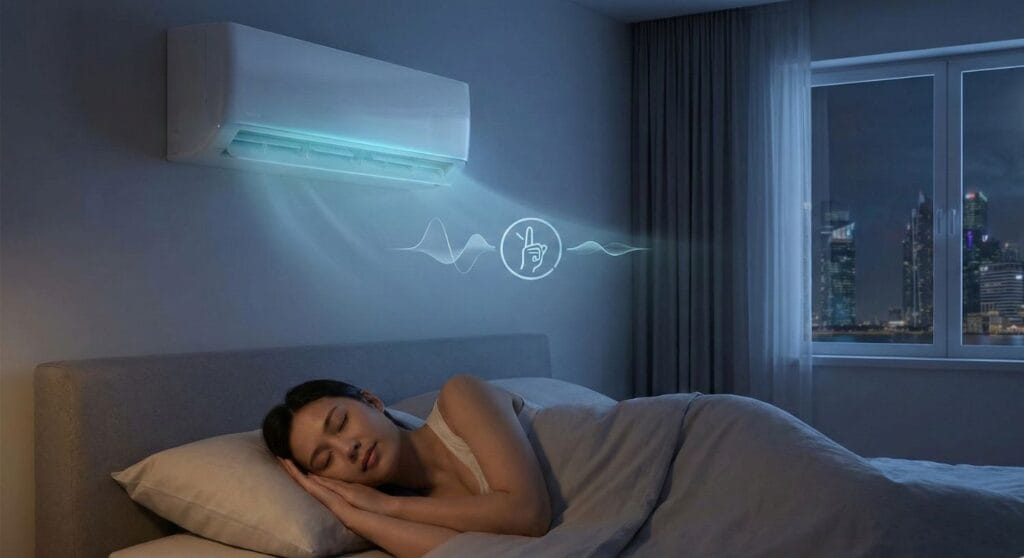
You’re finally drifting off after a long day. The room is cool, the pillows are perfect, and then—
Whirrrrrr-CLICK.
Your aircon cycles. The compressor kicks in. The fan speed changes. And just like that, you’re wide awake again.
If this sounds familiar, you’re not alone. In Singapore’s compact HDB bedrooms and condo units, where walls are thin and rooms are small, aircon noise isn’t just an annoyance—it’s the difference between waking up refreshed and dragging yourself through another exhausted day.
This guide cuts through the marketing claims to show you which aircons actually deliver quiet operation in Singapore bedrooms. We’ll explain what decibel ratings really mean, compare the quietest models available in 2026, and reveal the installation and maintenance factors that make the difference between a whisper-quiet unit and one that keeps you up all night.
Part 1: Understanding Aircon Noise (What the Numbers Mean)
Before comparing models, you need to understand how noise is measured and what levels actually affect your sleep.
The Decibel Scale Explained
Sound is measured in decibels (dB or dBA, where “A” indicates weighting for human hearing). Here’s what makes this tricky:
The scale is logarithmic, not linear.
This means:
- A 30 dB sound is 10 times more intense than a 20 dB sound
- A 40 dB sound is 100 times more intense than a 20 dB sound
- Every 10 dB increase sounds roughly twice as loud to human ears
So a 25 dB aircon isn’t just “a bit quieter” than a 35 dB unit—it sounds about half as loud to your sleeping brain.
Real-World Sound References
To understand what these numbers mean in practice:
| dB Level | Sound Equivalent | Sleep Impact |
|---|---|---|
| 19-20 dB | Rustling leaves, soft breathing | Virtually inaudible |
| 25 dB | Whisper at 5 feet | Barely noticeable |
| 30 dB | Quiet library | WHO recommended bedroom maximum |
| 35 dB | Soft background music | May disturb light sleepers |
| 40 dB | Quiet residential street | Noticeable, can interrupt sleep |
| 45 dB | Refrigerator humming | Clearly audible, affects sleep quality |
| 50 dB | Moderate rainfall | Disturbing for most sleepers |
| 55+ dB | Normal conversation | Sleep disruption guaranteed |
What Science Says About Sleep and Noise
The World Health Organization (WHO) recommends that bedroom noise should not exceed 30 dB(A) for quality sleep. Research shows that noise above this level can:
- Increase time to fall asleep
- Reduce deep sleep phases
- Cause more frequent awakenings
- Leave you feeling less rested even if you don’t remember waking
For light sleepers—estimated at 20-30% of the population—even sounds below 30 dB can cause disturbances. This is why the quietest aircon models targeting bedroom use aim for 19-25 dB.
The Catch with Manufacturer Specifications
Here’s what aircon marketing doesn’t tell you:
Published dB ratings are measured under ideal conditions:
- Lowest fan speed setting
- Optimal room temperature (minimal compressor work)
- New, clean unit
- Perfect installation with no vibration
Real-world operation is louder because:
- Higher fan speeds during initial cooling
- Compressor working harder in Singapore’s heat
- Accumulated dust affecting airflow
- Installation vibrations transmitted through walls
That “19 dB” unit might hit 35-40 dB during normal evening use. The key is choosing models that remain relatively quiet even at medium settings.
Part 2: The 2026 Singapore Quiet Aircon Rankings
Based on manufacturer specifications, real-world testing, and feedback from Singapore homeowners, here’s how the major brands compare for quiet bedroom operation.
The Quietest: 19-21 dB (At Low Speed)
These models achieve near-silent operation and are the top choices for light sleepers.
Mitsubishi Electric Starmex FP/GP Series
- Published noise level: 19 dB (low speed)
- Real-world range: 19-32 dB depending on fan speed
- Energy rating: 5-tick
- Key quiet features: Dual Barrier Coating reduces dust buildup affecting fan noise, advanced inverter compressor
Mitsubishi Electric has earned its reputation as the “king of quiet.” The Starmex series consistently delivers on its whisper-quiet promise. The FP and GP models use refined fan blade design and vibration-dampening mounting to minimise operational noise. For bedrooms, this is the benchmark other brands try to match.
Daikin iSmileEco Series
- Published noise level: 19 dB (quiet mode)
- Real-world range: 19-35 dB depending on fan speed
- Energy rating: 5-tick
- Key quiet features: Night Set Mode gradually adjusts operation for sleep, built-in Wi-Fi for silent remote control
Daikin matches Mitsubishi’s 19 dB specification and adds smart features that help maintain quiet overnight operation. The Night Set Mode is particularly useful—it gradually raises temperature by 0.5°C after 60 minutes, reducing compressor work during your deepest sleep phases.
Very Quiet: 21-23 dB (At Low Speed)
Excellent for most sleepers, though the very lightest sleepers might notice these units.
Panasonic X-Premium XU Series
- Published noise level: 21 dB (low speed)
- Real-world range: 21-36 dB depending on fan speed
- Energy rating: 5-tick
- Key quiet features: nanoe™ X air purification runs silently, Econavi sensor reduces unnecessary operation
Panasonic’s flagship model competes closely with the top two. While 2 dB louder than Mitsubishi/Daikin on paper, most sleepers won’t notice the difference. The real advantage is the active air purification, which runs continuously without adding noise—excellent for Singapore’s haze-prone climate.
LG Artcool+ Series
- Published noise level: 22 dB (low speed)
- Real-world range: 22-38 dB depending on fan speed
- Energy rating: 5-tick
- Key quiet features: Dual Inverter Compressor for stable, quiet operation
LG’s premium line delivers reliable quiet performance with a focus on energy efficiency. The Dual Inverter technology keeps the compressor running smoothly at lower speeds, avoiding the start-stop cycling that creates noise spikes.
Quiet: 23-28 dB (At Low Speed)
Good value options that work well for average sleepers.
Toshiba YouMe Series
- Published noise level: 23 dB (low speed)
- Real-world range: 23-40 dB depending on fan speed
- Energy rating: 5-tick
- Key quiet features: Magic Coil self-cleaning reduces dust-related noise over time
Toshiba offers solid quiet performance at a more accessible price point than the premium Japanese brands. The self-cleaning feature helps maintain quiet operation over the unit’s lifespan.
Midea All Easy Pro Series
- Published noise level: 21-28 dB (varies by model)
- Real-world range: 25-42 dB depending on fan speed
- Energy rating: 5-tick
- Key quiet features: Quiet Mode, Eco Mode for reduced operation
Midea has improved significantly in recent years. While still slightly louder than the premium Japanese brands, the price difference (often 30-40% less) makes this a reasonable choice for bedrooms where absolute silence isn’t critical. The gap narrows considerably on medium and high fan speeds.
The Noise Reality Check
What these ratings mean in practice:
At low speed (19-23 dB range), all premium brands are effectively silent for most people. You’d struggle to hear the unit operating.
The real differences emerge at medium and high speeds, during initial cool-down, and after months of dust accumulation:
| Brand | Low Speed | Medium Speed | High Speed | After 6 Months (Unmaintained) |
|---|---|---|---|---|
| Mitsubishi Electric | 19 dB | 28 dB | 38 dB | +3-5 dB |
| Daikin | 19 dB | 30 dB | 40 dB | +3-5 dB |
| Panasonic | 21 dB | 32 dB | 42 dB | +4-6 dB |
| LG | 22 dB | 33 dB | 43 dB | +4-6 dB |
| Midea | 25 dB | 36 dB | 46 dB | +5-8 dB |
The takeaway: If you’re a light sleeper who needs the aircon to run at medium or high speeds (larger bedroom, hot-facing unit, Singapore’s peak heat), the premium brands maintain a more significant quiet advantage.
Part 3: What Makes an Aircon Quiet?
Understanding the technology helps you evaluate claims and maintain quiet operation over time.
The Compressor: Heart of Quiet Operation
The compressor is the loudest component in any air conditioning system. Two technologies dramatically reduce compressor noise:
Inverter Technology (Essential)
Traditional (non-inverter) aircons work like a light switch—full power ON or completely OFF. Every time the compressor kicks on, you get a surge of noise. This cycling might happen every 10-15 minutes in a Singapore bedroom.
Inverter aircons work like a dimmer switch—adjusting power from 10% to 100% based on cooling needs. Once the room reaches temperature, the compressor slows to 20-30% capacity and runs continuously at a whisper.
Benefits for sleep:
- No jarring start-up noise every few minutes
- Consistent, predictable sound (easy to tune out)
- Temperature stays stable (no sweating-then-freezing cycles)
If you’re buying a new aircon in 2026, inverter technology is standard in all 5-tick models. There’s no reason to consider non-inverter for bedroom use.
Variable-Speed vs. Two-Stage Compressors
Within inverter technology, variable-speed (multi-stage) compressors are quieter than two-stage models because they make smaller, more gradual adjustments. Premium brands like Mitsubishi Electric and Daikin use advanced variable-speed compressors in their flagship models.
The Fan: Where Many Noise Problems Start
The indoor unit’s fan (blower) creates most of the sound you actually hear in the bedroom.
Fan Blade Design
Modern quiet units use aerodynamically designed blades that:
- Reduce turbulence (the “whoosh” sound)
- Minimise air resistance
- Distribute airflow more evenly
Mitsubishi Electric’s fan blade design is frequently cited as a key factor in their quiet reputation.
ECM (Electronically Commutated Motors)
ECM motors are more efficient and quieter than traditional PSC (permanent split capacitor) motors. They allow precise speed control, spinning at exactly the RPM needed rather than fixed speed steps.
Premium models from all major brands now use ECM motors. Budget models may still use PSC motors, which are noticeably louder and less adjustable.
The Barrel Fan (Blower Wheel)
The cylindrical blower that pushes air through the unit can become a major noise source when:
- Dust accumulates unevenly, creating imbalance
- Bearings wear, causing vibration
- Mounting becomes loose over time
This is why maintenance matters so much for quiet operation—a perfectly balanced fan in a new unit can become a noise machine after a year of neglect.
Airflow Design: The Hidden Factor
How air moves through and out of the unit affects perceived noise:
Wide Air Outlets
Units with wider discharge openings move the same volume of air at lower velocity, reducing the “rushing air” sound. This is one reason the Mitsubishi Electric Starmex design, with its notably wide outlet, achieves lower noise levels.
Coanda Effect
Some units (particularly Daikin) use the Coanda effect—directing air along the ceiling rather than straight into the room. This reduces the sensation of direct airflow hitting your face and can make the unit feel quieter even at the same dB level.
Night/Sleep/Quiet Modes
Most modern aircons include special modes designed for overnight operation:
What these modes typically do:
- Lock fan speed to lowest setting
- Gradually increase temperature setpoint (reducing compressor work)
- Disable LED displays and sounds
- Prioritise steady operation over rapid response
Daikin Night Set Mode: Raises temperature by 0.5°C after 60 minutes, then maintains that level. Based on the principle that your body temperature naturally drops during deep sleep.
Mitsubishi Electric Quiet Mode: Limits fan and compressor operation to minimum levels needed to maintain temperature.
Panasonic Sleep Mode: Combines temperature adjustment with Econavi sensor to reduce unnecessary cycling.
These modes can reduce operational noise by 3-8 dB compared to normal automatic operation—a meaningful difference for light sleepers.
Part 4: Why Your “Quiet” Aircon Became Noisy
Bought a quiet model but now it sounds like a washing machine? Here’s what went wrong.
Problem 1: Dust Accumulation
The most common cause of increasing aircon noise is simple: dirt.
Where dust causes noise:
- Filters: Blocked filters force the fan to work harder, creating more noise and turbulence
- Evaporator coils: Dust on coils restricts airflow, increasing fan speed requirements
- Blower wheel: Dust accumulation on fan blades creates imbalance, causing vibration
- Drainage tray: Blocked drainage can lead to water accumulation, creating gurgling sounds
The fix: Clean filters every 2-4 weeks. Schedule professional servicing every 3-4 months. The quietest aircon in the world won’t stay quiet without maintenance.
Problem 2: Refrigerant Issues
Low refrigerant levels force the compressor to work harder and can create distinctive sounds:
- Hissing: Often indicates a refrigerant leak
- Bubbling/gurgling: Refrigerant not flowing properly
- Louder compressor: Working harder to compensate for low charge
The fix: Professional diagnosis and repair. Refrigerant issues require qualified technicians.
Problem 3: Loose Components
Vibration is the enemy of quiet operation. Over time, screws, panels, and mountings can loosen:
- Rattling: Loose panels or covers vibrating against the unit
- Buzzing: Loose electrical connections or components
- Clicking: Relay switches wearing out
The fix: Some tightening can be done yourself (carefully, with power off). Electrical issues require professional attention.
Problem 4: Fan Motor Problems
The fan motor is a mechanical component with a finite lifespan:
- Squealing/screeching: Worn bearings needing lubrication or replacement
- Grinding: Severe bearing damage
- Humming at startup: Motor struggling to start (capacitor issue)
The fix: Professional motor repair or replacement. Continuing to run a failing motor causes further damage.
Problem 5: Installation Issues (From Day One)
Some noise problems trace back to installation:
- Vibration transfer: Indoor unit not properly secured to wall studs
- Pipe transmission: Refrigerant lines touching structure without isolation
- Poor drainage slope: Water pooling and gurgling instead of draining
- Incorrect sizing: Oversized unit short-cycling, undersized unit running constantly at high speed
The fix: Reinstallation or correction by qualified installer. These issues won’t resolve with maintenance alone.
The Noise Progression Timeline
A typically maintained aircon in a Singapore bedroom:
| Time Since Installation | Expected Noise Increase | Cause |
|---|---|---|
| 0-6 months | +0-2 dB | Normal break-in |
| 6-12 months | +2-4 dB | Dust accumulation |
| 1-2 years | +3-6 dB | Dust + early wear |
| 2-5 years | +4-8 dB | Component wear |
| 5+ years | +5-12 dB | Significant wear |
With proper maintenance (servicing every 3-4 months):
| Time Since Installation | Expected Noise Increase | Notes |
|---|---|---|
| 0-2 years | +0-2 dB | Like new |
| 2-5 years | +2-4 dB | Minimal increase |
| 5-8 years | +3-6 dB | Well-maintained wear |
| 8+ years | +5-8 dB | Consider replacement |
The difference between maintained and unmaintained units becomes dramatic after 2-3 years.
Part 5: Installation Factors for Quiet Operation
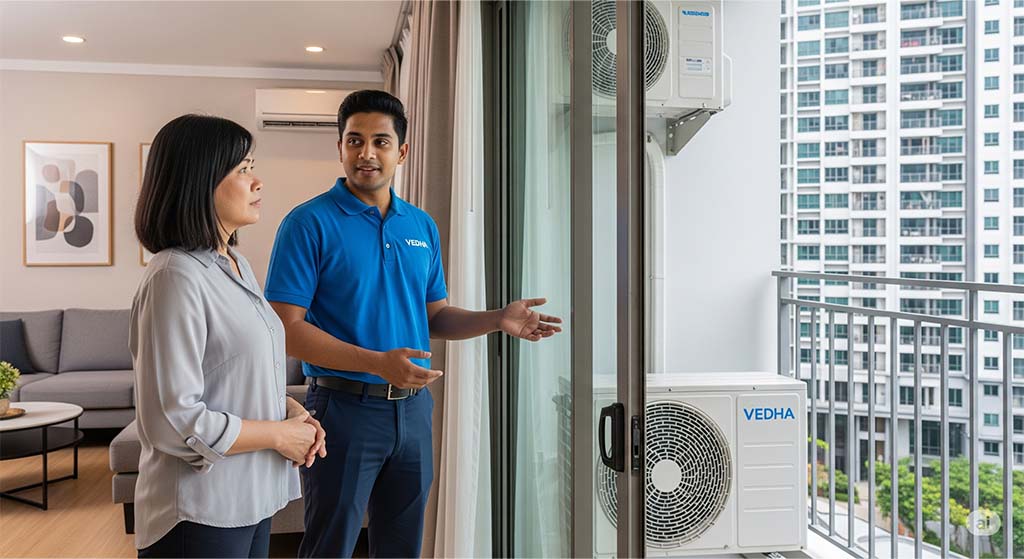
Even the quietest aircon can become noisy with poor installation. Here’s what to specify.
Indoor Unit Mounting
Wall Stud Anchoring
The indoor unit should be mounted directly into wall studs, not just drywall. In HDB flats with concrete walls, proper anchoring is essential. Loose mounting allows the unit to vibrate against the wall, transmitting sound throughout the room.
Vibration Isolation
Quality installations include rubber grommets or isolation pads between the mounting bracket and the wall. These absorb vibration before it can transfer to the structure.
Level Installation
A unit mounted even slightly off-level will drain poorly and may vibrate unevenly. Professional installers use spirit levels and adjust until perfect.
Refrigerant Line Routing
Cushioned Clamps
The copper refrigerant lines connecting indoor and outdoor units can transmit compressor vibration into your bedroom. Proper installation uses cushioned clamps (rubber-lined) rather than direct metal-to-metal contact.
Wall Penetration Isolation
Where lines pass through walls, isolation grommets prevent direct contact between pipes and structure. This small detail makes a significant difference in transmitted noise.
Secure but Not Rigid
Lines should be secured enough to prevent movement but with enough flexibility to absorb vibration. Completely rigid mounting transmits more noise.
Outdoor Unit Placement
While the outdoor condenser sits outside your bedroom, its placement still matters:
Distance from Bedroom Windows
If possible, position the outdoor unit away from bedroom windows. Every metre of distance reduces perceived noise.
Proper Levelling
An unlevel outdoor unit vibrates more. Quality installations include a level concrete pad or proper wall brackets.
Airflow Clearance
Outdoor units need clear airflow to operate efficiently. Restricted airflow causes the fan to work harder and louder.
Drainage Route
Improper drainage causes gurgling sounds as water struggles to flow:
Adequate Slope
Drainage pipes need sufficient slope (typically 1:50 or greater) for gravity flow. Flat or incorrectly sloped pipes create water pooling and noise.
Smooth Routing
Fewer bends and turns mean smoother water flow and less noise.
What to Ask Your Installer
Before installation, confirm:
- “Will you mount into wall studs/concrete with proper anchors?”
- “Do you use vibration isolation for the mounting bracket?”
- “Will refrigerant lines have cushioned clamps?”
- “What’s the drainage slope you’ll achieve?”
- “Where will the outdoor unit be positioned relative to bedroom windows?”
Quality installers will understand these questions. If they seem confused, consider a different company.
Part 6: Practical Tips for Quieter Sleep
Beyond buying a quiet unit and proper installation, these strategies help minimise nighttime noise.
Operating Strategy
Pre-Cool Before Bed
Start cooling 30-60 minutes before bedtime. This allows the unit to reach temperature while you’re still awake, so it can shift to quiet low-speed operation by the time you’re trying to sleep.
Use Night/Sleep Mode
Activate your aircon’s night mode when you get into bed. This locks in quiet operation settings for the entire night.
Slightly Higher Temperature
Setting 25°C instead of 22°C means less compressor work and lower fan speeds. Use a fan for additional perceived cooling if needed. Every degree higher reduces operating noise.
Avoid Extreme Differentials
Coming home to a 32°C room and setting the aircon to 18°C forces maximum speed operation for extended periods. Moderate your settings for quieter operation.
Room Setup
Bed Position
If possible, position your bed away from directly below or beside the indoor unit. Even quiet units are more noticeable at point-blank range.
Soft Furnishings
Curtains, carpets, and upholstered furniture absorb sound. A bedroom with hard surfaces (tiled floors, minimal curtains) will amplify aircon noise.
Close the Door
An open door creates air pressure challenges that can affect unit operation and sound transmission. A closed bedroom door also keeps the cooled space smaller, requiring less aircon work.
Maintenance for Quiet
Filter Cleaning: Every 2-4 Weeks
Clean filters are the single biggest factor in maintaining quiet operation. Dirty filters force harder fan operation.
General Servicing: Every 3-4 Months
Professional cleaning of coils, blower wheel, and drainage keeps all components operating at designed noise levels.
Chemical Wash: Every 12-18 Months
Deep cleaning removes accumulated grime that affects fan balance and airflow. A chemical wash can noticeably reduce noise in units that have become louder over time.
Listen for Changes
New sounds—rattling, clicking, humming changes—indicate problems developing. Address them early before they worsen.
When Your Unit Gets Noisy
Step 1: Check Filters
Clean or replace filters first. This solves many noise complaints immediately.
Step 2: Visual Inspection
Look for obvious issues: loose panels, visible dust on coils, debris in the unit.
Step 3: Professional Diagnosis
If basic steps don’t help, call a technician. Describe the sound (rattling, buzzing, grinding, etc.) and when it occurs (startup, continuous, cycling).
Step 4: Evaluate Repair vs. Replace
For units over 6-7 years old with significant noise issues, replacement may be more cost-effective than major repairs. Newer models are genuinely quieter than older generations.
Part 7: Special Considerations for Singapore
Singapore’s environment creates unique challenges for quiet aircon operation.
HDB Bedrooms
Compact Spaces
Singapore HDB bedrooms typically range from 9-12 sqm. In these small spaces, even minor noise is more noticeable because you’re closer to the unit. This makes proper sizing critical—a 12,000 BTU unit in a 10 sqm bedroom will short-cycle, creating frequent start-stop noise.
Thin Walls
Sound travels easily between HDB units. Your outdoor condenser’s noise affects your neighbour. Choose a quieter outdoor unit rating (under 50 dB) to maintain good relations.
Correct BTU Sizing
For HDB bedrooms:
- 9-11 sqm: 9,000 BTU
- 12-15 sqm: 9,000-12,000 BTU
- Master bedroom 15-18 sqm: 12,000 BTU
Oversizing is a common mistake that leads to noise problems.
Condo Considerations
MCST Rules
Many condo management corporations have noise regulations affecting outdoor unit placement and operation hours. Check before installation.
Multiple Units
In condos with multiple outdoor units clustered together, cumulative noise can be significant. Individual unit selection matters less when you’re hearing 20 condensers simultaneously.
Singapore Climate Factors
Year-Round Heat
Unlike temperate climates where aircons rest during cooler months, Singapore’s heat means 365-day operation. This accelerates wear and noise development. More frequent servicing is appropriate.
Humidity
High humidity promotes mould growth inside units, which can affect fan balance and create musty smells. Units with anti-mould coatings (like Mitsubishi Electric’s Dual Barrier Coating) stay cleaner and quieter longer.
Haze Season
During haze periods, more particles enter your aircon, accelerating dust accumulation. Additional filter cleaning during haze season helps maintain quiet operation.
Part 8: The Complete Buying Guide for Light Sleepers
Putting it all together—here’s your decision framework.
Priority 1: Choose a Quiet Model
If budget allows (premium tier):
- Mitsubishi Electric Starmex FP/GP Series
- Daikin iSmileEco Series
These deliver the quietest operation at all fan speeds and maintain performance over time.
If budget is moderate:
- Panasonic X-Premium XU Series
- LG Artcool+ Series
Excellent quiet performance with slight trade-offs at higher fan speeds.
If budget is tight:
- Midea All Easy Pro Series (latest generation)
- Toshiba YouMe Series
Good value with acceptable noise levels for average sleepers.
Priority 2: Correct Sizing
Match BTU to room size. For bedrooms, err slightly lower—a unit that runs longer at low speed is quieter than one that short-cycles at high speed.
Priority 3: Quality Installation
Specify vibration isolation, proper mounting, and careful pipe routing. This matters as much as the unit itself.
Priority 4: Maintenance Commitment
Budget for regular servicing. A cheap unit well-maintained will be quieter than a premium unit neglected.
The Total Cost of Quiet Sleep
Premium Quiet Setup (10-Year View):
| Item | Cost |
|---|---|
| Mitsubishi Electric System 3 | S$4,500-5,500 |
| Installation (quality installer) | Included |
| Servicing (quarterly × 10 years) | S$2,400-3,600 |
| Chemical wash (every 18 months) | S$700-1,000 |
| Total 10-Year Cost | S$7,600-10,100 |
Budget Setup (10-Year View):
| Item | Cost |
|---|---|
| Midea System 3 | S$2,800-3,500 |
| Installation (standard) | Included |
| Servicing (twice yearly × 10 years) | S$1,200-2,000 |
| Chemical wash (every 18 months) | S$700-1,000 |
| Replacement at year 7 (shorter lifespan) | S$3,000-4,000 |
| Total 10-Year Cost | S$7,700-10,500 |
The total cost is surprisingly similar. The premium setup provides better sleep quality throughout, while the budget setup requires replacement mid-cycle and may be noisier, especially in years 3-7.
Red Flags When Shopping
Watch out for:
- Dealers who can’t provide specific dB ratings
- “Quiet operation” claims without numbers
- Installation quotes that seem too cheap (cutting corners on vibration isolation)
- Pressure to oversize (“you need 12,000 BTU for that 10 sqm bedroom”)
- Unwillingness to discuss installation methodology
Green Flags When Shopping
Good signs:
- Dealer provides full specifications including dB at different fan speeds
- Installer discusses mounting method and vibration isolation
- Sizing recommendation based on actual room measurement
- Willingness to explain night mode and quiet features
- Clear servicing recommendations and maintenance packages
The Final Verdict
For light sleepers in Singapore, the difference between a good night’s rest and tossing all night often comes down to 10-15 decibels—a gap that’s hard to perceive in a showroom but impossible to ignore at 3 AM.
The quietest aircon models available in 2026—Mitsubishi Electric Starmex and Daikin iSmileEco—achieve genuine whisper-quiet operation at 19 dB. That’s quieter than a library, quieter than leaves rustling, quieter than your own breathing.
But quiet operation isn’t just about the specification sheet. It requires:
- Correct sizing for your room
- Professional installation with vibration isolation
- Regular maintenance to keep components clean and balanced
- Thoughtful operation using night modes and moderate temperature settings
When all these factors align, your aircon becomes invisible. You forget it’s running. You sleep through the night without registering the gentle movement of cool air.
That’s not just comfort. That’s the foundation of every productive day—the sleep you stopped noticing because nothing woke you up.
Concerned about aircon noise disrupting your sleep? VD Aircon specialises in quiet installations for Singapore bedrooms. We carry the quietest models from Mitsubishi Electric, Daikin, and Panasonic, and our installation methodology prioritises vibration isolation for whisper-quiet operation. Contact us at 96540044 to discuss your requirements.

We specialize in Aircon installation, repair, and service. We have all type & model of recon compressor, full set & fancoil. Our technicians are highly proficient in their respective field and repairs and fixes aircon of various brands.