Nine months of waiting. The nursery is painted. Crib assembled. Tiny clothes folded in drawers.
But here’s something most expecting parents overlook: the aircon.
In Singapore, aircon isn’t a luxury. It’s survival. And for a newborn, getting the nursery cooling right affects everything from sleep quality to skin health to something far more serious, the risk of SIDS.
We’ve serviced thousands of homes across Singapore. Many calls come from new parents, panicking because their baby won’t stop crying, the room feels wrong, or the aircon is blowing dust and making everyone sick. Most of these problems could have been prevented with proper preparation before the baby arrived.
This guide covers everything you need to know about setting up your aircon for a newborn. Not generic advice. Singapore-specific recommendations that account for our humidity, our housing types, and our around-the-clock aircon usage.
Why Aircon Matters More for Babies Than Adults
Here’s a fact that surprises many first-time parents: newborns can’t regulate their body temperature the way adults do.
Their thermoregulatory system is still developing. They have a higher surface area to weight ratio, meaning they lose heat faster. And they can’t tell you when they’re too hot or too cold. They just cry.
This isn’t just about comfort. Research published in Frontiers in Pediatrics found clear links between overheating and Sudden Infant Death Syndrome (SIDS). Profuse sweating was found at the scene of many SIDS cases. Elevated room temperature is now recognized as a risk factor alongside sleeping position and bedding.
A study of 60,364 SIDS cases in the United States found that on days when temperatures exceeded 29°C, the risk of sudden infant death was 2.78 times higher compared to 20°C days. Singapore’s ambient temperature regularly hits 32-34°C. Without proper cooling, indoor temperatures can climb even higher.
Here’s what this means practically: your aircon isn’t just keeping baby comfortable. It’s performing a safety function.
The Temperature Sweet Spot for Singapore Nurseries
Ask five paediatricians about the ideal nursery temperature and you’ll get five slightly different answers. But there’s a consensus range.
For Singapore, the recommended nursery temperature is 23-26°C.
Health Hub Singapore, the national digital health platform, recommends 23-26°C for newborns. This accounts for our tropical climate where maintaining Western-standard temperatures of 18-20°C isn’t practical and would result in enormous electricity bills.
Let’s break this down further:
23-24°C: Slightly cooler end. Good for babies who run warm, are swaddled, or sleep in rooms that get afternoon sun. May require warmer clothing.
24-25°C: The middle ground. Works for most Singapore babies dressed in a single layer cotton sleepsuit. This is what most hospital nurseries maintain.
25-26°C: Warmer end of the range. Suitable for babies with lower birth weight, those not swaddled, or during months when the weather is relatively cooler.
Here’s an important nuance: the temperature on your aircon remote isn’t necessarily the temperature at your baby’s crib level. Wall-mounted units cool unevenly. The area directly below the unit may be 22°C while the far corner reads 27°C.
Invest in a room thermometer placed near the crib. A simple digital thermometer costs under S$20 and gives you accurate readings where it actually matters.
How to Tell If Baby Is Too Hot or Too Cold
Numbers are useful. But your baby’s body tells you more than any thermometer.
Signs your baby is too hot:
- Sweating, especially on the back of neck or chest
- Damp hair
- Flushed or red cheeks
- Heat rash (small red bumps, especially in skin folds)
- Rapid breathing
- Restlessness or irritability
- Warm to the touch on chest and back
Signs your baby is too cold:
- Cool skin on chest or back (not just hands and feet)
- Pale or mottled skin
- Unusually quiet or lethargic
- Fussiness when put down
- Less movement than usual
Here’s a trick midwives use: place your hand on the back of your baby’s neck where it meets the spine. This area should feel comfortably warm, not hot and not cold. If it’s damp with sweat, lower the temperature. If it feels cool, add a layer or raise the temperature slightly.
Don’t be fooled by cold hands and feet. Babies often have cooler extremities due to developing circulation. This is normal. Focus on the core body temperature.
Crib Positioning: The 2-Meter Rule
Where you place the crib in relation to the aircon unit matters enormously.
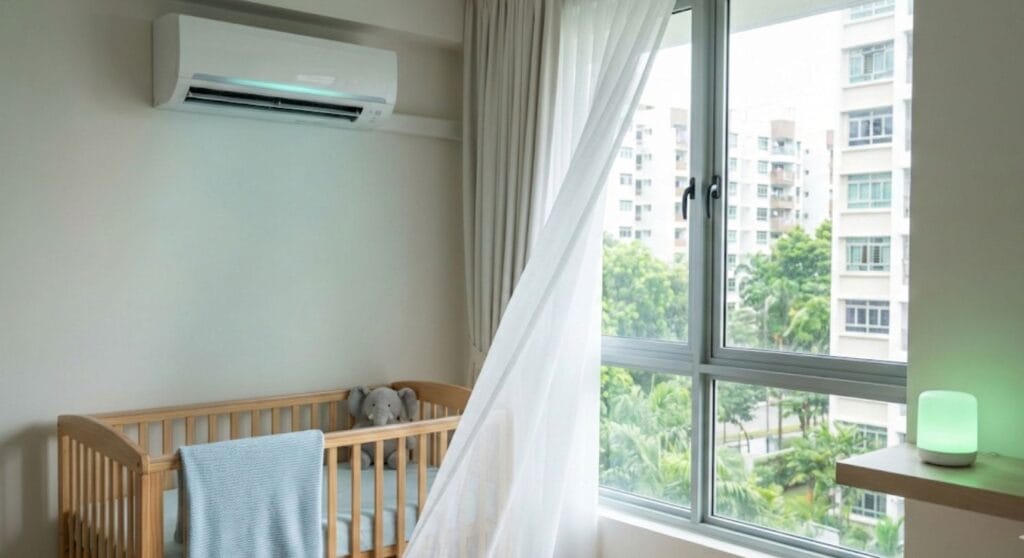
Never position the crib directly under or in line with the aircon’s direct airflow.
Cold air blowing directly onto a sleeping baby can cause:
- Rapid temperature drops that disrupt sleep
- Increased risk of respiratory infections
- Dry skin and irritated eyes
- Difficulty maintaining stable body temperature
The general recommendation is to keep the crib at least 2 meters away from the indoor unit. In a typical Singapore HDB bedroom, this usually means positioning the crib against the wall opposite the aircon, or perpendicular to the airflow direction.
If your room layout makes this difficult, you can:
Adjust the aircon louvers. Most units allow you to direct airflow upward or to the side. Point the airflow toward the ceiling rather than horizontally across the room. The cool air will gradually descend and distribute more evenly.
Use a ceiling fan on low speed. This circulates air without creating direct drafts. Research published in Archives of Pediatrics found that fan use during sleep reduced SIDS risk by 72% in certain positions, likely by improving ventilation without creating cold spots.
Consider an aircon with adjustable swing settings. Some inverter models allow you to set oscillation patterns that avoid certain areas of the room.
The Aircon Servicing Checklist Before Baby Arrives
This is critical. Your aircon has likely been accumulating dust, mould, and bacteria for months or years. A newborn’s immune system is underdeveloped, and their smaller airways make them far more susceptible to airborne contaminants than adults.
At minimum, schedule a professional servicing 4-6 weeks before your due date.
Why so early? You need buffer time in case issues are discovered that require parts replacement or additional work. You also want the chemical residue from cleaning to fully dissipate before bringing baby home.
Here’s what the servicing should include:
Basic servicing (every 3 months with a newborn in the house):
- Filter cleaning or replacement
- Drainage pipe flushing
- Coil inspection
- Performance check
Chemical wash (recommended before baby arrives):
- Complete disassembly of accessible components
- Chemical treatment to remove mould and bacteria
- Coil deep cleaning
- Drain pan sanitisation
- Blower wheel cleaning
Chemical overhaul (if aircon is older than 3 years or has visible mould):
- Full unit dismantling
- All components soaked and chemically treated
- Complete internal cleaning
- Reassembly with testing
For a nursery, we recommend requesting baby-safe or low-toxicity cleaning solutions. Standard chemical washes use effective but strong cleaning agents. Some professional services now offer FDA-approved, eco-friendly alternatives that are safer for households with infants. Ask about this when booking.
After servicing, run the aircon for 2-3 hours with windows open before using the room for the baby. This clears any residual chemical smell and allows fresh air to circulate.
Filter Cleaning: The Every-2-Week Rule
With a newborn, standard quarterly filter cleaning isn’t enough.
Clean your nursery aircon filters every 2 weeks.
Why so frequent? Several reasons:
Newborns breathe faster than adults. They take 30-60 breaths per minute compared to an adult’s 12-20. More breaths mean more exposure to whatever is in the air.
Their airways are smaller. Particles that an adult might filter out in the nasal passages can reach a baby’s lower respiratory system.
Singapore’s humidity promotes rapid mould growth. Aircon filters in our climate can develop mould colonies within weeks of a regular service.
You’re running the aircon more hours. Most new parents keep nursery aircon running 8-12 hours daily. More runtime means faster filter clogging.
Fortunately, basic filter cleaning is simple DIY:
- Turn off the aircon and wait 5 minutes
- Open the front panel and remove filters
- Rinse under running water, gently brushing away dust
- Let filters dry completely (this is crucial — putting damp filters back creates mould)
- Reinstall and run the unit
If you see dark spots on filters that don’t wash off, or notice a musty smell, that’s mould. Replace the filter entirely or call for professional cleaning.
Humidity: The Often-Ignored Factor
Aircon doesn’t just cool. It dehumidifies. And while Singapore’s outdoor humidity (often 80%+) makes some dehumidification welcome, excessive drying can cause problems for babies.
The ideal humidity for a nursery is 40-60%.
Below 40% humidity:
- Baby’s nasal passages dry out, leading to congestion
- Skin becomes dry and may crack or develop eczema flares
- Mucus membranes become irritated
- Sleep quality suffers due to discomfort
Above 60% humidity:
- Dust mite populations explode
- Mould growth accelerates
- The room feels stuffy despite being cool
- Bacteria thrive in moist conditions
Here’s the Singapore reality: our outdoor humidity is so high that most homes don’t need a humidifier even with aircon running. The concern is usually the opposite: the room staying too humid because the aircon can’t remove moisture fast enough.
However, if you’re running aircon for extended hours (8+ hours continuously), or if baby shows signs of dry skin or stuffy nose, indoor humidity can drop too low.
How to monitor and manage humidity:
A hygrometer (humidity meter) costs S$15-30 and shows you actual room humidity. Place it at crib level, away from the aircon unit.
If humidity drops below 40%:
- Consider a cool-mist humidifier (never warm mist — burn risk)
- Position humidifier 3-4 feet from the crib, never directly next to it
- Clean the humidifier weekly to prevent mould
- Use distilled water, not tap water
If humidity stays above 60%:
- Your aircon may be undersized for the room
- Check that doors remain closed during aircon operation
- Consider running dry mode for periods
- Have the aircon checked for low refrigerant
One note on humidifiers in Singapore: many parents buy them only to find they’re unnecessary. Our baseline humidity is so high that unless you’re running aircon around the clock, the room naturally rehumidifies when you open windows or doors. Don’t buy a humidifier preemptively. Wait to see if your baby actually shows signs of dry air problems.
Inverter vs Non-Inverter: Why It Matters for Nurseries
If you’re installing new aircon for the nursery, choose an inverter model. This isn’t about energy savings (though that’s a bonus). It’s about temperature stability.
Non-inverter aircons cycle on and off.
They run at full power until the room reaches the set temperature, then switch off completely. When the temperature rises again, they restart. This creates temperature swings of 2-3°C throughout the night.
For adults, barely noticeable. For newborns, potentially disruptive.
Inverter aircons modulate their power.
Instead of on/off cycling, they adjust compressor speed to maintain consistent temperature. The room stays within 0.5°C of the set point. No sudden temperature drops when the compressor kicks in. No gradual warming while it’s off.
For baby sleep, this consistency matters. Temperature fluctuations can trigger partial arousals, leading to fragmented sleep for everyone.
If you already have a non-inverter unit, it still works fine. Just be aware that the actual room temperature varies more than what’s shown on the remote. A room thermometer becomes even more important.
Noise Levels: How Loud Is Too Loud?
Modern aircons are generally quiet enough for nurseries. Most quality inverter units operate at 19-24 dB on low settings, softer than a whisper.
But noise considerations for babies are nuanced.
Some aircon noise can actually help.
The consistent hum of an aircon creates white noise, which many babies find soothing. It mimics the whooshing sounds they heard in the womb. Some parents deliberately avoid ultra-quiet units because the slight background noise helps their baby sleep.
The American Academy of Pediatrics recommends keeping nursery sound levels at or below 50 dB. Most aircons fall well within this limit. For comparison, 50 dB is roughly the volume of a quiet conversation.
Problematic noises to watch for:
- Intermittent clicking (relay switches, often from non-inverter units cycling)
- Rattling (loose panels or mounting brackets)
- Water dripping sounds (drainage issues)
- High-pitched whistling (airflow obstruction)
These irregular sounds can startle a sleeping baby. If your unit makes any of these noises, have it checked before the baby arrives.
The Pre-Cooling Strategy
Here’s a practical tip that makes a real difference: pre-cool the nursery.
Turn on the aircon 15-20 minutes before putting baby down for sleep. Let the room reach the desired temperature before baby enters.
Why does this help?
Babies react to temperature changes, not just absolute temperature. Walking from a warm living room into a cold nursery can trigger fussiness. But entering an already-cool room is seamless.
Pre-cooling also means the aircon doesn’t need to run at maximum power while baby is sleeping. Lower power equals quieter operation and more stable temperatures.
Transitioning In and Out of Air-Conditioned Spaces
Singapore parents face a unique challenge: the temperature differential between indoors and outdoors.
Your nursery at 24°C. The corridor at 30°C. The playground at 33°C with 85% humidity.
Sudden temperature changes can stress a baby’s developing thermoregulation system.
When leaving an air-conditioned room:
- Turn off the aircon 10-15 minutes before going out
- Let baby gradually adjust to rising temperature
- Remove any extra layers before exiting
When returning to an air-conditioned room:
- Don’t immediately place baby in front of the aircon
- Let the room cool gradually if it’s been off
- Watch for signs of being too cold
Some parents worry about “weakening” their baby by keeping them in aircon too much. Will baby become unable to tolerate heat?
The research doesn’t support this concern. Babies adapt to their normal environment. A baby who sleeps in aircon but spends awake time in normal Singapore temperatures develops normal thermoregulation. The key is avoiding extreme, sudden transitions.
Air Quality Features Worth Considering
When choosing an aircon for the nursery, certain features provide genuine benefit for infant health:
Ionisers / Plasma Filters
Some units release ions that attach to airborne particles, causing them to clump together and fall out of the air. Brands like Panasonic (Nanoe™) and Daikin (Streamer Technology) incorporate these features. Independent testing shows modest but real reductions in airborne allergens and bacteria.
Worth it? Probably yes for nurseries, especially if anyone in the family has allergies or asthma.
Self-Cleaning Functions
Higher-end units have automatic cleaning cycles that remove moisture from internal components after operation, reducing mould growth. Some use heat, others use specialized coatings.
Worth it? Helpful but not essential. Regular professional servicing achieves the same result.
HEPA or High-Grade Filtration
Standard aircon filters catch large particles but let smaller ones through. Some models offer upgraded filters that capture finer particles including some bacteria and mould spores.
Worth it? Good to have, but note that these filters need replacement more frequently and cost more. Factor in ongoing costs.
Sleep or Quiet Mode
This setting reduces fan speed and minimises compressor cycling overnight. Temperature may drift slightly (typically 1-2°C) but operation becomes near-silent.
Worth it? Very useful for nurseries. Most quality brands include this feature.
Common Mistakes New Parents Make
After years of servicing homes with newborns, we see the same errors repeatedly:
Setting the temperature too low
First-time parents often think colder is safer. They set the aircon to 18-20°C, then pile blankets on the baby. This creates overheating risk despite the cold room. The baby’s body tries to conserve heat under the blankets while the exposed face gets cold. Mixed signals to an underdeveloped thermoregulation system.
Better approach: Set a moderate temperature (24-25°C) and dress baby appropriately without excess bedding.
Running old, unserviced units
The aircon worked fine before baby arrived, so it must be fine now. Except that “fine for adults” and “fine for newborns” are different standards. A unit blowing slightly dusty air is a mild inconvenience for you. For a newborn, it’s a potential respiratory irritant.
Placing crib based on nursery aesthetics, not aircon positioning
The Instagram-perfect nursery layout might put the crib exactly in the aircon’s blast zone. Form follows function here. Position the crib for safety first, then work the decor around it.
Forgetting about the outdoor unit
The condenser on your aircon ledge affects the indoor unit’s performance. A condenser caked with dust runs inefficiently, leading to poor cooling and higher energy use. If you haven’t cleaned it in years, now is the time.
Over-relying on aircon settings
Watching your baby is more important than watching the thermostat. No temperature setting works perfectly for every baby in every situation. Develop the habit of checking baby’s neck temperature. Adjust based on what you feel, not just what the remote says.
Creating a Simple Nursery Aircon Routine
Here’s a practical daily routine that keeps things simple:
Morning:
- Open windows for 15-30 minutes to air out the room
- Check filter visually (clean every 2 weeks)
- Verify room thermometer is working
Before Naps:
- Pre-cool room 15 minutes before putting baby down
- Check that crib is positioned correctly
- Close door and windows
Overnight:
- Set timer or use sleep mode if preferred
- Dress baby appropriately for the temperature
- Check baby’s neck temperature at first wake-up
- Adjust settings if needed for remainder of night
Weekly:
- Wipe down aircon exterior and louvres
- Check humidity levels
- Look for any water stains near the unit (drainage issues)
Every 2-3 Months:
- Professional servicing
- Replace filters if disposable type
When to Call for Help
Contact a professional if you notice:
Musty or mouldy smell when aircon runs
This indicates mould in the unit. Don’t wait. Mould spores circulating in a nursery are a respiratory hazard for your baby.
Visible mould on vents or surrounding walls
The problem has progressed beyond the unit itself. You may need both aircon and wall mould treatment.
Water dripping from indoor unit
Usually a drainage blockage. Not immediately dangerous but creates humidity issues and potential water damage.
Aircon not reaching set temperature
Could be low refrigerant, dirty coils, or an undersized unit. Your baby’s room isn’t being properly cooled.
Unusual sounds that started recently
New clicking, rattling, or humming suggests developing mechanical issues.
Baby consistently showing signs of respiratory irritation
Coughing, sneezing, or congestion when in the nursery but not elsewhere may indicate air quality problems from the aircon.
Your nursery aircon is one of those things that should just work quietly in the background. Set it up correctly before baby arrives, maintain it regularly, and it won’t give you problems during those already-chaotic first months.
Get it wrong, and you’re troubleshooting at 3am with a crying baby and zero sleep.
One proper servicing appointment. One check of the crib position. One room thermometer. These small preparations make a real difference for your baby’s comfort and your peace of mind.
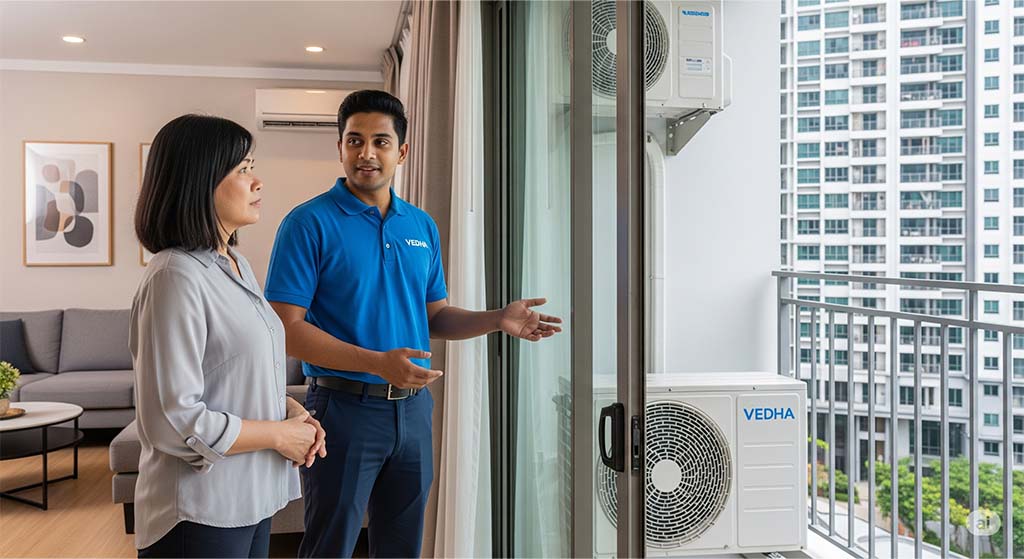
Expecting a baby and want your nursery aircon properly serviced? Vedha Construction offers baby-safe aircon cleaning with low-toxicity, eco-friendly solutions. Our technicians understand the specific requirements for newborn environments. Call 96540044 or book online for a pre-baby aircon health check.

We specialize in Aircon installation, repair, and service. We have all type & model of recon compressor, full set & fancoil. Our technicians are highly proficient in their respective field and repairs and fixes aircon of various brands.