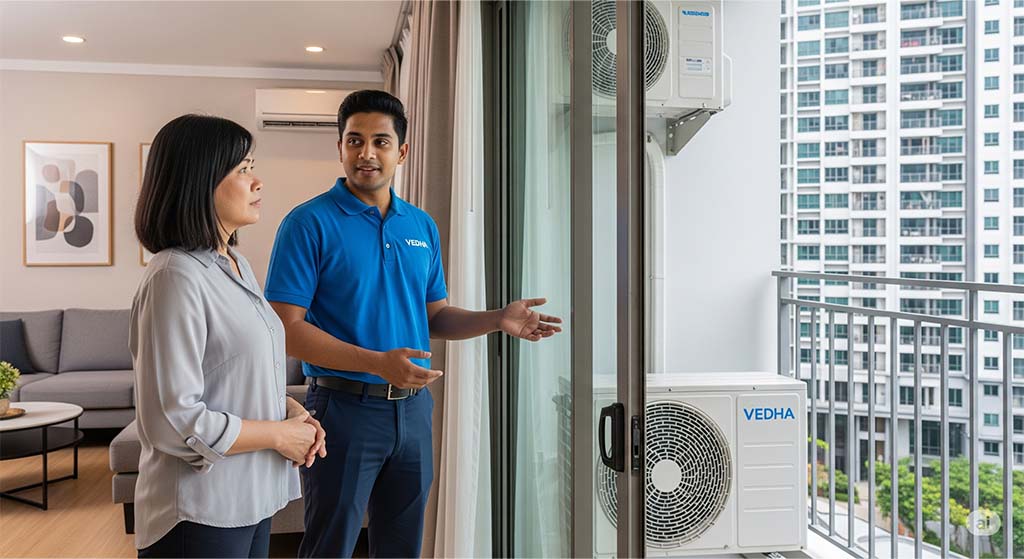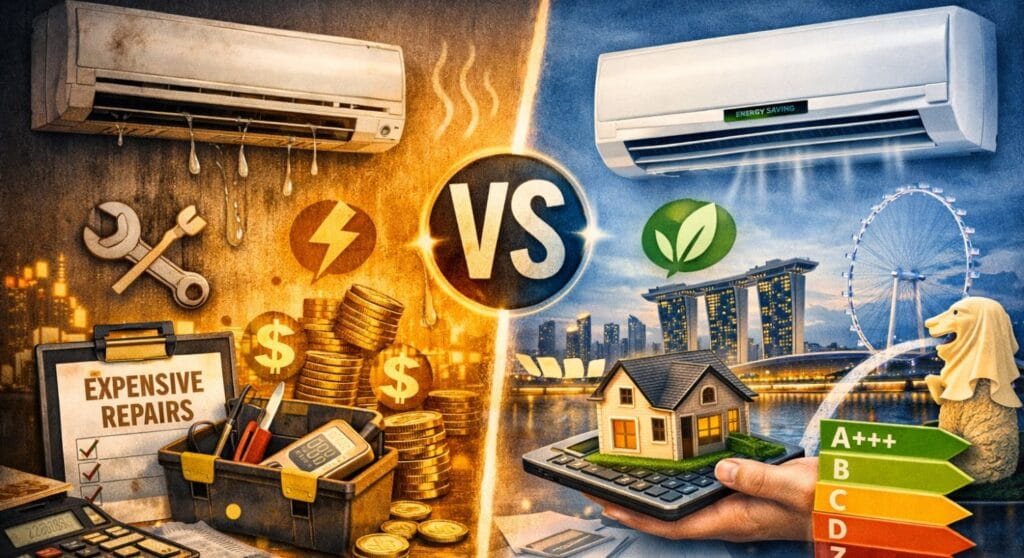
Your aircon just broke down. The technician quotes you S$450 for a new compressor. Your aircon is 8 years old, maybe 9, maybe you’re not even sure anymore.
A voice in your head says: “Should I just replace the whole thing?”
Another voice counters: “But it was working fine until now. Why throw away a perfectly good unit?”
Both voices have valid points. Both can be wrong.
The repair vs replace decision isn’t about feelings or hunches. It’s about math. Cold, honest math that most people never do because they’re standing in a hot room making a rushed decision while a technician waits for an answer.
This guide gives you the actual calculator. Not vague advice like “consider your options” or “it depends on your situation.” Real numbers, real formulas, real decision frameworks based on Singapore’s aircon market in 2025.
Let’s figure this out properly.
The 8-Year Reality Check
Eight years is significant for an aircon in Singapore. Here’s why:
The typical lifespan of a well-maintained split-system aircon in Singapore ranges from 7 to 12 years. Some last 15 years. Some fail at 6. Singapore’s climate, with year-round heat and humidity, makes aircons work harder than in temperate countries. That continuous strain accelerates wear.
At 8 years, your unit is past the midpoint of its expected life. It’s not ancient, but it’s not young either. Components designed for 50,000-80,000 operating hours are accumulating fatigue. The compressor, capacitors, fan motors, and control boards have all been through thousands of heating and cooling cycles.
More importantly, an 8-year-old aircon exists in a different technological era. The energy efficiency standards, refrigerant types, and smart features available in 2025 weren’t standard in 2017.
This context matters because the repair vs replace decision isn’t just about fixing what’s broken. It’s about what you’re fixing it into.
The Real Repair Costs in Singapore
Before you can calculate anything, you need to know what repairs actually cost. Here’s the current pricing landscape:
Minor repairs (S$50-200)
- Capacitor replacement: S$70-150
- Thermistor replacement: S$70-200
- Basic drainage issues: S$50-120
- Sensor or remote receiver: S$80-150
Moderate repairs (S$200-500)
- Fan motor replacement: S$150-400
- PCB (control board) replacement: S$200-400 for indoor unit
- Gas top-up with leak repair: S$150-300
- Electrical wiring faults: S$90-200
Major repairs (S$400-1,000+)
- Compressor replacement: S$500-1,000+
- Outdoor unit PCB: S$350-900
- Evaporator coil replacement: S$600-1,800
- Condenser coil replacement: S$400-800
Additional costs often forgotten
- Diagnostic fee: S$30-80
- Emergency/after-hours surcharge: S$50-150
- Second or third visit if parts need ordering: S$30-50 per visit
- GST: Add 9% to all quoted prices
The first rule of the calculator: always get the full repair cost in writing before deciding. A “S$300 repair” that becomes S$450 after diagnosis fees, GST, and “while we’re here, we noticed…” additions changes the math entirely.
The New Aircon Costs in Singapore (2025)
For a fair comparison, you need to know what replacement actually costs:
System 1 (single room)
- Budget brands (Midea, Hisense): S$1,050-1,500 installed
- Mid-range brands (Panasonic): S$1,400-1,800 installed
- Premium brands (Daikin, Mitsubishi Electric): S$1,500-2,200 installed
System 2 (two rooms)
- Budget to mid-range: S$2,200-3,000 installed
- Premium brands: S$2,800-3,600 installed
System 3 (three rooms, most common for HDB)
- Budget to mid-range: S$2,700-4,000 installed
- Premium brands (Mitsubishi, Daikin 5-tick): S$3,500-5,500 installed
System 4 (four rooms)
- Mid-range: S$4,000-5,500 installed
- Premium brands: S$5,000-6,500 installed
These prices include basic installation with standard pipe runs. Add S$200-500 for complex installations (concealed piping, longer runs, condo MCST requirements, or removal of old system).
Important: From April 2025, all new multi-split systems (System 2 and above) sold in Singapore must be minimum 5-tick efficiency rating. You can no longer legally buy a cheap 3-tick System 3. The “budget option” for multi-splits has effectively disappeared.
The 50% Rule: The Industry Standard
The most widely used rule of thumb in the aircon industry is simple:
If the repair cost exceeds 50% of a new unit’s price, replace.
Here’s how it works:
A new System 1 from a decent brand costs approximately S$1,500 installed. If your repair quote is S$800 (more than 50% of S$1,500), replacement makes more financial sense.
A new System 3 costs approximately S$3,500-4,500 installed. If your repair quote is S$2,000+ (more than 50%), you should strongly consider replacement.
Why 50%? Because the repair only fixes the immediate problem. It doesn’t address the age-related wear on every other component. A unit that needs a S$600 compressor today might need a S$350 PCB in 8 months and a S$200 fan motor 6 months after that. You’ve now spent S$1,150 on a unit that might fail completely within 2 years anyway.
The 50% rule protects you from the “repair death spiral” where you keep fixing an aging unit piece by piece until you’ve spent more than a new system would have cost.
The Age-Adjusted 50% Rule
The basic 50% rule doesn’t account for age. A repair that’s worthwhile on a 3-year-old unit might be foolish on a 10-year-old one. Here’s the adjusted version:
Under 5 years old: Repair if cost is less than 50% of new unit 5-7 years old: Repair if cost is less than 40% of new unit 8-10 years old: Repair if cost is less than 30% of new unit Over 10 years old: Repair if cost is less than 20% of new unit
For your 8-year-old unit, this means:
- New System 3 cost: ~S$4,000
- 30% threshold: S$1,200
- If repair exceeds S$1,200, replacement is likely the better financial decision
This adjustment exists because older units have less remaining useful life to spread the repair cost across. A S$600 repair on a unit with 2-3 years left costs you S$200-300 per year of remaining life. The same repair on a unit with 7+ years left costs under S$100 per year. The math favours the younger unit.
The Hidden Cost: Energy Efficiency Differential
Here’s where most repair vs replace calculations go wrong: they ignore operating costs.
An 8-year-old aircon, even when functioning perfectly, uses significantly more electricity than a new 5-tick unit. This isn’t speculation. It’s measured physics.
The efficiency gap explained:
Your 8-year-old unit was likely a 2-tick or 3-tick model when new (these were common and legal until recently). Even if it was a 4-tick, 8 years of wear has degraded its efficiency by an estimated 15-25%.
A new 5-tick system uses 30-40% less electricity than a 2-tick system of the same capacity. Combined with age-related degradation, your old unit might be using 40-50% more electricity than a new replacement.
What this costs you:
Assume your aircon runs 8 hours daily (typical for a bedroom used at night). At current electricity rates (approximately S$0.31-0.33/kWh), here’s the annual difference:
A 9,000 BTU old unit (inefficient): ~S$720/year in electricity A 9,000 BTU new 5-tick unit: ~S$430/year in electricity Annual savings: ~S$290
For a System 3 running in multiple rooms, the savings scale up: Old System 3: ~S$2,000-2,400/year New 5-tick System 3: ~S$1,200-1,400/year Annual savings: ~S$800-1,000
Over a 10-year lifespan, choosing the new unit saves S$8,000-10,000 in electricity alone.
Adjusting the calculator:
The true cost of keeping your old unit isn’t just the repair. It’s the repair plus the ongoing efficiency penalty.
If your repair costs S$600 but you’ll spend an extra S$800/year on electricity compared to a new system, your real first-year cost is S$1,400. By year two, you’ve spent S$2,200. By year three, S$3,000. At some point, you’ve exceeded what a new system would have cost.
The Refrigerant Factor
This is the technical consideration that catches many homeowners off-guard.
Your 8-year-old aircon almost certainly uses R410A refrigerant. Units installed before 2010 might use R22.
Here’s the problem:
- R22 has been phased out. Import is banned. Remaining stock is expensive and dwindling. If your unit uses R22, any repair requiring gas top-up will be costly and temporary.
- R410A is being phased out. New R410A units were banned from import in 2022-2023. While R410A gas is still available for repairs, it will become increasingly scarce and expensive over the next 5-7 years.
New units use R32 refrigerant, which is:
- More energy efficient
- More environmentally friendly (lower global warming potential)
- The current industry standard in Singapore
- Readily available and affordable for future servicing
If you repair your R410A unit today, you’re maintaining a system with an expiring refrigerant supply. Every future repair involving refrigerant will cost more as R410A becomes scarcer. By 2028-2030, R410A servicing may be significantly more expensive or difficult to obtain.
This doesn’t mean you must replace immediately. But it’s a factor that shifts the math toward replacement, especially for major repairs.
The Complete Calculator
Let’s build the full calculation. You need these inputs:
A. Current repair quote (in writing, including GST) B. Age of your current unit C. Type of system (System 1, 2, 3, or 4) D. Estimated remaining useful life E. Daily usage hours F. Cost of equivalent new system
Here’s the formula:
Step 1: Calculate remaining life factor
- Unit age 0-5 years: Remaining life factor = 1.0
- Unit age 6-7 years: Remaining life factor = 0.8
- Unit age 8-9 years: Remaining life factor = 0.6
- Unit age 10-12 years: Remaining life factor = 0.4
- Unit age 13+ years: Remaining life factor = 0.2
Step 2: Calculate adjusted repair threshold Adjusted threshold = New system cost × 0.5 × Remaining life factor
Step 3: Calculate annual energy penalty Estimated extra electricity cost for old unit vs new = S$200-400/year for System 1, S$500-800/year for System 3
Step 4: Calculate 3-year total cost of repair option Repair total = Repair cost + (Annual energy penalty × 3) + (Estimated additional repairs over 3 years, typically S$200-500)
Step 5: Calculate 3-year total cost of replace option Replace total = New system cost – (Annual energy savings × 3) – Climate voucher (S$400 if applicable)
Step 6: Compare If Repair total > Replace total, replace. If Replace total > Repair total, repair.
Worked Examples
Example 1: Minor repair on 8-year-old System 1
Situation: Fan motor failed. Quote: S$280. Unit is 8 years old Daikin System 1 (bedroom).
Calculation:
- New System 1 cost: ~S$1,800
- Remaining life factor (8 years): 0.6
- Adjusted threshold: S$1,800 × 0.5 × 0.6 = S$540
- Repair cost (S$280) is below threshold (S$540)
3-year comparison:
- Repair path: S$280 + (S$300 energy penalty × 3) + S$300 contingency = S$1,480
- Replace path: S$1,800 – (S$300 savings × 3) – S$400 voucher = S$500
Wait, replacement actually costs less? Yes, once you factor in energy savings and the climate voucher, a new 5-tick system can cost less over 3 years than repairing and running an old inefficient unit.
Decision: Borderline. If the old unit is otherwise in good condition and well-maintained, repair. If it’s been problematic or poorly maintained, replace.
Example 2: Major repair on 8-year-old System 3
Situation: Compressor failed. Quote: S$750 (one unit of the system). System 3 is 8 years old.
Calculation:
- New System 3 cost: ~S$4,200
- Remaining life factor (8 years): 0.6
- Adjusted threshold: S$4,200 × 0.5 × 0.6 = S$1,260
- Repair cost (S$750) is below threshold (S$1,260)
But wait, 3-year comparison:
- Repair path: S$750 + (S$800 energy penalty × 3) + S$600 contingency = S$3,750
- Replace path: S$4,200 – (S$800 savings × 3) – S$400 voucher = S$1,400
Decision: Replace. The energy savings and voucher make replacement substantially cheaper over 3 years, even though the repair itself passes the threshold test.
Example 3: Multiple repairs needed
Situation: Technician says your 9-year-old System 2 needs a PCB (S$350) and the compressor is “showing signs of wear” and “might fail soon.”
This is the repair death spiral warning sign. If a technician suggests additional problems beyond the immediate repair, the calculation must include the likely cost of those future repairs.
Calculation:
- Immediate repair: S$350
- Likely future repair (compressor): S$600-800
- Combined potential cost: S$1,150
- New System 2 cost: ~S$3,200
- Adjusted threshold (9 years, factor 0.6): S$3,200 × 0.5 × 0.6 = S$960
The combined repairs exceed the threshold. Even if you only do the PCB now, you’re committing to a unit that will likely need more expensive work within 12-18 months.
Decision: Replace. You’re throwing good money after bad.
The Climate Voucher Factor
The Singapore government’s Climate-Friendly Households Programme provides S$400 in vouchers for purchasing energy-efficient appliances, including 5-tick air conditioners.
This voucher significantly shifts the repair vs replace math. Every calculation above should subtract S$400 from the replacement cost if you’re eligible.
Eligibility: Singapore citizen households living in HDB flats. The voucher is per household, not per appliance. Check current eligibility at climate-friendly-households.gov.sg.
The voucher effectively makes replacement S$400 cheaper, which often tips borderline decisions toward replacement.
When Repair Still Makes Sense
Despite everything above, repair is sometimes the right choice:
1. Unit is under 6 years old Younger units have more remaining useful life. A repair spreads its cost over more years of service.
2. Repair is minor (under S$200) Small repairs like capacitors, sensors, or drainage issues are almost always worth doing regardless of unit age. These components fail randomly, not necessarily due to age.
3. Unit is high-quality and well-maintained A premium brand (Daikin, Mitsubishi Electric) that’s been serviced quarterly will often outlast a budget brand by 3-5 years. The brand and maintenance history matter.
4. You’re moving soon If you’re selling the property within 12-18 months, a repair that keeps the existing system functional might make more sense than installing a new system you won’t benefit from long-term.
5. Tenancy situation If you’re a tenant with limited lease remaining, check your tenancy agreement. Major aircon replacement might not be your responsibility.
6. Financial constraints Sometimes the S$300 repair now is more feasible than the S$4,000 replacement, even if replacement is better long-term economics. That’s a valid consideration, but go in with eyes open about the likely future costs.
When Replacement is Clearly Better
Replace without hesitation when:
1. Multiple components are failing If the technician identifies problems with compressor, PCB, and fan motor in the same visit, the system is dying comprehensively. Replace.
2. Refrigerant issues on R22 systems If your unit uses R22 and needs gas top-up, the writing is on the wall. R22 will only get more expensive and harder to find. Replace with an R32 system.
3. Repeated repairs in the past year If you’ve already spent S$400+ on repairs in the past 12 months and need another repair now, you’re in the death spiral. Replace.
4. Efficiency has visibly declined If the unit takes noticeably longer to cool the room, struggles on hot days, or your electricity bill has increased without usage change, the system is degraded beyond what repair can fix. Replace.
5. Unit is 12+ years old At this age, any repair over S$150-200 is questionable. The unit has exceeded its expected lifespan. Every component is on borrowed time. Replace.
6. Noise levels have increased significantly Increased noise indicates bearing wear, motor strain, or compressor issues. These rarely get better and usually indicate broader mechanical decline. Replace.
The Emotional Traps
Watch out for these mental traps that lead to bad repair vs replace decisions:
Sunk cost fallacy: “I just spent S$200 on servicing 6 months ago, I can’t replace it now.” What you spent in the past doesn’t change the math going forward. Each decision should be based on future costs only.
Status quo bias: “It’s been working fine, I don’t want to deal with installation disruption.” The disruption of installation is temporary. The inefficiency of an old unit costs you every single month.
Optimism bias: “The repair will probably solve everything and it’ll run for another 5 years.” On an 8+ year old unit, this optimism is rarely justified. Budget for the realistic scenario, not the best case.
Sticker shock: “S$4,000 for a new system? The S$600 repair is much cheaper.” You’re comparing an apple (one-time repair cost) to an orange (10+ year asset). Compare total costs over comparable timeframes.
Technician pressure: Some technicians have incentives to recommend repair (they make money on service calls) or replacement (they sell new units). Get quotes from multiple sources and don’t decide on the spot.
The Decision Summary
For your 8-year-old aircon:
Repair if:
- Repair cost is under S$300
- Issue is clearly isolated (one specific component)
- Unit has been well-maintained with no recent problems
- You’re not eligible for Climate Voucher
- You have financial constraints making replacement difficult right now
Replace if:
- Repair cost exceeds 30% of new system price
- Multiple issues identified
- Unit uses R22 refrigerant
- You’ve had repairs totalling S$400+ in past 12 months
- Unit’s efficiency has noticeably declined
- You’re eligible for the S$400 Climate Voucher
Get a second opinion if:
- Repair cost is S$300-800 (borderline zone)
- Technician diagnosis seems vague or incomplete
- You’re uncertain about unit’s maintenance history
The Final Calculation Template
Fill in these blanks for your specific situation:
Your repair quote: S$_____
Your unit’s age: _____ years
New equivalent system cost: S$_____
Your daily usage: _____ hours
Climate voucher eligible? Yes / No
Threshold calculation: New system cost × 0.5 × [remaining life factor for your age] = S$_____
Is repair quote below threshold? Yes / No
3-year total cost comparison:
- Repair path: S_____ (repair) + S _____ (energy penalty × 3) + S_____ (contingency) = S _____
- Replace path: S_____ (new system) – S _____ (savings × 3) – S_____ (voucher) = S _____
Which is lower? Repair / Replace
That’s your answer.
The repair vs replace decision doesn’t have to be stressful or confusing. It’s arithmetic. Plug in your numbers, run the calculation, and let the math tell you what makes financial sense.
Your aircon is 8 years old. It’s served you well. Now it’s decision time. Make that decision with numbers, not emotions.
Need an honest assessment of your 8-year-old aircon? VD Aircon provides transparent quotes with no pressure to repair or replace. We’ll give you the numbers and let you decide. Call 96540044 for a diagnostic.

We specialize in Aircon installation, repair, and service. We have all type & model of recon compressor, full set & fancoil. Our technicians are highly proficient in their respective field and repairs and fixes aircon of various brands.