You know your aircon needs servicing.
You’ve known for a while. Maybe the last technician mentioned it. Maybe you noticed the cooling isn’t quite what it used to be. Maybe there’s a faint musty smell when you first turn it on.
And yet.
The months slip by. “Next month” becomes “after Chinese New Year” becomes “when work slows down” becomes “definitely before the really hot weather.” Before you know it, a year has passed. Maybe two.
You’re not lazy. You’re not irresponsible. You’re just… human.
Procrastination around maintenance tasks is one of the most universal human behaviours. Nearly everyone does it. And almost everyone underestimates what it costs them.
This article is about two things: understanding why you keep putting off aircon servicing (the psychology is fascinating and completely normal), and calculating the actual financial cost of delay (it’s higher than you think, and the math is sobering).
By the end, you’ll either book that service appointment, or you’ll know exactly how much you’re choosing to pay for the privilege of postponing.
The Psychology of “Next Month”
Let’s start by understanding what’s happening in your brain when you decide, for the fifth time, that aircon servicing can wait.
The present-future disconnect
When you think about servicing your aircon, two versions of you are involved: present-you and future-you.
Present-you has to take action. Present-you has to find a company, compare prices, schedule an appointment, be home during the service window, and pay the bill. Present-you has to expend effort, time, and money right now.
Future-you gets all the benefits. Future-you enjoys better cooling, lower electricity bills, cleaner air, and avoided repairs. Future-you is comfortable and financially better off.
The problem? Your brain treats future-you almost like a stranger. Neuroscience research shows that when people think about their future selves, the same brain regions activate as when they think about other people. Your brain, in a very real sense, doesn’t fully connect present-effort with future-benefit.
So when you weigh “schedule servicing now” against “watch Netflix now,” your brain sees immediate effort versus benefits for someone who feels almost like another person. No wonder Netflix wins.
The invisible problem
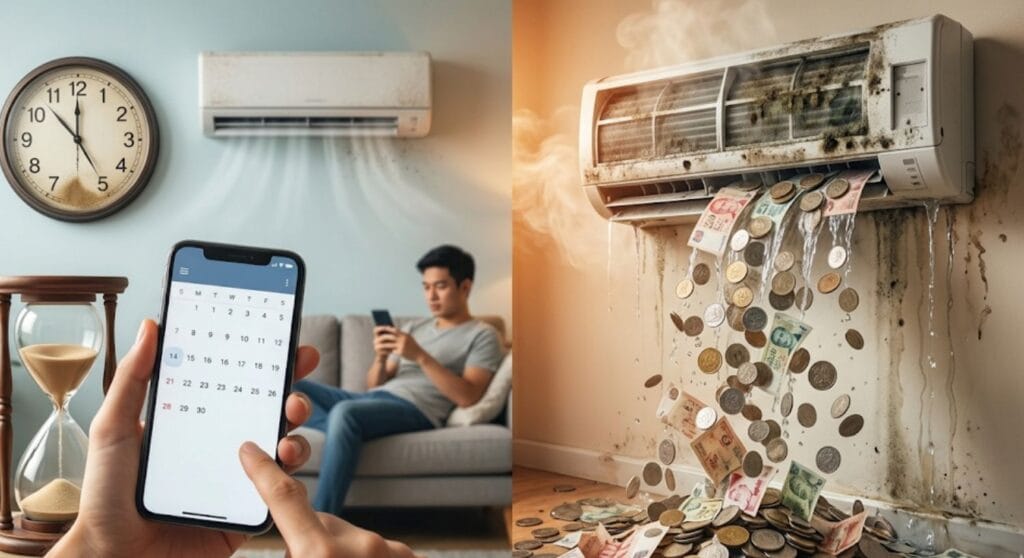
Aircon servicing suffers from a specific challenge: the consequences of skipping it are invisible until they’re catastrophic.
Your aircon still works. It still cools the room. It still turns on when you press the button. The gradual efficiency loss, the slowly accumulating dust, the developing mould, the strain on the compressor—none of this announces itself dramatically.
Compare this to, say, a flat tyre. A flat tyre makes driving impossible. The consequence is immediate and obvious. You can’t procrastinate fixing it because the problem blocks your ability to function.
Aircon neglect is different. The consequences accumulate silently in the background. Your electricity bill creeps up S$10, then S$20, then S$30 per month. But the increase is gradual enough that you don’t notice. You attribute it to rate increases, or hotter weather, or running the aircon more. The actual cause—declining efficiency from lack of maintenance—stays hidden.
By the time the problem becomes visible (water leaking, strange noises, complete breakdown), you’re no longer dealing with a servicing issue. You’re dealing with a repair emergency. And emergencies cost much more than prevention.
The effort-reward mismatch
Behavioural economists talk about “present bias”: we systematically overvalue immediate rewards and undervalue future ones. A S$50 service fee today feels more significant than a S$500 repair bill next year, even though the math clearly favours paying now.
This isn’t stupidity. It’s how human brains evolved. For most of human history, immediate threats and rewards mattered more than distant ones. A predator right now was more important than a drought next season. Our brains got very good at prioritising the present.
Modern life, unfortunately, is full of situations where this bias works against us. Retirement savings. Health screenings. And yes, aircon servicing. The effort is now, the reward is later, and our brains consistently underweight the future.
The friction factor
Here’s something interesting: people are much more likely to procrastinate tasks that involve multiple steps, uncertainty, or coordination with others.
Servicing your aircon involves all three:
- Research companies or recall which one you used before
- Compare prices or check if your old company is still reasonable
- Contact them and provide your details
- Coordinate a time that works with your schedule
- Potentially arrange to be home or give access
- Pay and manage the transaction
Each step is individually small. But the cumulative friction is significant. And at any point, something else can seem more urgent.
Compare this to buying something on Shopee: one click, done. No wonder online shopping is easier to do than scheduling services.
The optimism trap
Finally, there’s optimistic bias: we systematically underestimate the likelihood of bad things happening to us specifically.
“My aircon is still working fine.” “It’ll probably be okay for a few more months.” “I’ve never had a breakdown before.”
These thoughts feel reasonable. And for any individual month, they’re probably accurate. The problem is cumulative. Each month you postpone, you’re placing a small bet. The odds of a problem in any single month are low. But over 12, 18, 24 months of neglect, those small probabilities compound.
It’s like skipping dental check-ups. Any given month, your teeth are probably fine. But string together enough months, and the cavity that could have been a filling becomes the root canal that costs ten times more.
The Real Math of “Next Month”
Let’s move from psychology to arithmetic. What does procrastination actually cost?
Cost #1: Electricity efficiency loss
This is the silent killer. You don’t see it on any single bill, but it adds up relentlessly.
When your aircon filters and coils are dirty, the system has to work harder to achieve the same cooling. According to the U.S. Department of Energy and multiple HVAC studies, a neglected aircon system can use 15-25% more electricity than a clean, well-maintained one.
Let’s calculate what that means in Singapore:
A typical bedroom aircon (9,000 BTU) running 8 hours daily consumes roughly S$50-70/month in electricity when operating efficiently. At 15% efficiency loss, that’s an extra S$7.50-10.50/month. At 25% efficiency loss (significant neglect), that’s an extra S$12.50-17.50/month.
For a System 3 setup cooling multiple rooms, baseline consumption might be S$150-200/month. The efficiency penalty from neglect: S$22.50-50/month.
Here’s the key insight: this cost starts accumulating the moment you begin postponing servicing, and it continues every single month until you finally get the system cleaned.
If you delay servicing by 6 months on a System 3 with 20% efficiency loss: Extra electricity cost: S$180-240
If you delay by 12 months: Extra electricity cost: S$360-480
The servicing you skipped to “save” S$80-120 cost you S$360-480 in electricity alone.
Cost #2: Accelerated wear and tear
When your aircon works harder due to restricted airflow and dirty components, every part experiences more stress. The compressor runs longer cycles. The fan motor strains against resistance. The drainage system clogs more severely.
This accelerated wear shortens component lifespan. Industry estimates suggest that poorly maintained aircons fail 2-4 years earlier than well-maintained ones.
Let’s put a number on this. A new System 3 costs S$3,500-5,000 installed. If good maintenance gives you 12 years of life but poor maintenance gives you only 9 years, you’re replacing the system 3 years early.
Cost of those 3 lost years: S$3,500-5,000 ÷ 12 × 3 = S$875-1,250
Spread across the neglected period, this represents a hidden cost that eventually comes due all at once.
Cost #3: Repair escalation
Small problems become big problems when ignored. This is perhaps the most concrete cost of procrastination.
Here’s a typical progression:
Month 1-3 of neglect:
- Filters get dusty, reducing airflow
- Drainage starts to slow
- Efficiency drops slightly
- What it would cost to fix: S$40-50 (general servicing)
Month 4-8 of neglect:
- Coils develop significant buildup
- Bio-slime forms in drainage
- Mould begins growing
- Blower wheel accumulates grime
- What it would cost to fix: S$80-150 (chemical wash)
Month 9-15 of neglect:
- Drainage clogs completely, causing water backup
- Ice may form on coils due to restricted airflow
- Compressor runs under heavy strain
- Fan motor bearings lose lubrication
- What it would cost to fix: S$150-300 (chemical overhaul + minor repairs)
Month 16+ of neglect:
- Water damage to ceiling or walls from leaks
- Compressor overheating and potential failure
- Fan motor burnout
- PCB damage from electrical strain
- What it would cost to fix: S$300-1,000+ (major repairs or component replacement)
The S$40 servicing you postponed can easily become the S$600 repair you’re forced to pay.
Cost #4: Emergency premiums
When procrastination finally catches up with you, it usually happens at the worst possible time. Your aircon doesn’t politely fail during a cool week when you have time to shop around. It fails during a heatwave, on a weekend, when you desperately need cooling.
Emergency service calls typically cost S$50-150 more than scheduled appointments. Weekend and after-hours surcharges add another S$20-50. And when you’re desperate, you can’t negotiate or compare prices. You pay whatever the available technician charges.
The procrastinator’s premium: S$70-200 extra on top of whatever the repair costs.
Cost #5: Health and comfort costs
These are harder to quantify but very real.
A neglected aircon circulates dust, mould spores, and bacteria through your home. In Singapore’s humid climate, mould growth in unserviced aircon units is common and can exacerbate respiratory issues, allergies, and general discomfort.
Studies link indoor air quality to productivity, sleep quality, and overall wellbeing. A poorly maintained aircon that smells musty, cools unevenly, or makes noise affects your quality of life in ways that don’t show up on any bill.
The Procrastination Calculator
Let’s build a simple calculator for the total cost of delay.
Your inputs:
- Number of months since last servicing: _____
- Number of aircon units: _____
- Average monthly electricity per unit: S$_____ (estimate S$50-70 for bedroom, S$80-100 for living room)
The calculation:
Efficiency loss cost: Months delayed × Units × Monthly electricity × 0.15 (conservative efficiency loss) = S$_____
Example: 12 months × 3 units × S$60 × 0.15 = S$324
Repair escalation risk:
- 0-6 months delayed: Servicing cost (S$40-50/unit)
- 6-12 months delayed: Chemical wash likely (S$80-120/unit)
- 12-18 months delayed: Chemical overhaul possible (S$130-180/unit)
- 18+ months delayed: Repairs increasingly likely (S$200-500+/unit)
Lifespan reduction cost: If delaying servicing by 1 year reduces system life by ~4 months: System value ÷ Expected lifespan × 4 months = S$_____
Example: S$4,000 ÷ 144 months × 4 = S$111
Your total cost of procrastination: Efficiency loss + Probable repair tier + Lifespan reduction = S$_____
For a typical System 3 delayed 12 months: S$324 (efficiency) + S$360 (chemical wash for 3 units) + S$111 (lifespan) = S$795
You “saved” S$150 by skipping servicing. You paid S$795 for that saving.
The Procrastination Cycle (And How to Break It)
Understanding the pattern helps you interrupt it.
The cycle:
- Awareness: You notice your aircon needs servicing
- Intention: You decide to schedule it soon
- Deferral: Something else takes priority; you push it to “next month”
- Forgetting: The task leaves active memory
- Re-awareness: Something triggers the thought again (smell, bill, article like this one)
- Repeat: Back to step 2, with more time elapsed
Each cycle adds cost. The key is breaking the pattern at step 2 or 3.
Strategy 1: Reduce friction immediately
When you decide to service your aircon, take one concrete action within 60 seconds. Just one.
- Open your phone and message a service company
- Search for “aircon servicing” and save a number
- Set a calendar reminder for tomorrow to book
Don’t try to complete the entire task. Just move it one step forward. Once you’ve invested any effort, you’re more likely to continue.
Strategy 2: Use commitment devices
Tell someone else about your intention. “I’m booking aircon servicing this week.” Social accountability makes follow-through more likely.
Better yet, book right now while reading this article. Your future self will thank you. Your present self will feel the relief of having it done.
Strategy 3: Bundle with existing routines
Link servicing to something you already do. “Every quarter when I pay my SP bill, I schedule aircon servicing.” Attaching new habits to existing ones increases compliance dramatically.
Strategy 4: Prepay for maintenance contracts
If single appointments are easy to skip, consider an annual maintenance contract. You pay upfront, the company schedules visits, and the decision is removed from your hands.
Maintenance contracts typically run S$150-300/year for 3-4 visits, cheaper per visit than ad-hoc servicing. More importantly, prepaying changes the psychology. You’ve already spent the money; you might as well get the service.
Strategy 5: Make the invisible visible
Track your electricity bills. When you see the numbers month to month, efficiency loss becomes concrete. That abstract “my aircon is probably fine” becomes “my bill went up S$25 and I should do something about it.”
The Case Study That Adds Up
Let me share a scenario we see regularly:
A homeowner has a 6-year-old System 3 in their HDB flat. They serviced it twice in the first two years, then got busy and stopped. Three years pass with no maintenance.
One day, the master bedroom unit starts leaking water onto their parquet floor.
Here’s what that procrastination cost them:
Efficiency loss over 36 months: 3 units × S$60/month average × 20% efficiency loss × 36 months = S$1,296
Repair required: Chemical overhaul: 3 units × S$160 = S$480 Drainage repair: S$100 Fan motor replacement (worn out): S$280 Total repair: S$860
Collateral damage: Water damage to parquet flooring: S$200+ to repair
Emergency premium: Urgent weekend booking: S$80 extra
What they actually spent: S$1,296 + S$860 + S$200 + S$80 = S$2,436
What regular servicing would have cost: S$45/unit × 3 units × 4 visits/year × 3 years = S$1,620
Net cost of procrastination: S$2,436 – S$1,620 = S$816 extra, plus the hassle, stress, and floor damage.
And that’s assuming nothing more serious failed. If the compressor had burned out from the strain, add another S$600-1,000.
The Counter-Argument: “But It’s Still Working”
Some readers are thinking: “My aircon hasn’t been serviced in ages and it’s fine. This is all worst-case scenario stuff.”
Fair point. Not every neglected aircon fails dramatically. Some coast along for years.
But here’s what “fine” often actually means:
- Cooling that’s 80% of what it should be (you’ve adapted to the lower performance)
- Electricity bills that are 15-20% higher than necessary (you blame the rates)
- Air quality that’s compromised but not obviously bad (you don’t notice because you’re used to it)
- Components that are degrading but haven’t failed yet (the timer is ticking)
“Fine” is not the same as “optimal.” And the cost of fine accumulates invisibly.
Think of it like never changing your car’s oil. The car doesn’t immediately break down. It runs, it drives, it seems fine. The engine is wearing faster than it should, the efficiency is dropping, and one day the damage becomes irreversible. The fact that you got away with it for a while doesn’t mean you weren’t paying a price.
The Decision Point
You’ve read this far. You now understand:
- Why you procrastinate (and that it’s completely normal)
- What the delay actually costs (more than the servicing would)
- How to break the cycle (small immediate actions)
You have two choices:
Choice A: Close this article, tell yourself “I should really book servicing soon,” and let the cycle continue. This is what most people do. It’s comfortable. It’s familiar. And it costs you money every month.
Choice B: Take one action right now. Not tomorrow. Not this weekend. Now.
- Google “aircon servicing Singapore” and call the first reputable result
- Message a company on WhatsApp
- Set a reminder that actually prompts you to book
The difference between Choice A and Choice B isn’t motivation or willpower. It’s just whether you take one small action in the next 60 seconds.
The Real Cost of “Next Month”
Let’s close with the arithmetic one more time.
General servicing costs S$25-50 per unit. For a System 3, that’s S$75-150 per visit, or S$300-600 per year for quarterly servicing.
Delaying that servicing costs:
- S$200-500/year in excess electricity
- S$100-400/year in accelerated wear
- S$200-1,000+ in repair escalation (when it eventually catches up)
- Plus emergency premiums, health impacts, and comfort degradation
“Next month” isn’t free. “Next month” has a price. And you’re paying it whether you see the bill or not.
The question isn’t whether you can afford to service your aircon.
The question is whether you can afford not to.
Ready to break the cycle? VD Aircon makes booking easy—WhatsApp us at 96540044 and we’ll handle the rest. No friction, no excuses, just a cooler, more efficient home. Your future self will thank you.

We specialize in Aircon installation, repair, and service. We have all type & model of recon compressor, full set & fancoil. Our technicians are highly proficient in their respective field and repairs and fixes aircon of various brands.