
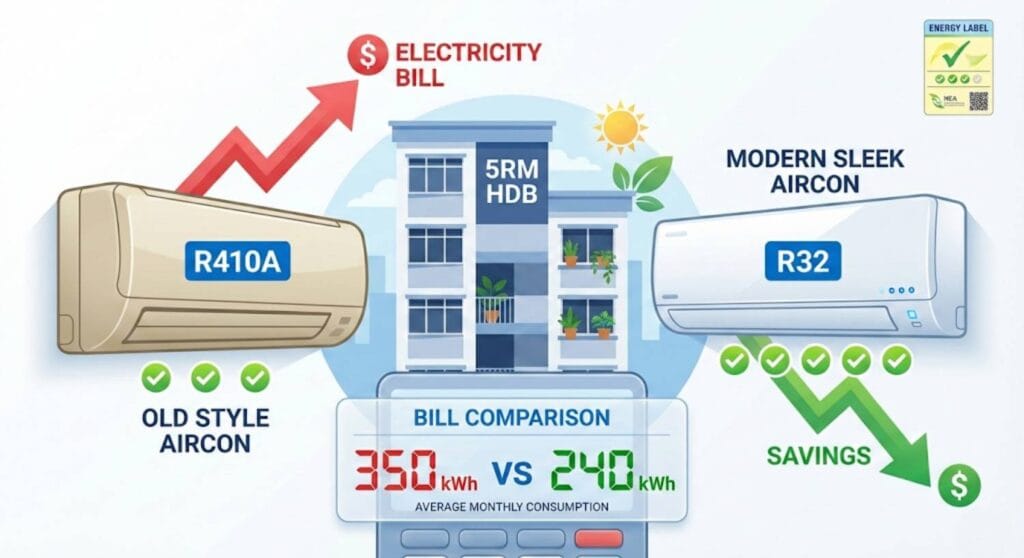
Your 3-tick aircon from 2018 felt like a solid purchase back then. Decent price. Good brand. Not the cheapest, not the most expensive.
But here’s the thing. In 2026, that same unit is basically an energy drain. What qualified as “acceptable efficiency” four years ago doesn’t cut it anymore. Singapore’s energy landscape shifted. Hard.
The National Environment Agency tightened standards. Old R410A refrigerant is getting phased out. New R32 units run circles around older models in efficiency. And with Q1 2026 electricity tariffs sitting at 29.11 cents/kWh (with GST), those monthly bills aren’t getting friendlier.
Let’s break down what changed, what it costs you, and when upgrading actually makes financial sense. No fluff. Just numbers and real-world scenarios for Singapore HDB homes.
How NEA Energy Labels Actually Work (The Stuff Nobody Explains Clearly)
Walk into any electronics store in Singapore. Every aircon has a sticker with green ticks. Most people glance at it, see 3 or 4 ticks, and move on.
That’s leaving money on the table. Here’s how the system works.
The Tick Rating System (1 to 5 Ticks)
NEA’s Mandatory Energy Labelling Scheme (MELS) rates aircons from 1-tick to 5-tick based on their Cooling Seasonal Performance Factor (CSPF). Higher CSPF means the unit converts electricity into cooling more efficiently.
1-Tick: Lowest efficiency. Cheapest upfront. Highest monthly cost. Honestly, you shouldn’t even see these in stores anymore since the 2-tick minimum requirement kicked in.
2-Tick: Minimum legal standard since 2022. Entry-level efficiency. Budget units sit here.
3-Tick: Average performance. Common in mid-range systems. This was considered “pretty good” back in 2018-2020. Not anymore.
4-Tick: High efficiency. Recommended for daily use in Singapore’s climate. Most modern inverter units land here.
5-Tick: Best available efficiency. Premium pricing, but the electricity savings are measurable and consistent.
Here’s what most retailers won’t tell you: In 2022, NEA raised the Minimum Energy Performance Standards (MEPS) by 7% within the 2-tick range. Translation? Units that barely scraped into the 3-tick category before got bumped down to 2-tick. The bar moved up.
That old 3-tick model you bought in 2018? If it were tested against today’s standards, it might rate closer to 2-tick. Or it might not even pass MEPS at all.
What the Label Actually Tells You
Beyond the ticks, the NEA label shows:
- Annual energy consumption (kWh/year) – This is how you calculate real costs
- Cooling capacity (BTU or kW) – Match this to your room size
- Model details – Brand, model number, system type
Most people fixate on BTU ratings and ignore the kWh figure. That’s backwards. The kWh number tells you what you’ll actually pay monthly.
The R410A to R32 Shift (Why This Matters to Your Wallet)
If your aircon was installed before 2020, it probably runs R410A refrigerant. If it’s newer, it’s likely R32.
The difference isn’t just environmental virtue signaling. It’s operational efficiency and lifespan.
What Changed
R410A: The old standard. Used globally from the mid-2000s through early 2020s. Zero ozone depletion potential (ODP), which made it better than the R22 refrigerant it replaced. But it has a Global Warming Potential (GWP) of 2,088. That’s 2,088 times worse than carbon dioxide per kilogram released.
R32: The new standard. Single-component refrigerant (versus R410A’s blend of R32 and R125). GWP of 675 – that’s 68% lower environmental impact. But here’s the part that affects your bills: R32 systems are 10-20% more energy efficient.
Why R32 Saves Money
R32 requires less refrigerant charge to operate. Smaller charge means less weight, less material, lower refilling costs if needed. But the real savings come from operational efficiency.
R32 has better heat transfer properties. It absorbs and releases heat more effectively during the cooling cycle. This means:
- Lower discharge temperatures (easier on compressor components)
- Better pressure ratios (more efficient compression cycles)
- Reduced volumetric cooling capacity requirements (smaller pipes, less resistance)
Technical stuff aside, R32 units use about 10-15% less electricity for the same cooling output compared to equivalent R410A models.
In Singapore’s 2026 market, you can’t even buy new R410A household units anymore. NEA started phasing them out Q4 2022. By 2026, it’s all R32 (or newer refrigerants testing in labs).
Can You Convert R410A Units to R32?
No. Hard stop.
Different operating pressures. Different oil requirements. Different compressor designs. You can’t drain R410A and refill with R32. Anyone who suggests this doesn’t understand refrigeration systems or is trying to damage your unit.
When your R410A aircon dies, replacement means upgrading to R32. Which, given efficiency gains, isn’t a bad thing financially.
The Real Cost of Running Old vs New Aircons (With Actual 2026 Tariff Math)
Let’s move past theory. What does this cost in actual dollars using Q1 2026 electricity rates?
Current Singapore tariff: 29.11 cents/kWh (with GST)
We’ll compare three scenarios for HDB flats using different aircon efficiency levels.
Scenario 1: 3-Room HDB Flat
Average monthly consumption: 350 kWh
Aircon contributes roughly 30-40% of total household electricity in Singapore (per EMA data). Let’s use 35% as middle ground.
Aircon portion: 350 kWh × 0.35 = 122.5 kWh/month
Old 3-Tick (2018 model):
- Energy consumption: ~950 kWh/year = 79.2 kWh/month (per unit)
- Monthly cost: 79.2 × 0.2911 = $23.06/month
- Annual cost: $276.72/year
New 5-Tick R32 (2026 model):
- Energy consumption: ~650 kWh/year = 54.2 kWh/month (per unit)
- Monthly cost: 54.2 × 0.2911 = $15.78/month
- Annual cost: $189.36/year
Savings: $87.36/year per aircon unit
3-room flats typically have 2 System 1 or System 2 units. Double that savings: $174.72/year
Scenario 2: 5-Room HDB Flat
Average monthly consumption: 450 kWh
Aircon portion: 450 kWh × 0.35 = 157.5 kWh/month
Old 3-Tick System:
- Let’s say you have 3 units (2 bedrooms + living room)
- Combined energy: ~2,850 kWh/year = 237.5 kWh/month
- Monthly cost: 237.5 × 0.2911 = $69.14/month
- Annual cost: $829.68/year
New 5-Tick R32 System:
- Combined energy: ~1,950 kWh/year = 162.5 kWh/month
- Monthly cost: 162.5 × 0.2911 = $47.30/month
- Annual cost: $567.60/year
Savings: $262.08/year
That’s not small change. Over the typical 7-10 year lifespan NEA uses for calculations, you’re looking at $1,834 to $2,621 in electricity savings alone.
The Payback Calculation (When Does Upgrading Make Sense?)
Let’s say you’re replacing 3 units in a 5-room HDB. Current market prices (2026):
Mid-range 5-tick R32 System 2 units (9,000-12,000 BTU): $900-$1,200 per unit installed
Total for 3 units: $2,700-$3,600
Annual savings from switching: $262/year
Payback period: $3,000 (average cost) ÷ $262 = 11.5 years
Wait, that seems long. But hold on.
That calculation assumes you’re replacing functioning units. If your current aircon is 8-10 years old (like most 3-tick R410A units from 2016-2018), you’re already approaching end-of-life. Compressors fail. Refrigerant leaks develop. Repair costs start stacking up.
In that case, the comparison isn’t “new unit cost vs continuing with current unit.” It’s “new efficient unit vs expensive repairs that buy you maybe 2-3 more years with an inefficient unit.”
Real-world payback when replacing an aging system: 18-24 months
Here’s why: You avoid repair costs ($300-$800 for compressor work, $150-$300 for refrigerant top-ups, $200+ for chemical overhauls becoming necessary yearly on old systems). Add those avoided costs to electricity savings, and the math changes fast.
The “My Aircon Still Works Fine” Trap
Biggest mistake Singapore homeowners make: waiting until complete failure before replacement.
Your 2017 R410A unit still blows cold air. But it’s working 15-20% harder than a new R32 model to achieve the same cooling. You’re paying that 15-20% penalty every single month.
Over 3 years (typical timeline from “still works” to “dead compressor”), that efficiency loss costs you $600-$900 on a 5-room setup. Money you never get back.
Strategic replacement when units hit 7-8 years old, before major component failure, maximizes the value of your switch to R32 technology.
What Different Tick Ratings Actually Cost You Monthly
Let’s create a simple calculator framework for common HDB setups using 2026 Q1 tariffs (29.11 cents/kWh with GST).
3-Room HDB (Average: 350 kWh/month total consumption)
Assuming 2 aircon units, 35% of consumption from AC:
| Aircon Rating | Monthly Aircon kWh | Monthly Aircon Cost | Annual Cost |
|---|---|---|---|
| 2-Tick | 85 kWh | $24.74 | $296.88 |
| 3-Tick (Old) | 79 kWh | $23.00 | $276.00 |
| 4-Tick | 68 kWh | $19.79 | $237.48 |
| 5-Tick (R32) | 54 kWh | $15.72 | $188.64 |
Yearly savings going from 3-tick to 5-tick: $87.36
Savings over 7 years: $611.52
5-Room HDB (Average: 450 kWh/month total consumption)
Assuming 3 aircon units, 35% of consumption from AC:
| Aircon Rating | Monthly Aircon kWh | Monthly Aircon Cost | Annual Cost |
|---|---|---|---|
| 2-Tick | 255 kWh | $74.23 | $890.76 |
| 3-Tick (Old) | 238 kWh | $69.28 | $831.36 |
| 4-Tick | 204 kWh | $59.38 | $712.56 |
| 5-Tick (R32) | 163 kWh | $47.45 | $569.40 |
Yearly savings going from 3-tick to 5-tick: $261.96
Savings over 7 years: $1,833.72
These numbers assume moderate usage (6-8 hours daily). Heavy users running AC 12+ hours daily see proportionally higher savings.
The Hidden Costs Nobody Talks About
Energy efficiency labels tell part of the story. Here’s what they don’t show.
Maintenance Frequency Changes with Efficiency
Lower-efficiency units work harder. Harder work means:
- Filters clog faster (more air volume processed to achieve same cooling)
- Coils accumulate dirt quicker (higher airflow velocity)
- Compressor oil breaks down faster (higher operating temperatures)
Maintenance schedule for 3-room HDB:
5-tick R32 unit:
- General servicing: Every 8-9 months
- Chemical wash: Every 18-24 months
- Filter cleaning: Monthly
Old 3-tick R410A unit:
- General servicing: Every 6 months
- Chemical wash: Every 12-15 months
- Filter cleaning: Bi-weekly (clogs faster)
Extra servicing over 5 years: ~2 additional general services ($80-$120 each) and 1 extra chemical wash ($120-$180).
Additional maintenance cost for older units: $280-$420 over 5 years
Add that to electricity waste, and you’re approaching $1,000 penalty for keeping an inefficient unit running in a 3-room flat over 5 years.
Refrigerant Top-Ups (The Sneaky Recurring Cost)
R410A systems develop micro-leaks as they age. Joints expand and contract. Seals degrade. By year 7-8, most units need gas top-ups every 18-24 months.
R410A top-up cost: $80-$150 per unit (depending on amount needed)
R32 top-up cost: $60-$100 per unit (requires less refrigerant volume)
R32’s single-component chemistry also means it’s easier to recycle and reclaim. If there’s a leak, you can top up without worrying about ratio changes that happen with R410A’s blended composition.
Over a unit’s later life (years 8-12), R410A systems typically need 2-3 top-ups. R32 systems, being newer and better sealed, average 1-2 top-ups in the same period.
Savings: $100-$200 over unit lifespan
When Upgrading Actually Makes Sense (The Decision Framework)
Not everyone should rush out and replace functional aircons. Here’s how to decide.
Upgrade Now If:
1. Your current units are 8+ years old
You’re approaching natural replacement timing anyway. Component failure risk climbs sharply after year 8 for tropical climate operation.
2. You’re seeing repair costs above $400 annually
Once repairs cost more than 15% of a new unit’s price yearly, the economics shift toward replacement.
3. Your monthly electricity bills jumped 15-20% without usage change
Sign of efficiency degradation. Compressor struggling. Refrigerant low. Heat transfer compromised. You’re paying the penalty every month.
4. You’re using 2-tick or older 3-tick models
The efficiency gap is too wide. You’re leaving 20-30% savings on the table monthly.
5. You live in heat island zones (Jurong, Punggol, CBD)
Higher ambient temperatures mean your aircon works harder. Efficiency matters more. The payback calculation accelerates in these neighborhoods.
Wait and Maintain If:
1. Your units are 3-5 years old and 4-tick or above
Current generation efficient units. The upgrade gap isn’t wide enough yet for economic replacement.
2. You’re planning to move within 2 years
Payback period won’t complete before you sell. Invest in good maintenance instead.
3. You have 5-tick units from 2022-2023
These are current-generation R32 systems. Nothing better available that justifies replacement cost.
4. Budget is genuinely tight
Maintain what you have religiously. Better to keep an older unit running efficiently through proper servicing than to stress finances for replacement.
Smart Upgrade Strategies for Different HDB Sizes
3-Room HDB Strategy
Most cost-effective approach: Stagger replacement
Year 1: Replace the bedroom unit that runs most (usually master bedroom). Choose 5-tick R32.
Year 2: Replace living room unit. Same efficiency level.
This spreads cost over 24 months while capturing 50% of savings immediately. The unit you use most gets upgraded first, maximizing early returns.
Budget: $1,800-$2,400 total over 2 years
4-Room HDB Strategy
Priority replacement: Living room + master bedroom first (highest usage), then secondary bedrooms.
Alternatively, leverage NEA’s Climate Vouchers program if eligible. $300 vouchers for households (eligible HDB residents) can offset 10-15% of replacement cost.
Budget: $2,700-$3,600 for 3 units
5-Room/Executive Strategy
Consider package deals: Many aircon companies offer multi-unit installation discounts. Replacing all 3-4 units together can save 10-15% versus individual installations.
Ask about VD Aircon’s aircon servicing deals – we bundle installation with first-year maintenance packages for multi-unit setups.
Budget: $3,600-$4,800 for 4 units with package pricing
The R32 Models Worth Considering in 2026
Not all R32 units perform equally. Here’s what actually matters beyond tick ratings.
Features That Justify Premium Pricing
Inverter Technology: Essential. Non-inverter R32 units exist but defeat the efficiency purpose. Inverter compressors adjust speed dynamically instead of on/off cycling. This alone saves 15-30% electricity versus fixed-speed units.
Smart Sensors: Models with occupancy detection or temperature sensing adjust output automatically. Practical for bedrooms where usage varies.
Dual Barrier Coating (Blue Fin/Gold Fin): Anti-corrosion protection. Critical for coastal areas (Punggol, East Coast, Sentosa) or industrial zones (Jurong). Extends coil life by 3-4 years.
Refrigerant-Cooled PCBs: High-end feature on premium 5-tick models. Protects inverter electronics from heat stress. Matters in heat island zones (CBD, Jurong) where outdoor units face 40°C+ conditions.
Brands Leading R32 Efficiency in Singapore 2026
Daikin iSmileEco+: Industry leader in R32 technology. 5-tick standard across range. Higher upfront cost but proven reliability. 10-year compressor warranty.
Mitsubishi Electric Starmex: Strong R32 lineup. Excellent smart features. Blue Fin protection standard. Slightly cheaper than Daikin.
Midea Xtreme Cool: Budget-friendly R32 option. 5-tick available. Less brand cachet but solid performance. Good choice for cost-conscious upgrades.
Panasonic Aero Series: Well-balanced pricing and features. Strong after-sales support in Singapore. 5-tick models competitive with Japanese brands.
Don’t overpay for “premium” features you won’t use. For most HDB homes, a solid 5-tick inverter model with basic smart functions covers everything needed.
Why Location Affects Your Energy Standards Decision
Remember that heat island article we wrote? Location matters here too.
If you’re in Jurong, Punggol, Sengkang, CBD, or near Tengah/NSC construction, your aircon operates in harsher conditions. Efficiency degradation happens faster.
For heat island residents, the case for 5-tick R32 units strengthens:
Standard environment (Bukit Timah, Novena):
- 4-tick units perform adequately
- Efficiency degradation: ~8-10% over 10 years
Heat island zones (Jurong, Punggol):
- 5-tick units recommended
- Efficiency degradation: ~12-15% over 10 years even with best models
That extra efficiency buffer matters when outdoor units sit in 38-40°C microclimates instead of 33-35°C conditions.
Plus, in heat island zones, your aircon runs more hours annually. Higher runtime multiplies efficiency savings. That 5-tick vs 4-tick difference becomes $40-60/year instead of $25-35/year in cooler neighborhoods.
What VD Aircon Recommends (Based on 9+ Years in Singapore Market)
We’ve installed and serviced thousands of units across every HDB type since 2016. Here’s what we’ve learned about energy efficiency and real-world performance.
Our Standard Recommendation Matrix
3-Room HDB, budget-conscious: 4-tick R32 inverter units
3-Room HDB, standard: 5-tick R32 inverter units
4-5 Room HDB, all cases: 5-tick R32 inverter units
Heat island locations: 5-tick R32 with enhanced coil protection minimum
Coastal areas: 5-tick R32 with Blue Fin/Gold Fin coating mandatory
We don’t upsell 5-tick for every situation. If you’re in a cool-zone 3-room flat with moderate usage, 4-tick R32 makes economic sense. The price gap to 5-tick ($200-300 per unit) takes 3-4 years to recover through electricity savings.
But for 5-room flats, intensive users, or heat island residents, 5-tick pays for itself in 18-24 months. Easy call.
Installation Matters As Much As Equipment
Best aircon installed poorly performs worse than average aircon installed correctly. We see this constantly.
Key installation factors affecting efficiency:
- Outdoor unit placement: Shaded when possible. Never west-facing direct sun without protection.
- Refrigerant line insulation: Proper thick insulation prevents condensation and heat gain.
- Drainage slope: Improper slope causes water backup, reducing cooling efficiency.
- Airflow clearance: Minimum 30cm clearance around outdoor unit. More for heat island zones.
VD Aircon’s installation includes airflow analysis (especially important for Punggol/Sengkang service yards prone to heat recirculation) and heat stress assessment for CBD units facing glass tower reflection.
That’s not standard practice industrywide. But it directly affects whether your 5-tick unit actually delivers 5-tick performance.
The Honest Truth About Energy Savings Claims
Here’s something most aircon companies won’t tell you: Manufacturer energy consumption figures are laboratory tested under ideal conditions.
Real-world performance varies based on:
- Installation quality (15-25% variance)
- Maintenance frequency (10-20% variance)
- Operating environment (heat island penalty: 15-30%)
- Usage patterns (appropriate sizing vs oversizing: 10-15% variance)
That 650 kWh/year rating on a 5-tick unit? In a poorly maintained system in Jurong with west-facing outdoor unit and clogged filters, it might actually consume 850-900 kWh/year.
Conversely, a properly maintained 4-tick unit in ideal conditions (Bukit Timah, shaded outdoor unit, monthly filter cleaning) might perform close to 5-tick laboratory numbers.
This is why we push maintenance so hard. Your aircon’s tick rating is potential performance. Actual performance depends on how you treat it.
A 5-tick unit serviced yearly will underperform a 4-tick unit serviced quarterly in real electricity consumption.
How VD Aircon Approaches Energy Efficiency Consultations
When clients ask about upgrades, we don’t lead with equipment sales. We start with usage analysis.
Our assessment covers:
- Current electricity bills (actual kWh, not just dollar amount)
- Aircon runtime patterns (hours per day, seasonal variation)
- Location thermal profile (heat island assessment)
- Current equipment age and maintenance history
- Household budget and replacement timeline flexibility
From there, we build a recommendation that balances:
- Immediate cost constraints
- Long-term savings potential
- Risk of component failure (for aging units)
- Environmental operating conditions
For a client in Bedok with 6-year-old 4-tick units running 4 hours daily, we recommend continuing with current units and increasing servicing frequency. The economics don’t support replacement yet.
For a client in Jurong with 9-year-old 3-tick units running 10 hours daily and showing refrigerant leaks, we recommend immediate 5-tick R32 upgrade. The payback is under 18 months, and component failure risk is high.
Same tick gap. Different recommendations. Because context matters more than generic “always buy 5-tick” advice.
The 2026 Bottom Line for Singapore Homeowners
NEA’s energy standards evolved for good reason. Singapore’s electricity consumption needs to drop. Climate commitments demand it. Household budgets benefit from it.
But upgrading for upgrade’s sake wastes money. The tick rating system is a tool, not a religion.
Smart approach:
- Understand your actual consumption (check last 6 months of bills)
- Know your location’s thermal profile (are you in a heat island?)
- Assess current equipment age and condition (repair frequency climbing?)
- Calculate realistic payback (factor in avoided repairs and maintenance costs)
- Choose appropriate efficiency level (5-tick isn’t always necessary)
For most Singaporeans in 2026, the math favors R32 systems at 4-tick minimum, 5-tick for larger HDB units or challenging locations. The R410A era ended. The efficiency gap between old 3-tick and new 5-tick units is too wide to ignore.
An 18-month payback on a necessary replacement is excellent ROI. Over the unit’s 10-year lifespan, you’re talking $2,000-3,000 in cumulative savings for a 5-room setup.
That’s real money. Not theoretical. Not promotional hype. Actual electricity bill reductions you’ll see monthly.
And in Singapore’s 2026 reality, where every household dollar counts, those savings matter.
Need honest advice on whether your HDB aircon system needs upgrading?
VD Aircon Services provides free energy assessments for HDB homes across Singapore. We’ll review your current setup, calculate actual savings potential, and recommend upgrades only when the economics support it.
Our affordable aircon services include 5-tick R32 system installations with proper heat stress assessment for your specific location. Whether you need the best aircon servicing Singapore offers for maintaining current units or urgent aircon servicing Singapore for failing systems, we approach every job with long-term value in mind.
As an aircon specialist Singapore homeowners trust since 2016, we’ve seen every efficiency scenario. We provide reliable aircon servicing Singapore backed by transparent pricing and genuine technical expertise.
Contact VD Aircon Services:
📞 96540044 (24/7)
📧 vedha.airconservices@gmail.com
🌐 www.vdairconservices.com
Check our current aircon servicing deals for multi-unit HDB replacement packages and maintenance contracts designed specifically for energy-efficient R32 systems.

We specialize in Aircon installation, repair, and service. We have all type & model of recon compressor, full set & fancoil. Our technicians are highly proficient in their respective field and repairs and fixes aircon of various brands.

